
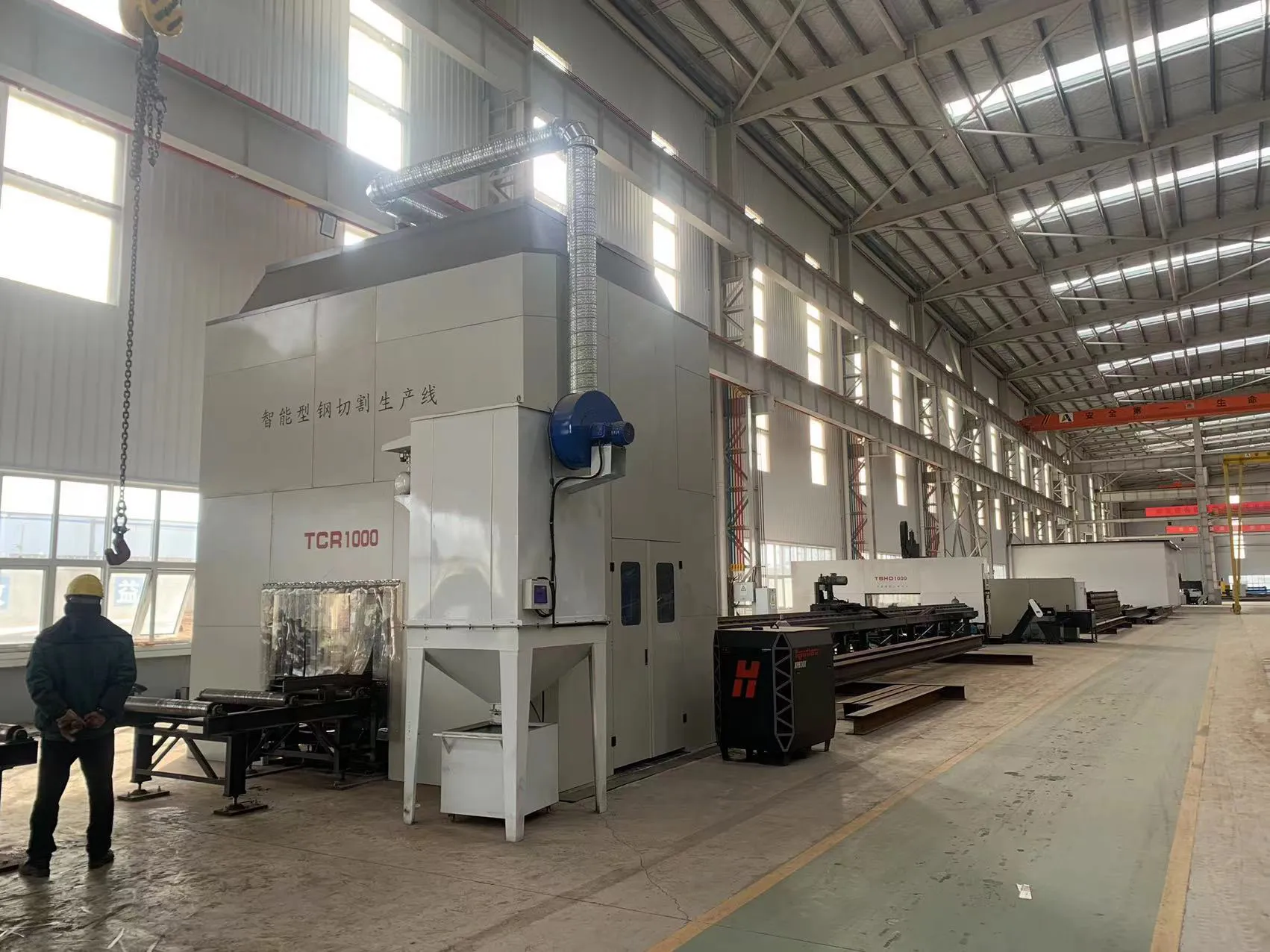
1. Technical Deployment of 6000W 3D Structural Processing in the Riyadh Construction Sector
The infrastructure landscape in Riyadh, driven by Vision 2030, necessitates a shift from traditional mechanical fabrication to high-output automated systems. This report evaluates the deployment of the 6000W 3D Structural Steel Processing Center within the context of stadium steel structure fabrication. Unlike conventional 2D laser systems or mechanical drilling/sawing lines, the 3D processing center integrates multi-axis motion to handle complex profiles including H-beams, I-beams, C-channels, and large-diameter hollow sections.
The selection of a 6000W fiber laser source is strategic. At this power density, the system achieves an optimal balance between photon absorption in structural carbon steel and operational speed. In the high-ambient temperature environment of Riyadh, the thermal management of the laser source and the cutting head is critical. The 6000W threshold allows for high-speed nitrogen or oxygen-assisted cutting of thicknesses up to 25mm with minimal Heat Affected Zones (HAZ), preserving the metallurgical integrity of the structural members required for long-span stadium roofs.
2. 3D Kinematics and Beveling for Weld Preparation
The core advantage of the 3D Structural Steel Processing Center lies in its five-axis or six-axis robotic/gantry head configuration. In stadium construction, the intersection of diagonal bracing and primary rafters involves complex compound angles.
Traditional methods require manual plasma cutting followed by extensive grinding to achieve the necessary bevels for Full Penetration (CJP) welds. The 3D laser system automates this by executing ±45° bevel cuts ($V, X, K,$ and $Y$ profiles) directly in the primary processing cycle. By utilizing a high-precision rotary chuck system and a fiber-optically delivered beam, the center maintains a geometric tolerance of ±0.1mm over a 12-meter beam length. This precision is vital for the modular assembly of stadium components, where cumulative error can lead to significant misalignment during site erection.
3. Zero-Waste Nesting: Algorithms and Material Efficiency
Heavy structural steel represents a significant portion of project CAPEX. Conventional laser tube or beam cutters often leave “dead zones” or “tailings” ranging from 200mm to 500mm due to the physical limitations of the chucking system. In a large-scale project like a Riyadh stadium, where thousands of tons of steel are processed, this waste is unacceptable.
The “Zero-Waste Nesting” technology implemented in this center utilizes a multi-chuck synchronization system. As the beam is processed, the leading chuck pulls the material while the trailing chucks provide continuous support and rotation. Through an advanced algorithmic nesting software, the cutting head is permitted to operate between the chucks or even past the final gripping point by employing a “hand-over” mechanism.
This enables:
– **Maximum Material Utilization:** Reducing tailing waste to less than 50mm, or in some configurations, achieving true zero-waste by utilizing the previous beam’s end as the start for the next component.
– **Dynamic Nesting:** The software analyzes the production queue for the stadium’s truss segments and nests shorter bracing members within the scrap sections of larger chord members.
– **Micro-Joint Integration:** For high-speed processing, the system utilizes micro-joints to ensure structural stability during rotation, which are then laser-severed in the final pass.
4. Synergy Between 6000W Fiber Sources and Automatic Processing
The 6000W fiber laser source provides a specific irradiance that facilitates “bright surface” cutting. In structural applications, the surface finish of the cut edge affects the fatigue life of the joint. The high power density ensures that the melt pool is evacuated rapidly by the assist gas, preventing the formation of dross (slag) on the underside of thick-walled H-beams.
Furthermore, the integration of automatic loading and unloading systems creates a closed-loop production environment. In Riyadh’s industrial zones, minimizing manual handling reduces the risk of surface contamination and physical injury. The automatic system measures the actual dimensions of the incoming raw sections (accounting for mill tolerances and beam camber) and adjusts the 3D cutting path in real-time. This “measure-and-compensate” workflow ensures that bolt holes and slots for gusset plates are perfectly aligned relative to the beam’s neutral axis, regardless of slight deviations in the raw material.
5. Specific Applications in Stadium Truss and Facade Systems
Stadiums in Riyadh often feature geometrically complex facades and cantilevered roof structures designed to provide shade while maintaining aesthetic appeal. These structures rely on “Tree Columns” and intricate space frames.
5.1. Complex Intersections
Using the 3D laser center, complex “fish-mouth” cuts for tubular intersections are executed with high angular accuracy. This eliminates the need for “gap-filling” during welding, which is a common point of failure in structural inspections. The 6000W laser creates a narrow kerf width, allowing for tight-fit assemblies that enhance the overall rigidity of the stadium’s primary frame.
5.2. Bolted Connection Precision
For the “plug-and-play” assembly required in modern stadium construction, the precision of bolt hole arrays is non-negotiable. The laser center’s ability to interpolate circular paths with zero mechanical backlash ensures that high-strength friction-grip (HSFG) bolts can be inserted without reaming on site. The thermal input is localized, ensuring that the area around the hole does not undergo significant hardening, which is a common issue with plasma-cut holes that can lead to stress cracking.
6. Environmental and Operational Considerations in Riyadh
The deployment of high-power lasers in the Middle East requires specific engineering considerations regarding the operating environment. The 6000W center is equipped with a dual-circuit industrial chiller with enhanced ambient temperature ratings.
Dust mitigation is also a critical factor. Riyadh’s particulate matter can interfere with optical paths. The system employs a pressurized bellows system and a multi-stage filtration unit to protect the laser delivery fiber and the 3D cutting head optics. This ensures consistent beam quality ($M^2 < 1.1$) even during extended production shifts in peak summer months.
7. Productivity Analysis: Laser vs. Traditional Methods
Data gathered from field operations indicates a significant throughput advantage:
– **Processing Time:** A typical 12-meter H-beam requiring 20 holes, four cope cuts, and two mitered ends takes approximately 8 minutes on the 3D laser center. Traditional mechanical processing (marking, sawing, drilling) would require 45 to 60 minutes.
– **Labor Reduction:** The automated center requires one operator and one loader, replacing a crew of six required for manual fabrication and layout.
– **Secondary Operations:** The “Zero-Waste” and precision-cut finish eliminate the need for secondary grinding or deburring, allowing components to move directly to the blasting and painting line.
8. Conclusion
The integration of a 6000W 3D Structural Steel Processing Center with Zero-Waste Nesting technology represents the current apex of steel fabrication for large-scale infrastructure. In Riyadh’s demanding construction market, the ability to produce complex stadium components with zero scrap and sub-millimeter precision provides a decisive competitive edge. The synergy between high-wattage fiber lasers and multi-axis kinematics solves the historical bottleneck of weld preparation and material waste, setting a new standard for structural engineering efficiency.
















