The Technical Evolution: Why 6000W Fiber Laser Power?
In the realm of structural steel, power is the prerequisite for speed and quality. For decades, the industry relied on plasma cutting or mechanical machining for thick-walled profiles. However, the 6000W (6kW) fiber laser has emerged as the “sweet spot” for structural applications. At this power level, the laser provides sufficient energy density to achieve high-speed melt-shear cutting through structural steel thicknesses commonly found in railway bridge supports, gantry frames, and station skeletons—typically ranging from 10mm to 25mm.
The 6kW fiber source offers a distinct advantage in terms of the Heat Affected Zone (HAZ). In railway infrastructure, the integrity of the steel’s grain structure is paramount. Excessive heat from traditional plasma cutting can lead to embrittlement at the edges, which is a critical failure point under the cyclic loading of passing trains. The high power density of a 6000W laser allows for faster feed rates, which minimizes the time the heat can conduct into the base material. The result is a narrower HAZ, superior edge perpendicularity, and a surface finish that often requires zero post-processing before welding or galvanizing.
Furthermore, the wall-plug efficiency of these 6kW units—often exceeding 35%—significantly reduces the operational cost compared to older CO2 lasers or high-definition plasma systems. In a high-energy market like Germany, this efficiency is not just an environmental benefit but a core component of the facility’s competitive pricing strategy.
3D Kinematics: Moving Beyond Flat Plate Cutting
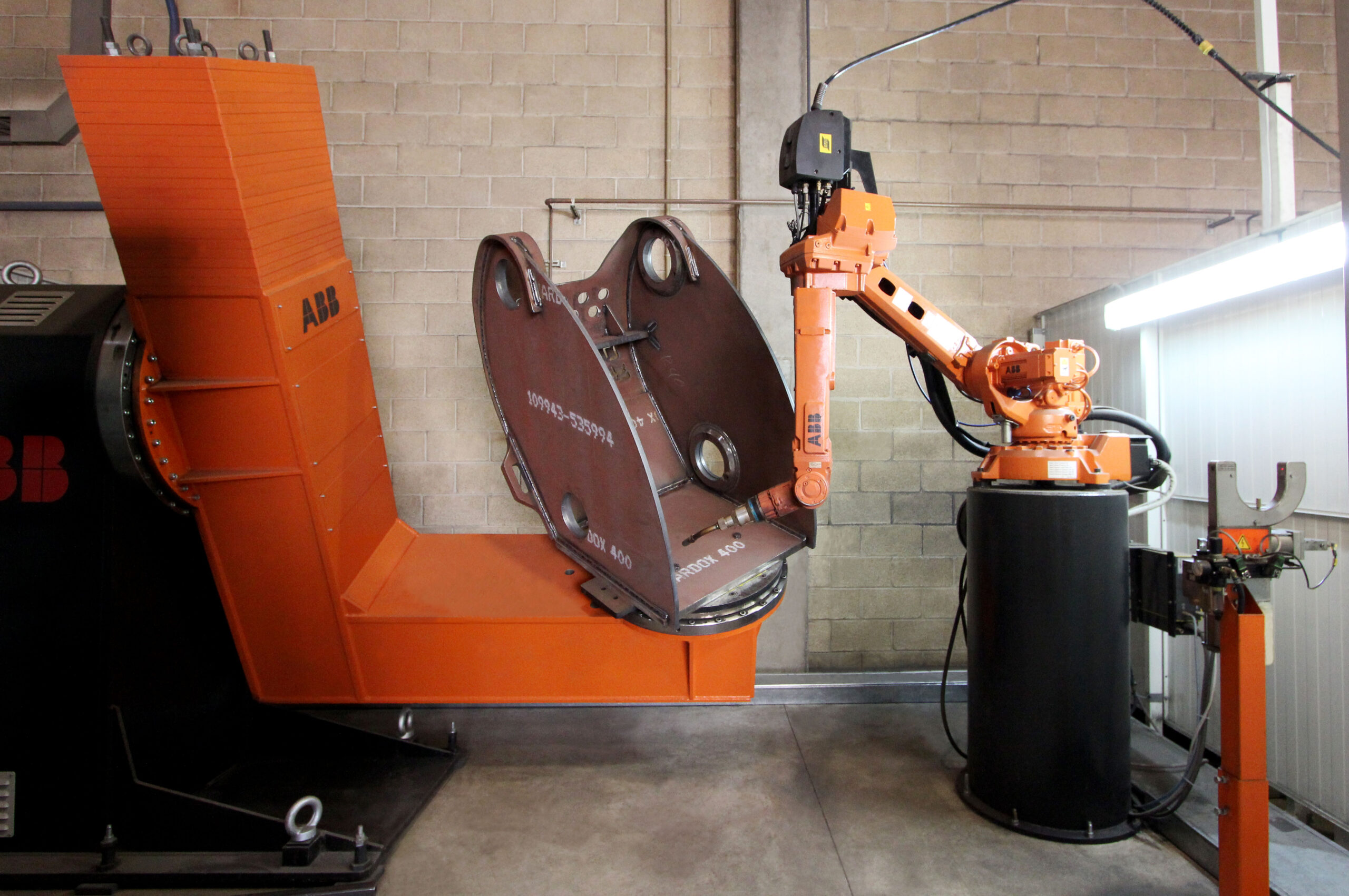
Structural steel is characterized by its geometry—I-beams, H-columns, U-channels, and rectangular hollow sections (RHS). Processing these requires more than a standard X-Y gantry. The Hamburg center utilizes a sophisticated 3D processing head mounted on a multi-axis robotic arm or a high-precision 5-axis bridge.
This 3D capability allows the laser to transition seamlessly between the web and the flanges of a beam. It enables complex “cope” cuts, miters, and holes to be processed in a single pass. For railway infrastructure, where beams often intersect at non-orthogonal angles to accommodate curved tracks or complex architectural designs of modern stations, the 3D head is indispensable.
The system utilizes advanced height sensing and profile mapping. Since hot-rolled structural steel often possesses inherent twists, bows, or dimensional tolerances, the 3D center employs tactile or laser-based scanning to map the actual profile of the workpiece before cutting. The software then compensates the cutting path in real-time, ensuring that bolt holes for rail fishplates or structural connections are placed with sub-millimeter accuracy, regardless of the beam’s physical imperfections.
Zero-Waste Nesting: The Software Revolution
One of the most significant challenges in structural steel fabrication is material waste. Off-cuts of heavy-duty steel are expensive to recycle and represent a direct loss of margin. The “Zero-Waste Nesting” protocol implemented in the Hamburg facility utilizes sophisticated algorithms to optimize the arrangement of parts on a single length of profile.
Traditional nesting often looks at parts individually, but zero-waste nesting employs “common line cutting” and “end-to-end sequencing.” In common line cutting, the laser performs a single cut that serves as the edge for two adjacent parts, effectively halving the cutting time and eliminating the “skeleton” waste between them.
The software also allows for “remnant management.” If a 12-meter beam is not fully utilized, the system automatically catalogs the remaining section and prioritizes its use for smaller components in the next production run, such as gusset plates or bracing brackets. In the context of the massive scale of railway projects, such as the upgrade of the Hamburg-Altona link, a 5% to 10% increase in material utilization translates to hundreds of tons of steel saved annually, aligning with the “Green Hamburg” sustainability initiatives.
Strategic Importance for Hamburg’s Railway Infrastructure
Hamburg serves as a vital node in the Trans-European Transport Network (TEN-T). The city is currently undergoing massive infrastructure renewals, including the S4 S-Bahn extension and the modernization of the Köhlbrand Bridge area. These projects require structural components that can withstand extreme weather, high vibration, and heavy axle loads.
The 6000W 3D processing center is uniquely suited for these requirements. For instance, the production of overhead line masts and signal gantries requires high-precision cutouts for electrical routing and structural bolting. Manual fabrication of these parts is labor-intensive and prone to human error. By automating this with a 3D fiber laser, the Hamburg facility can produce these components with “just-in-time” efficiency, reducing the need for massive on-site storage and allowing for rapid response to design changes in the field.
Moreover, the laser’s ability to cut weld preparations (bevels) directly into the 3D profile is a game-changer. Traditionally, a beam would be cut to length, then moved to a separate station where a technician would grind a V-groove or J-groove for welding. The 6000W 3D system performs the cut and the bevel simultaneously. This ensures that the weld geometry is mathematically perfect, leading to stronger, more reliable joints in railway bridges and support structures where failure is not an option.
Integration with Industry 4.0 and BIM
The Hamburg processing center does not operate in isolation. It is fully integrated into the Building Information Modeling (BIM) workflow. Engineers designing a new railway platform or a noise protection barrier can export their 3D models directly to the laser’s CAM (Computer-Aided Manufacturing) software.
This digital thread ensures that the “as-built” component perfectly matches the “as-designed” model. In the complex environment of Hamburg’s urban rail network, where new steel must be fitted into 100-year-old masonry or existing concrete foundations, this precision is vital. The system can even etch part numbers, QR codes, and assembly instructions directly onto the steel surface using the laser’s marking function. This facilitates error-free assembly on-site, as workers can scan a beam and immediately see its placement in the global coordinate system of the project.
Environmental Impact and Future-Proofing
Sustainability is no longer optional in German infrastructure. The 6000W 3D Structural Steel Processing Center contributes to Hamburg’s climate goals in several ways. Beyond the material savings of zero-waste nesting, the fiber laser process eliminates the need for cutting fluids and chemicals often used in mechanical sawing or drilling.
The reduction in secondary processing—grinding, cleaning, and re-working—lowers the total energy footprint of every ton of steel processed. Because fiber lasers are solid-state technology, they require significantly fewer consumables (no mirrors to align, no gas turbines to maintain) compared to legacy systems.
Looking forward, the system is designed for the era of “smart” steel. As we move toward high-strength, low-alloy (HSLA) steels for lighter and more efficient railway designs, the 6000W fiber laser is already equipped to handle these harder materials that often break traditional drill bits or dull saw blades.
Conclusion
The 6000W 3D Structural Steel Processing Center in Hamburg is more than just a piece of machinery; it is a critical infrastructure asset. By merging the raw power of 6kW fiber optics with the intelligence of zero-waste nesting and the flexibility of 3D motion, it provides the Hamburg railway sector with a tool that is as precise as it is productive.
As the city continues to expand its transit footprint and modernize its historic links, the ability to fabricate complex steel geometries with zero waste and surgical precision will be the cornerstone of a faster, safer, and more sustainable industrial future. For the fiber laser expert, this installation represents the pinnacle of current technology—a perfect marriage of physics, software, and heavy engineering.