The Evolution of Structural Steel Fabrication in Hamburg
Hamburg has long been a beacon of engineering excellence, from its historic port infrastructure to its modern architectural landmarks. As the demand for sophisticated sports arenas and massive public venues grows, the local fabrication industry has faced a challenge: how to produce massive steel components that are both aesthetically fluid and structurally rigid. Traditional methods—involving mechanical sawing, drilling, and manual plasma beveling—are increasingly viewed as bottlenecks.
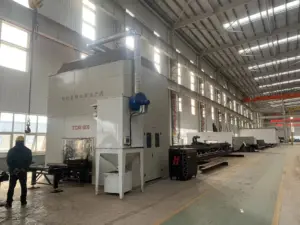
The introduction of the 6000W 3D Structural Steel Processing Center addresses these inefficiencies head-on. Fiber laser technology, once reserved for thin sheet metal, has matured. At 6000W, the power density is sufficient to pierce and profile thick-walled structural sections with incredible speed. In a city like Hamburg, where labor costs are high and precision is a non-negotiable standard, the move toward automated laser processing is not just an upgrade; it is an economic necessity.
The Power of 6000W: Precision at Scale
In the realm of structural steel, thickness is the primary adversary. Stadium structures rely on heavy-gauge sections to support massive cantilevered roofs and withstand dynamic wind loads. A 6000W fiber laser source provides the “sweet spot” for these applications. It offers the high-energy beam quality required to cut through carbon steel up to 25mm or 30mm with clean, dross-free edges.
Beyond mere thickness, the 6000W source ensures a minimized Heat Affected Zone (HAZ). In structural engineering, maintaining the metallurgical integrity of the steel is vital. Excessive heat from traditional plasma or oxy-fuel cutting can alter the grain structure of the metal, potentially leading to brittle zones. The fiber laser’s concentrated energy path ensures that the structural properties of the beams remain intact, meeting the stringent Eurocode standards required for German stadium construction.
Infinite Rotation: The 3D Head Advantage
The defining feature of this processing center is the 3D cutting head with Infinite Rotation capabilities. Traditional 3D heads are often limited by internal cabling, requiring a “rewind” after a certain degree of rotation. In complex structural processing, where a laser must navigate the four sides of an H-beam or the circumference of a large diameter tube, these pauses interrupt the cut and introduce potential points of failure or inaccuracy.
The Infinite Rotation system utilizes advanced slip-ring technology and sophisticated fiber-optic routing to allow the C-axis to spin indefinitely. This is paired with an A-axis tilting mechanism (typically +/- 45 to 60 degrees). For stadium projects, this means the machine can cut complex “saddle” joints on circular hollow sections or execute multi-sided bevels on wide-flange beams in a single, continuous motion.
When fabricating the primary nodes of a stadium’s space frame, the geometry is often multi-planar. The infinite rotation allows the laser to transition seamlessly from a straight cut to a V-groove or a K-bevel, ensuring that when two beams meet, the fit-up is airtight. This level of precision is the difference between a project that stays on schedule and one that is mired in manual on-site corrections.
Revolutionizing Stadium Node and Joint Construction
Stadiums are characterized by their unique geometries—curving facades, sloping roofs, and intricate lattice-work. These structures rely on “nodes”—the intersection points where multiple structural members converge. Historically, these nodes were the most difficult components to manufacture, often requiring complex casting or tedious manual assembly.
With the 6000W 3D laser, these nodes can be fabricated as “jigsaw” assemblies. The laser can cut interlocking tabs and slots into the steel beams, allowing for self-fixturing during assembly. This “bolt-and-weld” accuracy means that the massive steel rafters of a stadium in Hamburg can be test-fitted in the shop with millimeter precision.
Furthermore, the 3D head handles weld preparations automatically. Instead of a secondary team grinding bevels for weld penetration, the laser executes the beveling during the primary cutting phase. This ensures consistent throat thickness in the welds, which is a critical safety factor for structures that must support the weight of thousands of spectators and heavy snow loads.
Integration with BIM and Digital Twin Technology
The 6000W Structural Steel Processing Center does not operate in a vacuum. Its true power is unlocked when integrated with Building Information Modeling (BIM) software, such as Tekla Structures or Autodesk Revit. In Hamburg’s high-tech engineering firms, the workflow is entirely digital.
The 3D model of the stadium is exported directly to the laser’s CAM (Computer-Aided Manufacturing) software. The software’s nesting algorithms optimize the layout on the raw steel sections to minimize waste—a crucial factor given the rising costs of raw materials. The machine then executes the digital blueprint with absolute fidelity. This digital-to-physical bridge eliminates the human error associated with manual layout and marking, ensuring that every bolt hole and every mitered edge aligns perfectly when the steel arrives at the construction site.
Efficiency and Environmental Impact in Hamburg’s Industry
Hamburg is a city committed to sustainability and the “Green Dock” philosophy. The 6000W fiber laser aligns with these values through its energy efficiency. Compared to CO2 lasers or plasma systems, fiber lasers have a significantly higher wall-plug efficiency. They convert more electricity into light, resulting in lower power consumption per meter of cut.
Additionally, the precision of the 3D head reduces material waste. Because the laser kerf is so narrow (often less than 0.5mm), nesting can be tighter. The elimination of secondary grinding also reduces the industrial dust and noise pollution in the fabrication shop, creating a safer and cleaner environment for workers. For Hamburg-based companies, this modernization is a key part of their Corporate Social Responsibility (CSR) and adherence to increasingly strict environmental regulations.
Overcoming Challenges in Large-Scale Steel Processing
Processing 12-meter or 15-meter structural beams presents unique logistical challenges. The processing center in Hamburg is equipped with heavy-duty loading and unloading systems that synchronize with the laser’s movements. Large-scale gantry systems or “moving chuck” designs ensure that the beam is supported throughout its travel, preventing sag that could compromise the 3D cutting geometry.
The 6000W laser also features advanced sensing technology. Structural steel is rarely perfectly straight; it often has “mill tolerance” or slight bowing. The 3D head is equipped with capacitive sensors that measure the actual position of the material in real-time, adjusting the cutting path to compensate for any deviations. This “active compensation” is what allows the machine to maintain such high tolerances over such large workpieces.
The Future of Hamburg’s Architectural Skyline
The implementation of the 6000W 3D Structural Steel Processing Center with Infinite Rotation is more than just a capital investment; it is a statement of intent. It signals that Hamburg’s steel fabricators are ready to tackle the next generation of iconic stadium designs—structures that push the limits of physics and aesthetics.
As we look toward the future, we can expect to see even more daring designs: stadiums with retractable roofs that operate with the precision of a watch, and grandstands that seem to defy gravity. These architectural feats will be built on a foundation of laser-cut precision. The ability to rotate infinitely around a steel profile, cutting with 6000 watts of concentrated light, has turned the most difficult structural challenges into routine operations.
In conclusion, the marriage of high-power fiber lasers and multi-axis motion control is transforming the structural steel landscape. For the stadium projects of Hamburg and beyond, this technology ensures that the backbone of our public spaces is stronger, more precise, and more efficiently produced than ever before. The expert fabricator no longer just works with steel; they orchestrate light and motion to create the skeletons of our future monuments.