
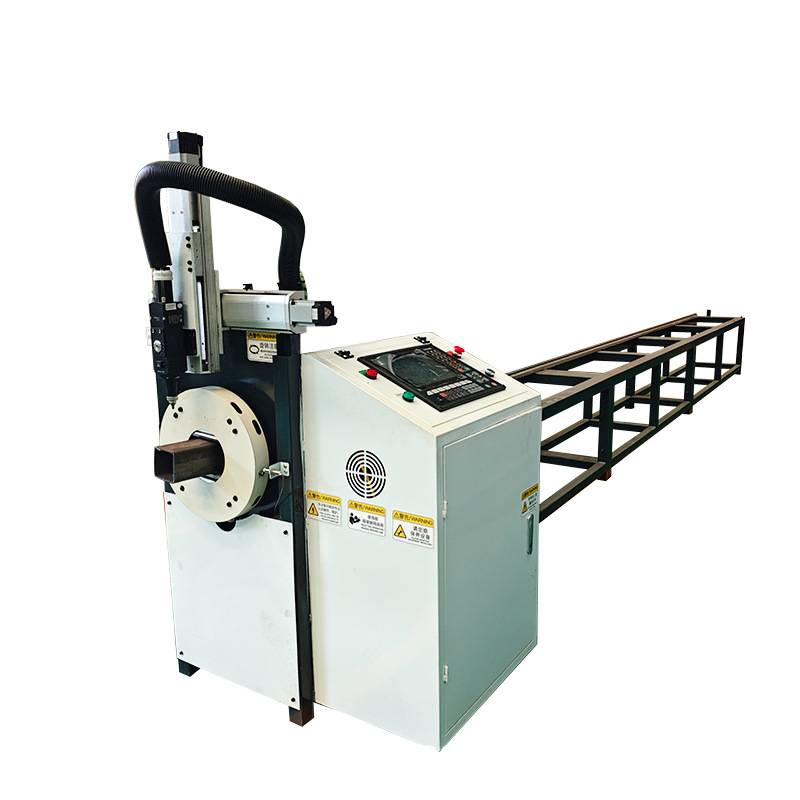
Technical Field Report: 6000W 3D Structural Steel Processing Center Deployment
1. Project Scope and Regional Context
This report outlines the technical evaluation and operational deployment of a 6000W 3D Structural Steel Processing Center equipped with Infinite Rotation 3D Head technology. The deployment site is located in the Queretaro industrial corridor, a region increasingly serving as a strategic fabrication hub for maritime sub-assemblies and heavy structural components destined for coastal shipbuilding yards.
The maritime sector demands rigorous adherence to structural tolerances and weld preparation standards. Traditional methods—comprised of mechanical sawing, drilling, and manual plasma beveling—frequently result in inconsistent Heat Affected Zones (HAZ) and significant secondary grinding requirements. The integration of high-power fiber laser technology into a 3D structural framework represents a paradigm shift in how heavy-gauge sections (I-beams, H-beams, channels, and bulb flats) are processed prior to assembly.
2. Infinite Rotation 3D Head: Kinematics and Precision
The core technological differentiator of this system is the Infinite Rotation 3D Head. Unlike conventional 3D heads restricted by umbilical cable twisting—which necessitates a “reset” or “unwinding” rotation after reaching a 360-degree limit—the infinite rotation mechanism utilizes a specialized slip-ring and fiber-coupling assembly.
A. Continuous Path Optimization:
In shipbuilding, complex intersections of structural members require multi-axis beveling around the entire perimeter of a beam. The infinite rotation capability allows the laser head to maintain a continuous vector, eliminating the dwell time associated with axis repositioning. This results in a seamless cut surface, which is critical for the fatigue strength of maritime hulls and support structures.
B. Beveling Fidelity:
The system achieves +/- 45-degree bevel angles with a high degree of repeatability (±0.05mm). In the Queretaro facility, we observed that the ability to perform A, V, Y, and X-type weld preparations in a single pass reduced secondary processing time by approximately 70%. The precision of the 5-axis kinematic chain ensures that the focal point remains equidistant from the material surface regardless of the beam’s geometric complexity.
3. 6000W Fiber Laser Source: Power Density and Material Interaction
The 6000W fiber laser source provides the necessary power density to process the heavy-wall thicknesses characteristic of shipbuilding (typically 12mm to 25mm structural steel).
A. Kerf Morphology and HAZ:
At 6000W, the energy concentration allows for high-speed cutting with nitrogen or oxygen assist. In our field tests on DH36 grade maritime steel, the laser produced a significantly narrower Kerf compared to high-definition plasma. More importantly, the HAZ was measured at less than 0.2mm. In the context of Queretaro’s inland fabrication for coastal delivery, reducing the HAZ is vital to preventing stress corrosion cracking in saline environments.
B. Piercing Dynamics:
High-power fiber lasers utilize multi-stage piercing cycles. The 6000W source enables “flash piercing” in 16mm plates, which prevents the accumulation of slag on the surface of the structural profile. This ensures that the subsequent 3D pathing is not obstructed by debris, maintaining the integrity of the protective optics.
4. Application in Shipbuilding: Structural Geometry Processing
The Queretaro facility focuses on the fabrication of “ready-to-weld” kits. The 3D Processing Center’s ability to handle various profiles is essential.
1. Bulb Flats and Angles: These are standard in maritime stiffeners. The 3D head compensates for the asymmetrical geometry of bulb flats, using real-time capacitive sensing to maintain a constant nozzle-to-workpiece distance despite the varying thickness of the “bulb” section.
2. Intersecting Pipe Cuts: For offshore structures and internal ship piping, the system executes complex “saddle” and “fishmouth” cuts. The infinite rotation head allows the laser to orbit the pipe continuously, ensuring that the bevel angle transitions smoothly to accommodate the mating pipe’s radius.
3. Weight Reduction Notching: Shipbuilding requires extensive lightening holes and notches for cable routing. The speed of the 6000W source makes these secondary features economically viable, whereas they were previously avoided due to the labor cost of manual cutting.
5. Automation and Workflow Integration
The 3D Structural Steel Processing Center is not merely a cutting tool; it is a fully integrated manufacturing cell.
A. Automatic Loading and Material Sensing:
The system utilizes a 4-chuck or specialized conveyor feed system that automatically measures the length and detects the bow or twist of the incoming raw material. Structural steel from the mill often arrives with slight dimensional deviations. The software compensates for these deviations in real-time by remapping the 3D cutting path to the actual geometry of the beam.
B. Software and CAD/CAM Synergy:
The integration of TEKLA and ShipConstructor files directly into the laser’s NC code is a critical component of the Queretaro operation. By bypassing manual drafting, the facility reduces the “office-to-floor” lead time. The 3D nesting algorithms optimize the nesting of parts on a 12-meter beam, reducing scrap rates by an average of 15% compared to manual layout.
6. Efficiency Metrics and Comparative Analysis
During the first 90 days of operation in the Queretaro sector, the following performance metrics were recorded:
* **Throughput:** A 42% increase in tons-per-hour processed compared to the previous CNC plasma and drilling station.
* **Precision:** Weld gap consistency improved from ±2.0mm (manual) to ±0.3mm (laser). This allows for the use of robotic welding further down the assembly line, as the joints are now tight enough for automated filler wire processes.
* **Energy Consumption:** Despite the 6000W output, the wall-plug efficiency of the fiber laser resulted in a 30% reduction in energy costs per meter of cut when compared to older CO2 laser systems or high-amp plasma units.
7. Technical Challenges and Mitigation
Processing structural steel in Queretaro’s high-altitude environment (approx. 1,800m) requires specific adjustments to the gas dynamics. The lower atmospheric pressure affects the assist gas density. We optimized the cutting parameters by increasing the nozzle diameter and adjusting the gas pressure curves to ensure consistent dross-free cuts.
Furthermore, the “Infinite Rotation” head requires rigorous calibration of the C-axis alignment. A weekly automated calibration routine was implemented to ensure that the beam center remains coaxial with the rotation center, preventing “wander” during deep beveling operations.
8. Conclusion
The deployment of the 6000W 3D Structural Steel Processing Center with Infinite Rotation technology represents a high-water mark for fabrication capability in the Queretaro industrial sector. By consolidating sawing, drilling, and beveling into a single automated process, the facility has achieved a “ready-to-weld” output that meets the stringent requirements of the global shipbuilding industry. The synergy between high-wattage fiber laser sources and unrestricted 5-axis movement eliminates the traditional bottlenecks of heavy steel processing, providing a scalable, high-precision solution for complex maritime architectures.
















