
1. Technical Overview: The Evolution of Structural Fabrication in Dammam
The industrial landscape of Dammam, particularly within the Eastern Province’s bridge engineering sector, is undergoing a paradigm shift from traditional mechanical and plasma-based fabrication to high-precision laser processing. As bridge designs become more complex—necessitating intricate geometries for aesthetic urban overpasses and high-load industrial spans—the limitations of legacy systems have become apparent. This report evaluates the deployment of the 6000W 3D Structural Steel Processing Center, focusing on its impact on throughput and structural integrity.
In Dammam’s bridge projects, the primary challenge lies in the sheer scale of H-beams, I-beams, and large-diameter tubular sections. Traditional methods involve multi-stage processing: sawing, drilling, and manual beveling. The integration of a 6000W fiber laser source into a 3D structural center collapses these stages into a single automated cycle. This transition is not merely about speed; it is about the elimination of cumulative tolerances that occur when moving heavy workpieces between disparate workstations.
2. The 6000W Fiber Laser Synergy and Material Interaction
The selection of a 6000W power rating is strategic for structural steel. While higher wattages exist, the 6kW threshold represents the “sweet spot” for high-speed nitrogen and oxygen cutting on structural thicknesses ranging from 10mm to 25mm—the standard gauge for bridge gusset plates and web reinforcements. At 6000W, the photon density is sufficient to maintain a narrow kerf width while ensuring the Heat Affected Zone (HAZ) remains within the strict parameters required by international bridge welding codes (such as AWS D1.5).
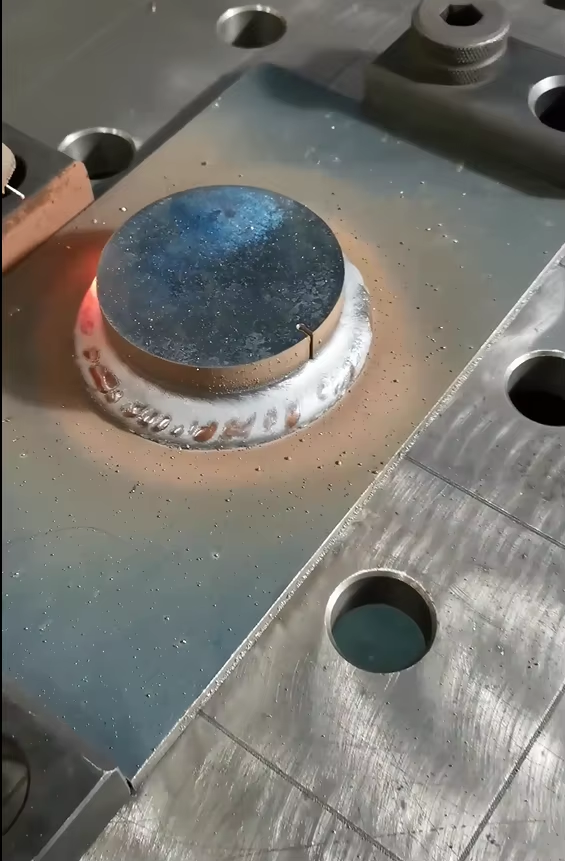
Furthermore, the 6000W source provides the necessary beam stability for piercing thick-walled sections without excessive spatter. In the humid, saline environment of Dammam, the quality of the cut edge is paramount. laser cutting produces a surface finish that significantly reduces the post-process grinding required for protective coating adhesion. Compared to plasma cutting, the laser-cut edge exhibits minimal carbonization, ensuring that the zinc-rich primers used in bridge construction bond more effectively to the substrate.
3. Mechanics of the Infinite Rotation 3D Head
The core technological differentiator in this processing center is the Infinite Rotation 3D Head. Traditional 5-axis laser heads are often limited by “cable wind-up,” requiring the head to “unwind” after a certain degree of rotation. In structural steel processing—where the head must navigate around the flanges of an H-beam or follow the circumference of a large pipe—this unwinding causes significant downtime and introduces potential restart artifacts in the cut path.
3.1. Kinematics and Beveling Precision
The Infinite Rotation head utilizes a slip-ring or specialized fiber-optic rotary joint assembly that allows for continuous N×360° rotation. From a field engineering perspective, this allows for seamless transition between face cutting and beveling. In bridge engineering, V-type, Y-type, and K-type bevels are essential for full-penetration welds. The 3D head achieves these angles with an accuracy of ±0.05mm, a tolerance unattainable by manual or robotic plasma systems.
3.2. Dynamic Focal Control
The 3D head is equipped with high-speed capacitive sensing. Given that structural steel sections are rarely perfectly straight (often possessing slight mill-scale deviations or warping), the head must dynamically adjust its Z-axis height in real-time. The infinite rotation capability ensures that even during complex beveling maneuvers, the focal point remains optimal relative to the material surface, preventing dross formation and ensuring a clean exit of the melt pool.
4. Application in Dammam Bridge Engineering
The application of this technology in Dammam focuses on the fabrication of truss bridges and elevated highway interchanges. These structures require high-tension bolt holes and complex “fish-mouth” cuts for tubular supports. Accuracy in these components is critical for onsite assembly; even a 2mm deviation in a bolt hole can stall a project and necessitate expensive field-rectification.
4.1. Precision Bolt Hole Processing
Traditional structural fabrication relies on punching or drilling. Punching can induce micro-cracks in high-strength steel, which are detrimental to the fatigue life of a bridge. The 6000W laser, guided by the 3D head, “mills” these holes with extreme precision. The taper of the hole is virtually non-existent, and the thermal input is so localized that the metallurgical properties of the surrounding steel remain unchanged. This satisfies the stringent “Class A” hole requirements for friction-grip bolts used in Dammam’s infrastructure.
4.2. Complex Intersections and Coping
Bridge trusses often involve beams intersecting at non-orthogonal angles. The 3D Structural Steel Processing Center handles these “coping” cuts with ease. By importing TEKLA or CAD models directly into the center’s nesting software, the 3D head executes complex spatial paths that allow beams to slot together with zero-gap tolerances. This precision reduces the volume of weld filler metal required, thereby reducing the overall weight and cost of the bridge structure.
5. Overcoming Efficiency Bottlenecks in Heavy Processing
Efficiency in a Dammam fabrication yard is measured by “tons per man-hour.” The 3D Structural Steel Processing Center introduces a high level of automation that minimizes manual intervention. The system typically features an automated loading/unloading conveyor that can handle 12-meter profiles.
One of the primary efficiency gains is found in the software integration. The synergy between the 6000W laser and the 3D head allows for “Common Cut” nesting on structural sections. This technique shares a single cut line between two adjacent parts, reducing the total cutting path and gas consumption. In a field audit of a local Dammam facility, the implementation of this system resulted in a 42% reduction in total fabrication time for a standard 20-ton truss segment compared to traditional plasma and saw methods.
6. Maintenance and Operational Considerations in High-Ambient Environments
Operating a 6000W fiber laser in the Eastern Province presents specific environmental challenges, primarily ambient heat and airborne particulates. The processing center’s 3D head is pressurized with filtered air to prevent dust ingress into the optical path. Furthermore, the chiller units for the 6000W source are up-rated for high-ambient performance, ensuring that the laser medium remains at a stable operating temperature even when outside temperatures exceed 45°C.
The “Infinite Rotation” mechanism also simplifies maintenance. By eliminating the constant flexing and twisting of internal cables found in limited-rotation heads, the frequency of internal harness failure is significantly reduced. This leads to higher “Up-Time” (MTBF), which is a critical KPI for large-scale infrastructure projects with tight delivery schedules.
7. Conclusion: The Strategic Imperative
The 6000W 3D Structural Steel Processing Center with Infinite Rotation 3D Head is no longer a luxury for Dammam’s bridge engineering sector; it is a strategic necessity. The ability to produce complex, beveled, and high-precision structural components in a single operation directly addresses the industry’s need for faster project cycles and higher structural safety margins.
From a technical standpoint, the infinite rotation capability solves the most persistent geometric challenges in 3D cutting, while the 6000W fiber source ensures the necessary throughput for heavy steel. As Dammam continues to expand its urban and industrial infrastructure, the adoption of this technology will be the defining factor between fabricators who can meet modern engineering standards and those who are left behind by the limitations of the past.
End of Report
Compiled by: Senior Laser & steel structure Consultant
Location: Dammam Field Office
















