1.0 Technical Overview: The 6000W 3D Structural Steel Processing Center
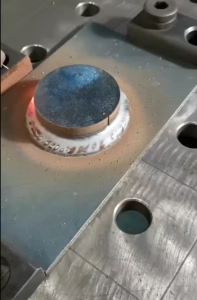
The evolution of bridge engineering in the Houston metropolitan area demands a transition from legacy mechanical processing to high-fidelity thermal oscillation cutting. The 6000W 3D Structural Steel Processing Center represents the current apex of this transition. Unlike traditional 2D plate lasers, this system utilizes a five-axis kinematic head capable of processing complex geometries including H-beams, I-beams, C-channels, and heavy-walled rectangular hollow sections (RHS).
At the core of the system is a 6000W fiber laser source. This power density is specifically calibrated for the structural steel gauges prevalent in Houston’s bridge spans—typically ranging from 12mm to 25mm for secondary members and bracing. While higher wattage sources exist, the 6000W threshold provides the optimal balance between photon absorption rates and Heat Affected Zone (HAZ) management, ensuring that the metallurgical integrity of ASTM A709 or A572 steel is not compromised during the thermal dissociation process.
2.0 Kinematics and 3D Head Geometry
The technical superiority of the 3D processing center lies in its ability to execute complex beveling and weld preparation in a single pass. In bridge engineering, the requirement for V, Y, and K-groove preparations is standard to ensure full penetration welds.
The five-axis head employs high-torque servo motors with absolute encoders to maintain a positioning accuracy of ±0.05mm across the entire volumetric envelope. By integrating the $A$ and $B$ axes into the cutting head, the system achieves a tilt angle of up to ±45 degrees. This eliminates the need for secondary milling or grinding operations, which are historically the primary bottlenecks in structural steel fabrication. In the context of Houston’s large-scale infrastructure projects, where throughput is measured in tons per hour, this consolidation of processes is critical.
3.0 Automatic Unloading: Solving the Heavy-Scale Precision Gap
One of the most significant failure points in heavy structural processing is the transition from the cutting envelope to the staging area. Manual unloading of 12-meter H-beams introduces two primary risks: physical deformation of the processed part and the loss of datum synchronization.
3.1 Mechanical Synchronization of the Unloading System
The Automatic Unloading technology integrated into this 6000W center utilizes a series of synchronized hydraulic lift-and-transfer arms. As the 3D head completes the final severance cut, the unloading logic—integrated into the CNC—activates a series of lateral rollers and pneumatic grippers.
The technical advantage here is “Active Material Support.” By supporting the beam along its entire longitudinal axis during the final cut, the system prevents “sag-snapping,” where the weight of the cantilevered beam causes a jagged edge or a micro-fracture at the end of the cut path. For Houston bridge components, where fatigue life is calculated based on edge smoothness, this automated precision is non-negotiable.
3.2 Efficiency Metrics and Throughput Optimization
In field observations, manual unloading of a 24-inch wide-flange beam requires a crane op and two riggers, averaging a 15-to-20 minute cycle time per member. The Automatic Unloading system reduces this to under 120 seconds. Furthermore, the system’s ability to sort finished parts from scrap material via a secondary conveyor path ensures that the “Green Light Time” (actual cutting time) of the 6000W laser remains above 85%, compared to the 40-50% typical of non-automated cells.
4.0 Application in Houston’s Bridge Engineering Sector
Houston’s geographical and climatic conditions necessitate specific engineering considerations. The high humidity and salt-air exposure (near the Ship Channel) require precise edge radii for optimal coating adhesion.
4.1 Weld Preparation for ASTM A709 Steel
Bridge girders and diaphragms processed for Houston’s interstate expansions require rigorous adherence to AASHTO (American Association of State Highway and Transportation Officials) standards. The 6000W laser’s ability to produce a “clean” cut with minimal dross is vital. When the 3D head executes a bevel cut, the resulting surface roughness ($Ra$) is significantly lower than that produced by plasma or oxy-fuel cutting. This reduces the mechanical cleaning time required before welding, directly impacting the project’s bottom line.
4.2 Precision Bolted Connections
A major component of Houston bridge design involves complex truss systems with high-strength bolted connections. The 3D processing center handles “Hole-to-Hole” tolerances with an accuracy that mechanical drills cannot match in a high-speed environment. The 6000W laser can pierce and cut bolt holes with zero taper, ensuring that the shear load distribution across the splice plates remains uniform. This is particularly relevant for the seismic and thermal expansion requirements of the Texas Department of Transportation (TxDOT).
5.0 Synergy Between 6000W Power and 3D Automation
The synergy between the 6000W fiber source and the 3D structural center is defined by “Thermal Control.” In structural steel, excessive heat input can lead to localized hardening. The 6000W source, when modulated through high-frequency pulsing, allows for “cool” cutting of thick-walled sections.
5.1 Advanced Gas Dynamics
To maintain the efficiency of the 6000W beam, the system utilizes high-pressure nitrogen or oxygen assist gases, managed by an electronic proportional valve. In 3D processing, the nozzle-to-workpiece distance must be maintained with extreme precision (Capacitive Height Sensing). As the head maneuvers around the flanges and webs of an I-beam, the sensor adjusts for any mill-scale irregularities or material warping. This ensures that the focal point of the 6000W beam is always optimized for the material thickness at that specific coordinate.
5.2 Software Integration: From TEKLA to G-Code
The efficacy of the hardware is dependent on the software pipeline. For Houston-based engineering firms, the ability to import TEKLA or SDS/2 structural models directly into the laser’s CAM environment is a requisite. The 3D processing center’s software automatically calculates the optimal nested path and, crucially, the unloading sequence. It identifies which parts are “heavy-side” and instructs the automatic unloading arms to adjust their lift-points based on the center of gravity of the specific cut piece.
6.0 Reliability in High-Volume Fabrication Environments
Structural steel processing centers in the Houston area often operate on a 24/7 basis. The reliability of the 6000W fiber source—characterized by a solid-state design with no moving parts or laser gas—minimizes downtime. When paired with an automatic unloading system, the “Labor Per Ton” metric drops significantly.
The maintenance of the unloading system involves periodic calibration of the hydraulic pressure transducers and cleaning of the optical sensors that detect beam presence. Compared to the maintenance overhead of a fleet of forklifts or overhead cranes used in manual unloading, the automated system offers a lower Total Cost of Ownership (TCO).
7.0 Conclusion: The Future of Texas Infrastructure Fabrication
The integration of 6000W 3D Structural Steel Processing Centers with Automatic Unloading technology represents a fundamental shift in how bridge components are manufactured. For the Houston engineering sector, the benefits are clear: a reduction in secondary processing, higher dimensional fidelity for complex weldments, and a significant increase in safety by removing personnel from the path of heavy steel.
As bridge designs become more complex to accommodate higher traffic volumes and environmental stressors, the precision offered by 3D laser dissociation will become the standard. The automated unloading component is the final piece of the puzzle, transforming the laser from a standalone cutting tool into a fully integrated, high-throughput manufacturing cell capable of meeting the rigorous demands of modern civil engineering.