
1.0 Field Report Overview: 3D Laser Integration in Katowice Rail Infrastructure
This technical field report evaluates the operational deployment and performance metrics of a 6000W 3D Structural Steel Processing Center within the Katowice industrial corridor. Katowice, serving as a critical node in the Trans-European Transport Network (TEN-T), necessitates high-volume production of structural components for railway expansion, including bridge spans, overhead line equipment (OLE) supports, and heavy-duty station gantries.
Traditional fabrication methods involving plasma cutting followed by manual mechanical beveling have historically created bottlenecks in this sector. The implementation of 6000W fiber laser technology with integrated 5-axis ±45° beveling capabilities represents a shift toward “single-pass fabrication,” where complex geometries and weld-ready edges are produced in a unified CNC cycle. This report analyzes the technical synergy between high-wattage fiber sources and 3D kinematic heads in the context of heavy-duty S355 and S460 structural steels.
2.0 Technical Specifications of the 6000W 3D Processing Architecture
2.1 Fiber Laser Source Dynamics
The 6000W fiber laser source is selected as the optimal power-to-thickness ratio for railway infrastructure. While 12kW+ sources exist, the 6000W threshold provides a stabilized beam parameter product (BPP) that minimizes the Heat Affected Zone (HAZ) in structural sections ranging from 6mm to 25mm. In Katowice’s rail projects, where fatigue resistance is paramount, maintaining a narrow HAZ is critical to preventing micro-cracking in the base metal.
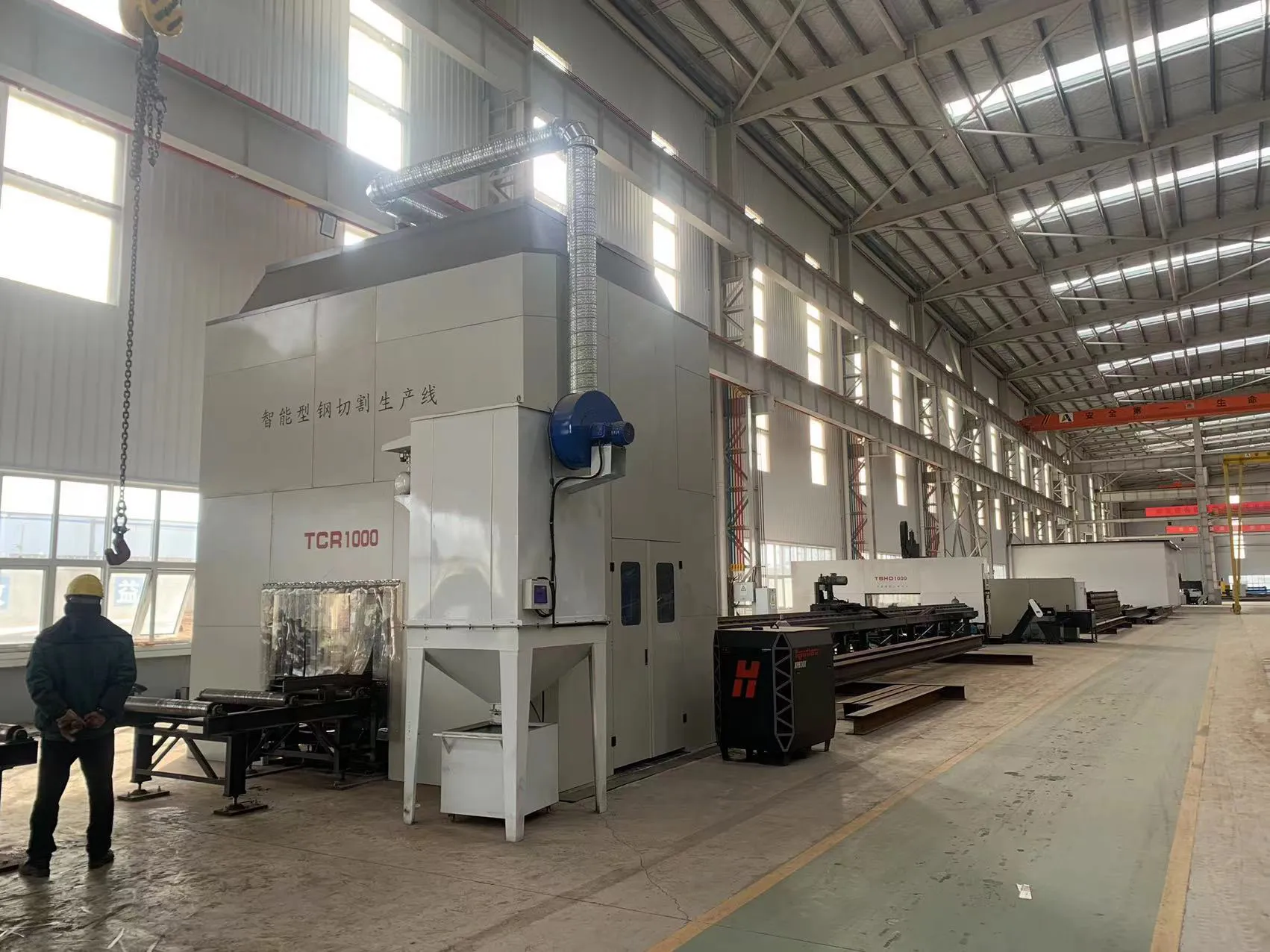
The 6000W output allows for high-speed piercing and consistent melt-pool ejection during 3D maneuvers. This power level ensures that the assist gas (typically O2 for thick carbon steel or N2 for stainless components) can effectively clear the kerf even when the cutting head is tilted at a 45° angle, which effectively increases the material thickness the beam must penetrate (effective thickness = nominal thickness / cos(θ)).
2.2 5-Axis Kinematics and Structural Handling
Unlike flat-bed lasers, the 3D Structural Processing Center utilizes a multi-axis chuck system and a high-degree-of-freedom cutting head. For the H-beams and rectangular hollow sections (RHS) common in Katowice’s rail infrastructure, the machine must compensate for material deviations—such as “camber” and “sweep”—inherent in hot-rolled steel. The system employs laser-based profiling sensors to map the actual geometry of the workpiece before cutting, adjusting the toolpath in real-time to ensure dimensional accuracy across 12-meter spans.
3.0 The Role of ±45° Bevel Cutting in Weld Preparation
3.1 Elimination of Secondary Processing
The most significant technical hurdle in heavy steel processing is the preparation of weld grooves (V, Y, K, and X-type joints). In conventional Katowice workshops, beams are cut to length, then moved to a separate station for manual grinding or mechanical milling to create the necessary bevel. This introduces cumulative tolerances and increases labor costs.
The ±45° beveling capability allows the 6000W laser to execute these grooves during the primary cutting phase. By articulating the head during the perimeter cut, the machine produces a finished edge that meets Eurocode 3 standards for weld penetration. In the production of railway bridge cross-girders, this has resulted in a 40% reduction in total fabrication time per component.
3.2 Precision in Complex Intersections
Railway gantries often require complex “fish-mouth” cuts or angled intersections where RHS members meet at non-orthogonal angles. The 3D processing center calculates the changing bevel angle along the circumference of the cut to ensure a constant root gap for the robotic welding cells that follow. This level of precision is unattainable with manual plasma torches and is essential for the high-vibration environment of railway tracks, where weld integrity is non-negotiable.
4.0 Application Analysis: Katowice Railway Infrastructure Projects
4.1 Bridge and Viaduct Components
In the Katowice region, the modernization of rail bridges requires heavy-gauge S355J2+N steel plates and beams. The 6000W 3D laser is utilized to cut precise bolt holes and drainage apertures in main longitudinal girders. The high power density of the fiber laser ensures that hole cylindricity remains within ±0.1mm, facilitating the use of friction-grip high-strength bolts without the need for post-cut reaming.
4.2 Overhead Line Equipment (OLE) and Signal Gantries
Electrification projects in the Silesian Voivodeship require thousands of standardized yet geometrically complex supports. The 3D processing center’s ability to handle “random-length” raw material and nest different parts within a single H-beam significantly reduces scrap rates. The ±45° beveling is particularly useful here for the base-plate-to-column connections, where full-penetration butt welds are required to resist wind loading and catenary tension.
5.0 Synergistic Efficiency: Automation and Software Integration
5.1 CAD/CAM to Production Pipeline
The efficiency of the 6000W center in Katowice is largely driven by the digital thread. Using TEKLA Structures or similar BIM software, engineering models are exported directly as DSTV or STEP files to the laser’s CAM environment. The software automatically identifies bevel requirements and generates the 5-axis toolpath. This eliminates manual layout (marking) on the steel, a common source of error in traditional heavy fabrication.
5.2 Material Flow and Automatic Loading
To maximize the duty cycle of the 6000W source, the Katowice facility employs an automated loading and unloading system. Heavy sections (up to 200kg/m) are fed into the machine via a conveyor system with hydraulic clamping. While the laser is cutting a 45° bevel on one end of a beam, the system is already calculating the optimal nesting for the next section. This continuous flow is vital for meeting the aggressive deadlines associated with state-funded infrastructure projects.
6.0 Technical Challenges and Mitigations
6.1 Thermal Management
Continuous 6000W output generates significant thermal energy. When performing steep bevel cuts, the dwell time of the beam on the material surface increases. To mitigate thermally induced distortion, the processing center utilizes a pressurized “cool-mist” assist system and optimized piercing sequences (pulse piercing) to maintain the structural integrity of thin-walled sections used in secondary rail structures.
6.2 Slag and Dross Control
Bevel cutting at 45° increases the likelihood of dross accumulation on the interior of the profile. The system employs a specialized “anti-spatter” internal coating or vacuum-assisted extraction to ensure that the interior surfaces of railway RHS members remain clean, preventing corrosion points and allowing for easy insertion of internal reinforcement sleeves if required.
7.0 Conclusion: The Future of Structural Steel in Silesia
The deployment of the 6000W 3D Structural Steel Processing Center with ±45° beveling in Katowice represents a maturing of the regional manufacturing base. By converging power, precision, and multi-axis kinematics, the facility has moved beyond “cutting” into “integrated manufacturing.”
For railway infrastructure, where the margin for error is dictated by stringent safety codes, the ability of the 3D laser to provide repeatable, high-precision bevels ensures that the subsequent welding and assembly phases are optimized. The reduction in secondary processing, coupled with the power of a 6000W fiber source, positions this technology as the cornerstone of modern structural steel fabrication, particularly for the demanding requirements of the Polish rail network’s modernization. The data indicates that for heavy-section processing, the transition from mechanical or plasma-based workflows to 3D laser processing is not merely an incremental improvement but a fundamental shift in production capacity and structural reliability.
















