The Strategic Landscape: Wind Energy and Ho Chi Minh City
Vietnam has emerged as a frontrunner in the Southeast Asian transition toward renewable energy, driven by its extensive coastline and favorable wind conditions. As the nation aims for carbon neutrality, the demand for wind turbine towers has skyrocketed. Ho Chi Minh City (HCMC), with its sophisticated logistics network and proximity to major ports like Cat Lai and Hiep Phuoc, has become the logical epicenter for the heavy fabrication required for these projects.
However, the fabrication of wind towers is not a standard construction task. It requires the manipulation of massive structural steel plates, often ranging from 10mm to 50mm in thickness, which must be rolled and welded into precise conical shapes. The bottleneck in traditional manufacturing has always been the edge preparation. The introduction of a 6000W 3D Structural Steel Processing Center equipped with a ±45° beveling head changes the economic and technical equation for HCMC-based manufacturers, allowing them to compete on a global scale.
The Power of 6000W: The “Sweet Spot” for Structural Steel
In the realm of fiber lasers, 6000W is often considered the “sweet spot” for structural steel processing. While higher wattages (12kW to 30kW) exist, the 6000W resonator offers a perfect balance between capital investment and operational efficiency for the specific gauges used in wind tower sections.
At 6000W, the laser beam maintains a high power density that allows for clean, high-speed cutting of carbon steel. In the context of wind towers, where the steel is often S355 or higher grade, the 6000W source provides enough energy to penetrate thick sections while maintaining a narrow Heat Affected Zone (HAZ). This is critical; a smaller HAZ ensures that the metallurgical properties of the tower—which must withstand decades of cyclical stress and coastal corrosion—remain uncompromised.
Precision Beveling: The ±45° Technical Advantage
The most significant advancement in this processing center is the 3D 5-axis cutting head capable of ±45° beveling. Traditional laser cutting produces a 90-degree edge. However, to join two massive steel plates for a wind tower, a “V,” “Y,” or “K” shaped groove is required to allow for full-penetration welding.
In the past, these bevels were created using plasma cutting or manual grinding. Plasma, while fast, often leaves behind dross and a significant oxide layer that must be mechanically removed before welding. Manual grinding is labor-intensive, inconsistent, and slow.
The 6000W 3D fiber laser solves this by performing the beveling during the initial cutting phase. The 5-axis head tilts with extreme precision, creating a ±45° angle that is accurate to within microns. This “ready-to-weld” finish means that once the plate leaves the laser bed, it can go directly to the rolling and welding station. For HCMC manufacturers, this reduces the production cycle of a single tower section by as much as 30%.
Overcoming Geometric Complexity in 3D Structural Processing
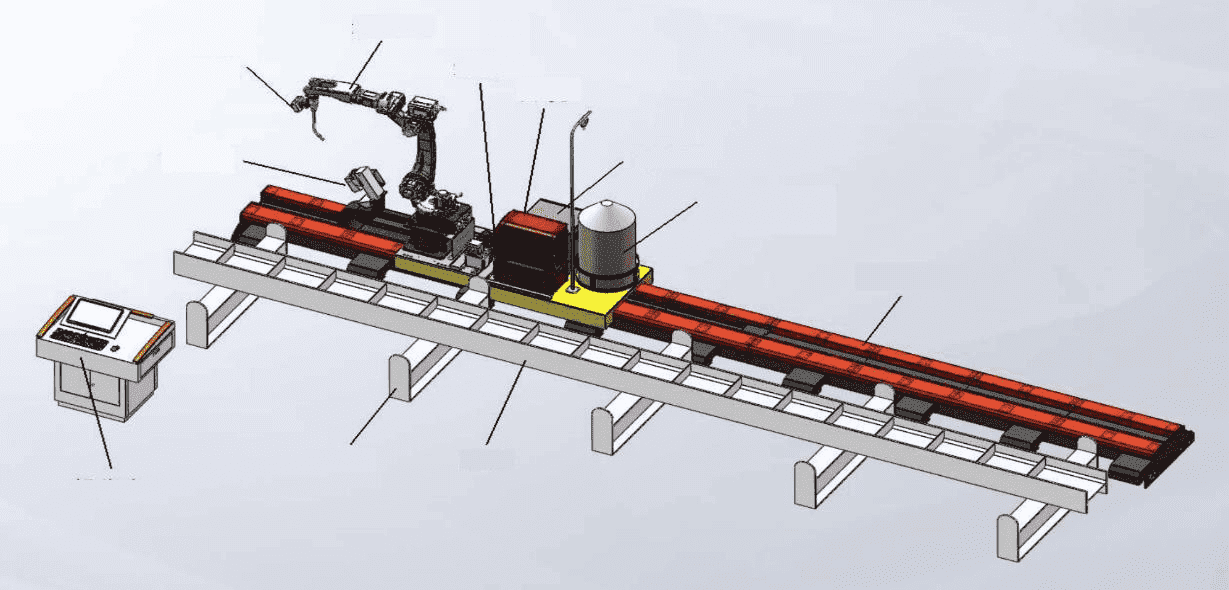
Wind turbine towers are not simple cylinders; they are tapered structures that require complex geometries. Furthermore, the structural steel processing center is designed to handle more than just flat plates. It often incorporates rotary axes or 3D sensing to manage the structural “flanges” and internal reinforcements of the tower.
The 3D aspect of the system refers to its ability to maintain a constant focal distance over uneven surfaces or to cut into pre-curved sections. In HCMC’s fabrication shops, this allows for the precision cutting of door frames (the entry point at the base of the tower) and internal platforms. The software integration—using advanced CAD/CAM algorithms—calculates the complex kinematics of the ±45° head to ensure that even on a curved path, the bevel angle remains perfectly consistent relative to the material surface.
Thermal Management and Material Integrity
One of the challenges of using 6000W of concentrated energy on thick structural steel is heat management. If the material absorbs too much heat, the dimensions can warp, leading to fit-up issues during the assembly of the tower sections.
Modern 3D processing centers in HCMC utilize sophisticated cooling systems and pulsed laser technologies to mitigate this. The fiber laser’s wavelength (approximately 1.06 microns) is absorbed efficiently by the steel, allowing for faster cutting speeds which, paradoxically, results in less total heat input into the part compared to slower methods. This ensures that the massive diameters of the wind tower sections remain perfectly round, which is essential for the structural integrity of the entire turbine.
Economic Impact: Cost-Efficiency in the HCMC Industrial Sector
Operating a 6000W fiber laser in Ho Chi Minh City offers distinct economic advantages over traditional CO2 lasers or plasma systems. First is the electrical efficiency. Fiber lasers convert electricity to light with about 35-40% efficiency, whereas CO2 lasers hover around 10%. In an industrial setting, this leads to massive savings in utility costs.
Furthermore, the “gas mix” strategy utilized by these centers—using compressed air or high-pressure oxygen—allows for tailored finishes. For wind towers, oxygen-assisted cutting at 6000W provides a smooth, square edge that is ideal for thick carbon steel. When combined with the ±45° beveling, the reduction in labor costs is the most significant factor. By eliminating the need for a secondary team of grinders and preparatory welders, the cost per ton of fabricated steel drops significantly.
The Role of Automation and Industry 4.0
The 6000W structural steel processing centers appearing in HCMC are rarely standalone machines. They are integrated into Industry 4.0 ecosystems. Automated loading and unloading systems handle the massive weight of the steel plates, while sensors monitor the health of the laser optics and the consistency of the beam in real-time.
For wind tower production, traceability is paramount. Each cut can be logged, and the precision of the bevel can be verified by onboard vision systems. This data-driven approach ensures that every tower section produced in the HCMC facility meets international standards (such as DNV or IEC), which is a prerequisite for exporting components to offshore wind projects in Europe, Taiwan, or the United States.
Addressing Local Challenges: Humidity and Power Stability
Implementing high-precision laser technology in a tropical environment like Ho Chi Minh City requires specific engineering considerations. High humidity can lead to condensation on optical components, which can be catastrophic for a 6000W beam.
To counter this, these processing centers are equipped with environmentally controlled cabinets and advanced chillers that maintain a constant dew point. Additionally, given the fluctuations in the local power grid, high-capacity voltage stabilizers and UPS systems are integrated to protect the sensitive fiber resonators. This localization of high-end German or Swiss technology for the Vietnamese climate is a testament to the engineering maturity of the HCMC industrial sector.
Future Outlook: Beyond the Tower
While the immediate focus of these 6000W ±45° beveling systems is the wind turbine tower, the implications for Vietnam’s broader infrastructure are vast. The same technology is being applied to bridge building, shipbuilding, and the construction of high-rise steel structures.
As Ho Chi Minh City continues to grow as a manufacturing hub, the transition from “manual and heavy” to “automated and precise” is encapsulated in the fiber laser. The ability to cut, bevel, and prep structural steel in a single motion is not just a technical upgrade; it is a fundamental shift in how Vietnam builds its future. The 6000W 3D Structural Steel Processing Center is the engine of this shift, turning raw steel into the backbone of a green energy revolution with unprecedented speed and precision.