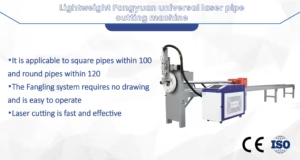
Optimizing Industrial Production: The 4kW Tube laser cutter for Galvanized Steel in Toluca
The industrial landscape of Toluca, State of Mexico, stands as one of the most significant manufacturing hubs in North America. As the region continues to evolve from traditional assembly to high-precision engineering, the adoption of advanced fiber laser technology has become a necessity. Specifically, the 4kW tube laser cutter has emerged as the gold standard for processing galvanized steel, a material ubiquitous in the automotive, construction, and HVAC industries that dominate the Toluca-Lerma corridor.
Integrating a 4kW fiber source into a tube-specific CNC system allows manufacturers to achieve unprecedented levels of accuracy and throughput. When dealing with galvanized steel, the technical challenges are unique; the zinc coating, while providing excellent corrosion resistance, introduces variables that require high power density and sophisticated gas dynamics. This guide explores the engineering principles, operational strategies, and regional advantages of utilizing 4kW laser cutting technology for galvanized tube processing in the Toluca industrial sector.

The Technical Superiority of 4kW Fiber Laser Power
In the realm of laser cutting, power dictates not only the maximum thickness of the material but also the speed and quality of the finish. A 4kW fiber laser provides a versatile power range that is particularly effective for tube geometries. Unlike flat sheet cutting, tube processing involves constant changes in the angle of incidence and requires the laser to penetrate various wall thicknesses as the chuck rotates the workpiece.
For galvanized steel, the 4kW threshold is critical. The zinc layer on galvanized steel has a significantly lower melting point (approximately 419°C) than the underlying steel (approximately 1500°C). When a lower-power laser attempts to cut this material, the zinc often vaporizes inconsistently, leading to “spatter” or “dross” that adheres to the nozzle or the cut edge. The 4kW power density allows for a much faster traverse speed, which minimizes the heat-affected zone (HAZ) and ensures that the zinc is vaporized cleanly along the kerf without compromising the integrity of the surrounding protective layer.
Challenges and Solutions in Cutting Galvanized Steel
Galvanized steel is preferred in Toluca’s construction and automotive sectors because of its longevity. However, for laser cutting operators, it presents the “zinc vapor challenge.” As the laser interacts with the material, the zinc coating vaporizes before the steel melts. This vapor can interfere with the laser beam’s stability and contaminate the protective lens of the cutting head.
To mitigate this, 4kW systems utilize advanced high-pressure gas delivery. Using Nitrogen (N2) as an assist gas is the preferred method for galvanized tubes. Nitrogen acts as a mechanical force that “pushes” the molten steel and vaporized zinc out of the cut at high velocities. This results in a bright, weld-ready edge that requires no secondary finishing. In Toluca’s high-altitude environment, where oxygen levels are slightly lower than at sea level, the precision of Nitrogen-assist laser cutting becomes even more vital to maintain consistent chemical reactions within the kerf.

Toluca’s Industrial Context: Why 4kW is the Regional Standard
Toluca is home to some of the world’s largest automotive OEMs and Tier 1 suppliers. These facilities require components—such as chassis reinforcements, seat frames, and exhaust supports—that are often made from galvanized tubular steel. The 4kW tube laser cutter fits perfectly into this supply chain. It offers the speed required for “Just-In-Time” (JIT) manufacturing and the precision required for complex interlocking joints and notches.
Furthermore, Toluca’s climate and altitude (approximately 2,660 meters above sea level) influence the cooling requirements of high-power machinery. Modern 4kW fiber lasers are equipped with robust dual-circuit chilling systems that manage the temperature of both the laser source and the cutting head. This ensures that even during the peak production shifts common in the State of Mexico’s industrial parks, the machine maintains a stable beam profile and consistent cutting parameters.
Advanced Features of Tube Laser Systems
A 4kW tube laser cutter is more than just a power source; it is a complex robotic system. Key features that enhance production in galvanized steel include:
- Automatic Loading Systems: For high-volume facilities in Toluca, manual loading is a bottleneck. Automatic bundle loaders can feed raw galvanized tubes into the machine, allowing for continuous operation.
- Active Seam Detection: Galvanized tubes often have a visible weld seam. High-end laser cutting machines use optical sensors to detect this seam and rotate the tube so that holes or notches do not interfere with the seam, ensuring structural integrity.
- Spatter Protection: Advanced nozzle designs and “anti-spatter” software cycles help prevent the zinc vapor from clogging the equipment, which is a frequent issue when processing galvanized materials.
Optimizing Cutting Parameters for Galvanized Tubes
Achieving the perfect cut on a 4kW machine requires a balance of several variables. For galvanized steel, the focal point of the laser is typically set slightly below the surface of the material. This ensures that the energy is concentrated where the steel needs to melt, while the assist gas pressure is maximized to clear the zinc vapor.
The nozzle diameter also plays a crucial role. A smaller nozzle (1.2mm to 1.5mm) is often used for thinner galvanized tubes to concentrate the gas pressure, while larger nozzles are used for thicker wall sections. In the competitive manufacturing environment of Toluca, optimizing these parameters can reduce cycle times by 15-20%, providing a significant edge in bidding for large-scale industrial contracts.
Maintenance and Safety Considerations
Operating a 4kW fiber laser involves significant safety protocols, particularly when cutting galvanized steel. The vaporization of zinc produces zinc oxide fumes, which can be hazardous if inhaled. It is mandatory for shops in Toluca to utilize high-capacity dust collection and filtration systems. These systems should be integrated directly with the laser cutting enclosure to capture particulates at the source.
From a maintenance perspective, the fiber laser is much easier to maintain than older CO2 technology, as it has no moving parts or mirrors in the beam path. However, the external optics and the slats of the tube supports must be cleaned regularly. When cutting galvanized steel, “slag” or “dross” can build up on the support points. If not removed, this buildup can scratch the galvanized coating of the next workpiece, leading to potential corrosion points in the future.
Economic Impact and ROI for Toluca Manufacturers
The investment in a 4kW tube laser cutter is significant, but the Return on Investment (ROI) is driven by the elimination of secondary processes. Traditional methods of tube processing—sawing, drilling, and milling—require multiple setups and manual handling. A fiber laser performs all these tasks in a single operation.
For a workshop in Toluca, this means a reduction in labor costs and a massive increase in part accuracy. The ability to cut complex geometries in galvanized steel without damaging the protective coating allows manufacturers to serve the solar energy sector, the aerospace industry, and specialized trailer manufacturing, all of which are growing rapidly in the region. By adopting 4kW technology, local companies can compete not just on price, but on the technical complexity and quality of their output.
Conclusion: The Future of Metal Fabrication in the State of Mexico
As Toluca continues to solidify its position as a global manufacturing leader, the transition to high-power fiber laser cutting is inevitable. The 4kW tube laser cutter represents the ideal balance of power, precision, and cost-efficiency for processing galvanized steel. By understanding the metallurgical challenges of zinc-coated materials and leveraging the advanced capabilities of CNC fiber systems, Toluca’s engineers can ensure their operations remain at the forefront of industrial innovation.
Whether it is for structural components in the rising skyline of Mexico City or precision parts for the automotive plants in Lerma, the 4kW laser cutting process is the engine driving the next generation of Mexican manufacturing. Investing in this technology is not merely an upgrade; it is a strategic move toward a more efficient, precise, and profitable future in metal fabrication.