
Introduction to 4kW Tube laser cutting in León’s Industrial Sector
The industrial landscape of León has undergone a significant transformation over the last decade, evolving into a primary hub for automotive manufacturing, construction, and specialized metal fabrication. Central to this evolution is the adoption of high-power fiber laser technology. Among the various configurations available, the 4kW tube laser cutter has emerged as the workhorse of the modern workshop. This specific power rating provides a “sweet spot” for performance, allowing for high-speed processing of thin-walled materials while maintaining the capacity to pierce and cut thicker structural sections with precision.
For manufacturers in León dealing with galvanized steel, the 4kW fiber laser represents a leap forward in efficiency. Galvanized steel, characterized by its protective zinc coating, presents unique metallurgical challenges during the laser cutting process. However, when paired with a robust 4kW source and the right auxiliary gas configurations, it allows for the production of complex components for chassis, racking systems, and architectural frameworks with minimal post-processing requirements.
The Mechanics of the 4kW Fiber Laser Source
At the heart of the system is the fiber laser source. Unlike CO2 lasers, which rely on gas mixtures and mirrors, a fiber laser generates its beam through a bank of diodes and delivers it via a flexible fiber optic cable. A 4kW rating indicates the continuous wave output power available at the cutting head. This power density is critical when processing galvanized materials, as it must be sufficient to vaporize both the zinc coating and the underlying steel substrate instantaneously to prevent the formation of excessive dross or “burr.”
 laser cutting machine“>
Processing Galvanized Steel: Technical Challenges and Solutions
Galvanized steel is preferred in León’s construction and agricultural sectors due to its superior corrosion resistance. However, from a laser cutting perspective, the zinc layer is a double-edged sword. Zinc has a significantly lower melting and boiling point than the carbon steel it protects. During the laser cutting process, the zinc can vaporize and interfere with the stability of the laser beam, or it can become trapped in the molten steel, leading to porosity in the cut edge.
Managing Zinc Vaporization
When the 4kW laser hits the surface, the zinc layer (which boils at approximately 907°C) vaporizes long before the steel (which melts at 1500°C) is fully penetrated. This rapid vaporization can create a high-pressure gas pocket that disrupts the assist gas flow. To counter this, professional-grade 4kW machines utilize high-pressure nitrogen as an assist gas. Nitrogen acts as a cooling agent and a mechanical force, blowing the molten material out of the kerf before the zinc can integrate into the cut zone. This results in a clean, silver-colored edge that maintains the integrity of the galvanized protection as close to the cut as possible.
Optimizing Cutting Parameters
For a 4kW system, the cutting parameters for galvanized steel must be finely tuned. The frequency of the pulse, the duty cycle, and the nozzle height are critical. In León’s high-altitude environment (if referring to León, Mexico), atmospheric pressure can also affect the behavior of assist gases. Engineers typically recommend a slightly larger nozzle diameter for galvanized tubes to allow for a higher volume of nitrogen flow, which helps in clearing the zinc fumes that could otherwise cloud the protective lens of the laser head.
Engineering Advantages of Tube-Specific Laser Systems
While flatbed lasers are versatile, a dedicated tube laser cutting machine offers mechanical advantages that are indispensable for complex geometries. These machines are equipped with rotary chucks—often a four-claw pneumatic system—that can handle square, rectangular, oval, and even D-shaped profiles. The 4kW source allows these machines to maintain high feed rates even when the tube is rotating at high RPMs.
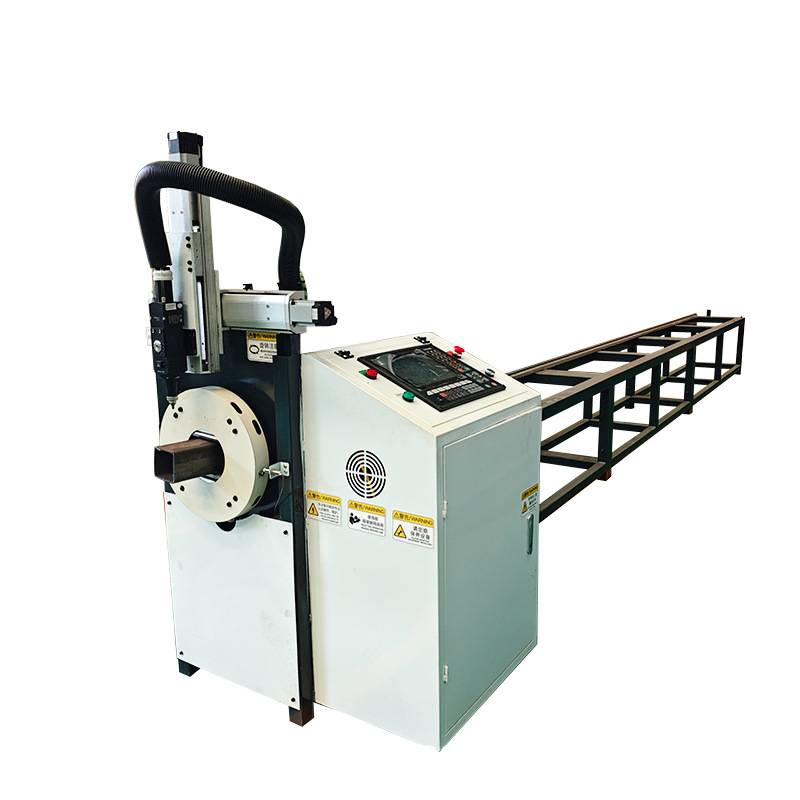
Automated Loading and Material Handling
In the industrial zones of León, where high-volume production is the norm, manual loading is a bottleneck. Modern 4kW tube lasers often feature automated bundle loaders. These systems can pick a single length of galvanized pipe from a 6-meter bundle, measure its length, detect any bowing or twisting, and feed it into the chucks. This level of automation ensures that the laser cutting process remains continuous, maximizing the ROI on the 4kW investment.
Advanced Nesting and Software Integration
The efficiency of laser cutting is not just about the hardware; it is about the software. Specialized CAD/CAM software for tube processing allows engineers in León to design complex “fish-mouth” joints, interlocking tabs, and weight-reduction holes. The software automatically calculates the “unfolded” path for the laser and adjusts the focus point in real-time as the tube rotates. This is particularly vital for galvanized steel, where the thickness of the zinc may vary slightly across the surface of the tube.
Applications in León’s Primary Industries
The versatility of the 4kW tube laser cutter makes it an essential tool across several sectors in the region. By replacing traditional sawing, drilling, and milling with a single laser cutting process, companies can reduce production times by up to 70%.
Automotive and Transportation
León is a cornerstone of the Bajío automotive cluster. Here, 4kW lasers are used to cut galvanized structural tubes for bus frames, trailer chassis, and specialized vehicle components. The precision of the laser ensures that every hole and notch is perfectly aligned, which is critical for the subsequent robotic welding stages. Because the 4kW laser provides a clean cut, the need for grinding the edges before welding is significantly reduced, preserving the galvanized coating near the joint.
Construction and Infrastructure
In the construction of industrial warehouses and commercial centers, galvanized steel tubing is used for HVAC ducting, electrical conduits, and structural supports. The ability of the 4kW laser to cut through 10mm or 12mm wall thicknesses with ease allows for the creation of heavy-duty connectors and trusses that are both lightweight and durable. The “tab and slot” design capability enabled by laser cutting allows these structures to be “dry-fitted” on-site, reducing assembly errors and labor costs.
Maintenance and Operational Longevity
Investing in a 4kW tube laser cutter requires a commitment to rigorous maintenance, especially when processing galvanized materials. The zinc dust generated during the laser cutting process is fine and conductive. If not properly managed, it can settle on optical components or electrical cabinets.
Dust Extraction and Filtration
A high-capacity dust extraction system is mandatory. For galvanized steel, the filters must be designed to handle the sticky nature of zinc oxide fumes. Regular cleaning of the extraction ducts prevents the buildup of flammable residues and ensures that the workspace remains safe for operators. In León’s climate, ensuring that the chiller system for the 4kW source is operating at peak efficiency is also vital, as fiber lasers are sensitive to temperature fluctuations.
Optical Care
The protective window of the laser head is the most vulnerable component. When laser cutting galvanized steel, “spatter” is more common than with standard cold-rolled steel. Operators must inspect the lens multiple times per shift. Using high-purity assist gases (99.99% nitrogen) significantly extends the life of these optics by providing a consistent pressure barrier against contaminants.
Economic Impact and Future Outlook
The adoption of 4kW tube laser cutting technology is a strategic move for any fabrication shop in León looking to compete on a global scale. The initial capital expenditure is offset by the dramatic increase in throughput and the reduction in secondary operations. As the region continues to attract foreign investment, the demand for high-precision, corrosion-resistant components will only grow.
Furthermore, the 4kW power level is future-proof. While lower-power 1kW or 2kW systems exist, they often struggle with the speeds required for high-volume galvanized production. The 4kW system provides the overhead needed to handle a wider range of wall thicknesses and material types, including aluminum and stainless steel, which are also prevalent in León’s manufacturing mix.
Conclusion
The 4kW tube laser cutter is more than just a piece of machinery; it is a catalyst for industrial sophistication in León. By mastering the nuances of laser cutting galvanized steel—from managing zinc vaporization to optimizing nesting software—local manufacturers can produce world-class products that meet the stringent demands of the automotive and construction industries. As fiber laser technology continues to advance, the integration of high-power sources with intelligent automation will remain the cornerstone of León’s manufacturing excellence.
















