
Engineering Guide: Optimizing 4kW Tube Laser Cutting for Aluminum Alloy in the Toluca Industrial Corridor
The industrial landscape of Toluca, Estado de México, has evolved into a critical hub for high-precision manufacturing, particularly in the automotive and elevator sectors. For elevator factory owners and lead engineers, the transition toward lightweight, high-strength materials like Aluminum Alloy necessitates a fundamental shift in fabrication technology. The 4kW Tube Laser Cutter represents the current gold standard for this transition, balancing power efficiency with the rigorous tolerances required for vertical transportation systems. This guide explores the engineering advantages of the tube-welded standard bed and the specific parameters for high-precision aluminum processing.
The Structural Foundation: Engineering the Tube-Welded Standard Bed
In the context of high-speed laser cutting, the machine bed is not merely a frame; it is a vibration-damping foundation that dictates the long-term accuracy of every cut. For elevator components—where guide rail brackets and cabin frames must align within sub-millimeter tolerances—the stability of the bed is paramount.
The tube-welded standard bed is engineered using high-quality structural steel tubes, which undergo a rigorous multi-stage treatment process. Unlike cast iron beds which can be brittle, or simple plate-welded frames that may warp under thermal stress, the tube-welded structure offers a superior strength-to-weight ratio.
The manufacturing process involves:
1. Stress Relief Annealing: The bed is heated to over 600°C and cooled slowly to eliminate internal stresses generated during welding. This ensures that the frame remains dimensionally stable for over 20 years of continuous operation.
2. Precision Milling: Large-scale gantry milling machines process the mounting surfaces for the guide rails and racks in a single setup, ensuring absolute parallelism and perpendicularity.
3. Vibration Damping: The hollow sections of the welded tubes are strategically designed to dissipate the kinetic energy produced by the high-acceleration movements of the 4kW laser head.
For Toluca-based factories operating in high-output environments, this structural integrity translates to a machine that maintains its “factory-new” precision even after years of three-shift rotations.

4kW Fiber Laser Dynamics: The Sweet Spot for Aluminum Alloy
Aluminum alloys, such as the 6061 and 6063 series commonly used in elevator door headers and decorative cabin trims, present unique challenges for laser cutting. Aluminum is highly reflective and possesses high thermal conductivity, which can lead to beam instability and dross formation if the power density is insufficient.
A 4kW fiber laser source provides the optimal power density to overcome these physical barriers. At 4000 watts, the laser can achieve:
– High-Speed Piercing: Reducing the “heat-affected zone” (HAZ) and preventing the material from warping during the initial entry.
– Clean Cutting Edges: By utilizing high-pressure nitrogen as an assist gas, the 4kW beam melts the aluminum instantaneously, while the gas blows the molten metal away, leaving a mirror-like finish that requires zero post-processing.
– Thickness Versatility: While thinner decorative panels are cut at lightning speeds, the 4kW source retains the capacity to cut through structural aluminum tubes up to 12mm-15mm thick, covering the entire range of elevator component requirements.
Precision Requirements for the Elevator Industry
Elevator engineering is a discipline defined by safety and smoothness of motion. The components produced in a Toluca facility—ranging from complex interlocking door mechanisms to structural hoistway brackets—must meet international standards such as EN 81-20/50.
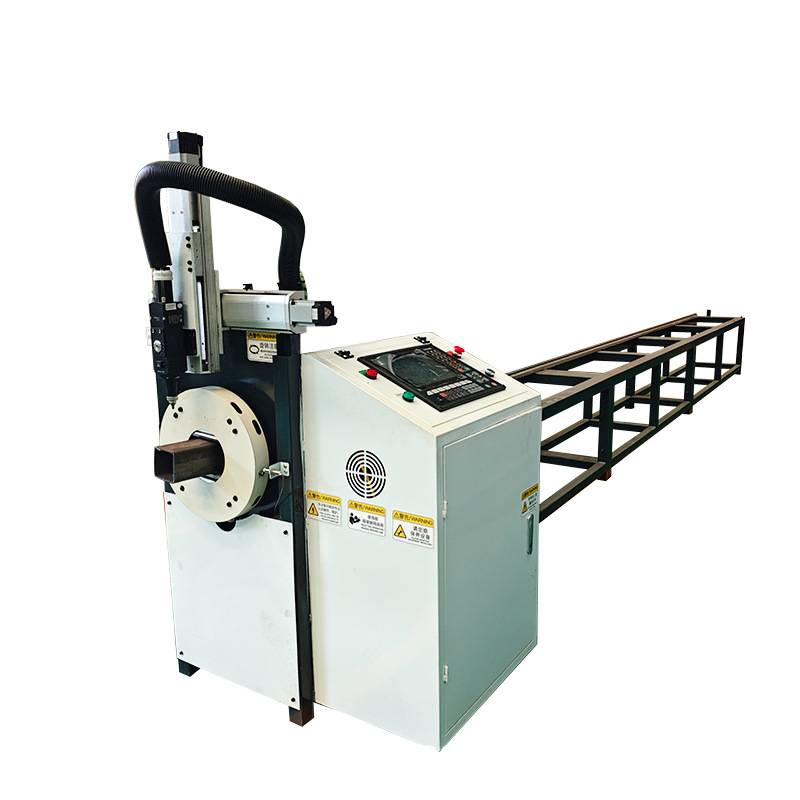
The 4kW Tube Laser Cutter addresses these needs through:
– Geometric Accuracy: Achieving a positioning accuracy of ±0.03mm and a repeatability of ±0.02mm. This level of precision is critical for the interlocking “teeth” of elevator doors, where even a 0.1mm deviation can cause mechanical noise or failure.
– Complex Profile Handling: Modern elevator designs often utilize non-standard tube shapes (oval, D-shaped, or custom extrusions). Advanced CNC controllers allow for real-time compensation of tube deformation, ensuring that holes and notches are cut perfectly centered regardless of the raw material’s slight variances.
– Automatic Centering Chucks: High-speed pneumatic chucks ensure that the aluminum tube is held with consistent pressure, preventing the crushing of thin-walled profiles while maintaining a firm grip for high-speed rotation.
Operational Efficiency in the Toluca Market
Toluca’s industrial parks are characterized by a competitive supply chain. To maintain a competitive edge, local elevator manufacturers must optimize their “Cost Per Part.” The 4kW Tube Laser Cutter contributes to this through significant reductions in secondary operations.
Traditionally, aluminum tubes were cut to length, then moved to a machining center for hole drilling, and finally to a deburring station. The laser cutter integrates these three steps into a single process. For a standard elevator cabin frame component, this integration can reduce the production cycle time by up to 70%. Furthermore, the nesting software optimized for tube cutting minimizes material waste, which is a significant cost factor given the current market price of high-grade aluminum alloys in Mexico.
Technical Specifications and Data-Driven Performance
For engineers reviewing equipment for procurement, the following technical parameters define the 4kW Aluminum-specialized system:
– Laser Source: Fiber Laser (IPG or Raycus)
– Maximum Tube Length: 6000mm (Standard) / 9000mm (Optional)
– Diameter Range: 20mm to 220mm (Round); up to 150mm (Square)
– Acceleration: 1.2G to 1.5G
– Cooling System: Dual-temperature industrial chiller (specifically calibrated for the high-altitude atmospheric pressure of Toluca, which affects cooling efficiency)
– Assist Gas Control: Electronic proportional valves for precise Nitrogen/Oxygen/Air switching.
In aluminum applications, the use of Nitrogen at 15-20 bar is recommended for the 4kW system. This prevents oxidation of the cut edge, ensuring that if the component requires subsequent welding or anodizing, the surface is chemically ready without additional cleaning.
Maintenance and Long-Term Reliability for High-Altitude Operation
Toluca’s altitude (approximately 2,660 meters above sea level) presents unique environmental variables for industrial machinery. Air density is lower, which can affect the cooling efficiency of traditional heat exchangers and the flow dynamics of assist gases.
The 4kW Tube Laser systems designed for this market feature:
– Oversized Cooling Units: To compensate for the lower air density, ensuring the laser source and cutting head remain within the optimal 20°C to 25°C range.
– Dust Extraction Systems: Aluminum cutting produces fine, highly flammable dust (Aluminium fines). Our systems include specialized explosion-proof dust collectors and high-velocity extraction fans to maintain a safe working environment.
– Sealed Optical Path: To prevent the ingress of local industrial pollutants, ensuring the laser beam maintains its focal integrity over long production runs.
Economic Impact and ROI Analysis
For a factory owner in Toluca, the investment in a 4kW Tube Laser Cutter is justified through a rapid Return on Investment (ROI). When compared to 2kW systems, the 4kW variant increases cutting speed in 6mm aluminum by more than 250%.
Consider the following data point:
– Component: Elevator Door Header (Aluminum 6061, 4mm wall thickness)
– Traditional Method (Saw + Drill + Deburr): 12 minutes per unit.
– 4kW Laser Method: 85 seconds per unit.
This throughput increase allows a single machine to replace multiple manual workstations, reducing labor costs and eliminating the human error associated with manual layout and drilling. In the high-stakes world of elevator safety, the elimination of human error is perhaps the most significant “hidden” profit margin.
Conclusion
The 4kW Tube Laser Cutter, with its tube-welded standard bed and aluminum-optimized parameters, is more than a tool; it is a strategic asset for the Toluca elevator industry. By providing the structural stability needed for high-precision cuts and the power required to master reflective alloys, this technology enables local manufacturers to compete on a global scale. As urban centers in Mexico continue to grow vertically, the demand for precision-engineered elevators will only increase. Factories that adopt these high-precision laser standards today will be the leaders of the infrastructure of tomorrow.
















