
Engineering Guide: Precision 4kW Fiber Laser Cutting for Galvanized Steel in the Guadalajara Aerospace Sector
The manufacturing landscape in Guadalajara, Jalisco, has undergone a significant transformation, evolving from a traditional electronics hub into a sophisticated center for aerospace and automotive engineering. For aerospace factory owners and lead engineers, the requirement for high-precision components—specifically those fabricated from galvanized steel—demands a rigorous evaluation of laser cutting technology. The 4kW fiber laser, integrated with a tube-welded standard bed, represents the current “gold standard” for balancing throughput, edge quality, and structural longevity in this demanding market.
The Strategic Importance of 4kW Power in Aerospace Fabrication
In the context of aerospace manufacturing, material integrity is non-negotiable. Galvanized steel, while offering superior corrosion resistance due to its zinc coating, presents unique challenges during thermal cutting. A 4kW fiber laser source provides the optimal energy density to penetrate both the zinc layer and the carbon steel core with minimal thermal distortion.
At 4,000 watts, the laser achieves a power density that allows for high-speed processing of galvanized sheets ranging from 1.0mm to 6.0mm—the typical thickness range for aerospace ducting, brackets, and internal structural housing. Unlike lower-wattage systems that may struggle with the reflective nature of the zinc coating, the 4kW system ensures a stable keyhole effect, resulting in a cleaner kerf and a significantly reduced Heat Affected Zone (HAZ). This is critical for maintaining the mechanical properties of the base metal, ensuring that the component meets strict AS9100 quality standards.
Structural Engineering: The Technical Superiority of the Tube-Welded Standard Bed
The foundation of any high-precision CNC machine is its bed. In the Guadalajara market, where ambient temperatures and humidity can fluctuate, structural stability is paramount to prevent geometric deviations over long production cycles. The tube-welded standard bed is engineered to address these specific environmental and mechanical stressors.
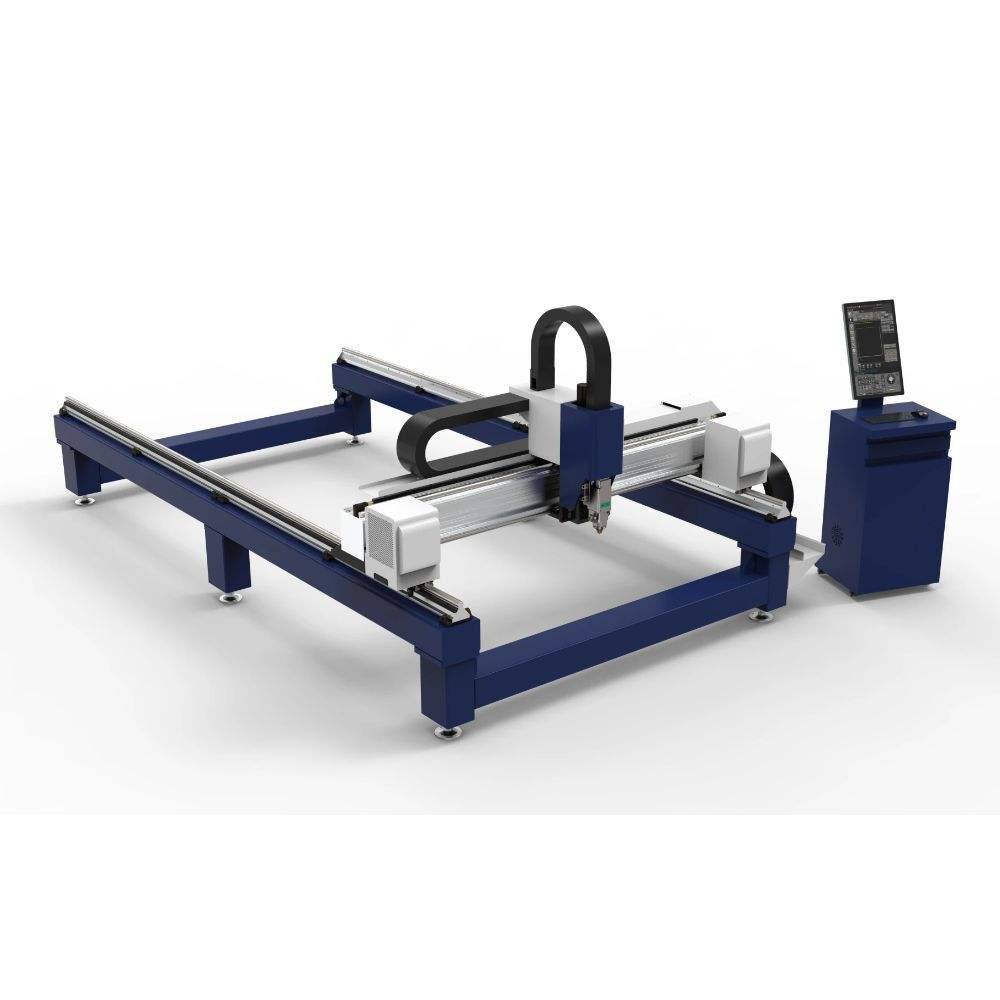
The construction process involves high-quality industrial carbon steel tubes that are welded into a reinforced lattice structure. This design offers several engineering advantages over cast iron or thin-plate welded alternatives:
1. Resonance Damping: The hollow-core structure of the tube-welded bed, often filled with specialized damping materials or reinforced with internal stiffeners, effectively absorbs the high-frequency vibrations generated by rapid gantry accelerations (up to 1.2G).
2. Thermal Stability: Aerospace components require tolerances within ±0.05mm. The tube-welded structure undergoes a rigorous stress-relief annealing process in high-temperature furnaces. This ensures that the internal stresses of the welds are neutralized, preventing the bed from warping or “creeping” over years of operation in a non-climate-controlled factory floor.
3. Strength-to-Weight Ratio: The structural geometry provides high rigidity without excessive mass. This allows the motion control system to achieve higher speeds and more precise stops, which is essential when cutting complex aerospace geometries with tight radii.
Overcoming the Challenges of Cutting Galvanized Steel
Galvanized steel is notoriously difficult for traditional CO2 lasers and low-power fiber lasers due to the different melting points of zinc (approx. 419°C) and steel (approx. 1500°C). When the laser hits the material, the zinc vaporizes before the steel melts, often leading to “blowouts,” dross accumulation on the bottom of the cut, and surface contamination.
The 4kW fiber laser solves this through specialized gas dynamics and frequency modulation. Engineers in Guadalajara are increasingly adopting Nitrogen (N2) as an auxiliary gas at high pressures (typically 12-18 bar) for galvanized applications. The nitrogen acts as a mechanical force to eject the molten zinc and steel rapidly, preventing the formation of oxide layers.
Furthermore, the 4kW beam profile allows for a “High-Pressure Air” cutting strategy in certain non-critical aerospace applications. This significantly reduces operational costs—a key factor for Tier 2 and Tier 3 suppliers in the Mexican market—while maintaining a cut speed that is 20-30% faster than oxygen-assisted cutting on the same thickness.
Motion Control and High-Precision Integration
For the Guadalajara aerospace sector, the machine’s ability to repeat a cut a thousand times with zero deviation is the difference between a profitable contract and a rejected batch. The integration of the 4kW source with high-precision components is vital.
The systems utilized in these specialized machines feature:
– Alpha/Beta Series Servo Motors: Providing high torque and millisecond response times.
– Helical Rack and Pinion Systems: These offer more surface contact than straight racks, leading to smoother motion and higher precision (Grade 6 or better).
– Automatic Focus Laser Heads: These heads utilize capacitive sensors to maintain a constant distance from the galvanized sheet, even if the material has slight surface undulations or “oil canning” from the galvanizing process.

Data-Driven Performance Metrics
When evaluating a 4kW system for a Guadalajara facility, engineers should look at the following performance data for galvanized steel (Grade G90):
– 1.5mm Thickness: Cutting speeds can reach 35-40 m/min with Nitrogen.
– 3.0mm Thickness: Cutting speeds average 12-15 m/min.
– Dimensional Accuracy: ±0.03mm per meter of travel.
– Repeatability: ±0.02mm.
These metrics allow aerospace planners to calculate precise Lead Times and Tooling Costs, ensuring that Mexican fabrication shops remain competitive with international counterparts in the US and Canada.
Maintenance and Longevity in the Mexican Industrial Environment
Guadalajara’s industrial zones often face challenges with power stability and dust. A professional-grade 4kW laser system must be equipped with a dual-circuit industrial chiller and a high-grade voltage stabilizer. The tube-welded bed further contributes to longevity by providing a stable platform for the linear guides. If a bed lacks rigidity, the linear guides will wear unevenly, leading to “chatter” marks on the cut edge—a defect that would fail an aerospace visual inspection.
The use of a standard tube-welded bed also facilitates easier maintenance. The accessibility of the internal components and the modular nature of the slat system mean that downtime is minimized during routine cleaning or part replacement.
Conclusion: The Future of Aerospace Fabrication in Jalisco
As Guadalajara continues to attract investment from global aerospace leaders, the local supply chain must upgrade its technological capabilities. Investing in a 4kW Sheet Metal Laser with a Tube-welded Standard Bed is not merely an equipment purchase; it is a strategic commitment to precision engineering.
By mastering the nuances of galvanized steel cutting—leveraging the stability of a stress-relieved bed and the raw power of a 4kW fiber source—local manufacturers can secure their position in the global aerospace value chain. The data proves that this configuration offers the highest ROI through reduced scrap rates, lower secondary processing costs (no deburring required), and the ability to meet the most stringent tolerances required by modern flight hardware.
















