
Engineering Excellence: The 40kW Tube Laser Revolution in Queretaro’s Elevator Industry
The industrial landscape of Queretaro has evolved into one of North America’s most sophisticated manufacturing hubs. As the Bajío region continues to attract global investment, the demand for high-precision structural components—particularly within the elevator and vertical transport sector—has reached an all-time high. For elevator factory owners and lead engineers, the transition from traditional mechanical processing to ultra-high-power fiber laser technology is no longer a luxury but a strategic necessity. The introduction of the 40kW Tube Laser Cutter, specifically optimized for carbon steel, represents the pinnacle of this technological shift.
This guide examines the technical architecture of 40kW laser systems, focusing on the structural advantages of the tube-welded standard bed and the specific performance metrics required for high-precision carbon steel fabrication in the Queretaro market.
The Power Dynamics of 40kW Fiber Lasers
In the context of elevator manufacturing, carbon steel is the primary material for car frames, guide rail brackets, and counterweight assemblies. A 40kW fiber laser source provides an unprecedented power density that fundamentally alters the physics of the cut. While a 12kW or 20kW machine might struggle with thick-walled structural tubes, the 40kW system maintains a high-speed “bright surface” cut, even on carbon steel exceeding 25mm in thickness.
For Queretaro-based engineers, the primary advantage is the reduction of the Heat Affected Zone (HAZ). High-power lasers allow for faster feed rates; the faster the laser moves, the less time heat has to dissipate into the surrounding material. This results in minimal thermal deformation, ensuring that long elevator guide rails and structural supports maintain their geometric integrity over lengths of 6 meters or more.

Technical Analysis of the Tube-Welded Standard Bed
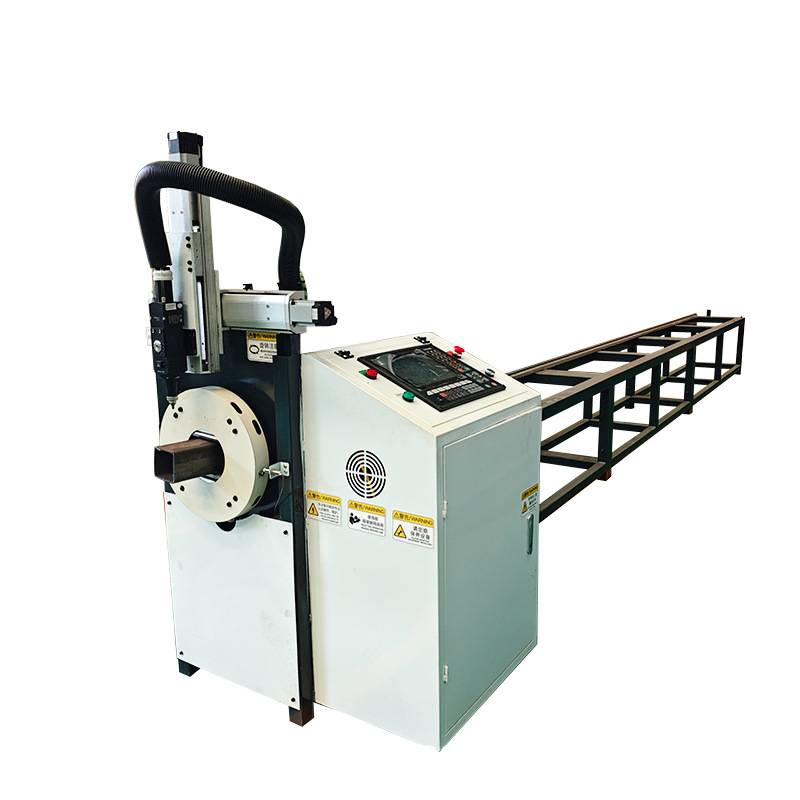
The foundation of any high-precision CNC machine is its bed. For a 40kW system, the structural requirements are immense. The “Tube-Welded Standard Bed” is an engineered solution designed to balance rigidity, vibration damping, and thermal stability.
Unlike cast iron beds which can be brittle, or simple plate-welded beds which may retain internal stresses, the tube-welded bed utilizes high-strength carbon steel rectangular tubes. These tubes are strategically reinforced with internal stiffeners. The engineering process involves several critical stages:
1. Stress Relief Annealing: After welding, the entire bed undergoes a high-temperature annealing process in a controlled furnace. This removes the internal stresses created during the welding process, preventing the bed from warping over years of operation in Queretaro’s variable climate.
2. Vibration Damping: The hollow sections of the tube-welded design are often engineered to dissipate the harmonic vibrations generated by high-speed acceleration and deceleration of the cutting head (often reaching 1.2G to 1.5G).
3. Precision Machining: The mounting surfaces for the guide rails and racks are machined in a single pass using large-scale gantry milling centers. This ensures a parallelism and flatness tolerance of less than 0.03mm across the entire length of the bed.
For elevator manufacturers, this structural stability translates directly into “verticality.” When cutting the interlocking notches for an elevator car frame, a deviation of even 0.5mm can lead to assembly misalignment and increased noise during operation. The tube-welded bed ensures that the machine’s accuracy remains consistent from the first hour of the shift to the last.
High-Precision Carbon Steel Fabrication for Elevators
Elevator components demand a unique combination of structural strength and aesthetic precision. Carbon steel, while robust, requires careful gas management during the laser cutting process. The 40kW system excels in two specific areas:
Oxygen-Assisted Cutting: For thick carbon steel plates and tubes (15mm+), oxygen assistance facilitates an exothermic reaction that speeds up the cut. The 40kW power allows for a narrower kerf width, which is essential for creating tight-tolerance bolt holes in guide rail brackets.
Nitrogen/Air High-Pressure Cutting: For thinner sections (3mm to 10mm), the 40kW laser can utilize high-pressure nitrogen or filtered compressed air to achieve “clean” cuts at speeds exceeding 40 meters per minute. This eliminates the need for secondary grinding or deburring—a significant cost-saving factor for Queretaro factories looking to optimize their throughput.
Market-Specific Considerations for Queretaro
Queretaro’s industrial sector is characterized by its adherence to international standards (ISO, AWS, and CEN). Elevator exporters in the region must meet stringent safety codes. The 40kW tube laser supports these requirements through:
Traceability and Repeatability: Digital control systems allow for the storage of specific cutting parameters for different grades of carbon steel (e.g., A36, S235JR). This ensures that every bracket produced is identical to the last, satisfying quality control audits.
Integration with BIM and CAD/CAM: Modern 40kW systems interface directly with Building Information Modeling (BIM) software. Engineers can export 3D tube designs directly to the laser’s nesting software, reducing material waste in the high-cost Queretaro real estate and utility market.
Operational Efficiency and ROI for Factory Owners
From a financial perspective, the investment in a 40kW tube laser must be justified by the reduction in “cost per part.” In the elevator industry, where production volumes are moderate but complexity is high, the 40kW system offers several ROI drivers:
1. Consolidation of Processes: A single tube laser can replace saws, drills, and milling machines. It can cut the profile, drill the mounting holes, and create the mitered joints for welding in a single continuous operation.
2. Material Savings: Advanced nesting algorithms for tubes can reduce scrap rates by 10-15%. In a high-volume elevator factory, these savings in carbon steel can amount to tens of thousands of dollars annually.
3. Energy Efficiency: While 40kW sounds high, the “wall-plug efficiency” of modern fiber lasers is approximately 35-40%. Because the cutting speed is so much higher than lower-power alternatives, the energy consumed per meter of cut is actually lower.
The Engineering Perspective: Maintenance and Longevity
For the engineers tasked with maintaining these machines in Queretaro, the tube-welded standard bed offers a distinct advantage in terms of maintenance. The stability of the bed reduces the wear and tear on the linear guides and the rack-and-pinion drive system. Furthermore, the 40kW laser source is modular. If one diode module fails, the system can often continue to operate at a lower power until a replacement is installed, preventing total production downtime.
The cooling system is another critical engineering component. A 40kW laser generates significant heat within the resonator and the cutting head. High-capacity dual-circuit chillers are mandatory, especially during Queretaro’s hotter months. These chillers maintain a constant temperature for the optics, preventing “thermal shift” which can cause the laser focus to drift during long cutting cycles.
Conclusion: The Future of Vertical Transport Manufacturing
The elevator industry is moving toward lighter, stronger, and more complex structural designs. The 40kW Tube Laser Cutter, with its specialized focus on carbon steel and its rigid tube-welded bed, provides the technological foundation necessary to meet these challenges. For manufacturers in Queretaro, this technology represents more than just a faster way to cut metal; it represents the ability to innovate at the speed of the global market.
By adopting 40kW technology, Queretaro’s elevator factories can ensure higher safety standards, lower operational costs, and a level of precision that was previously unattainable with traditional manufacturing methods. As the skyline of Mexico and the world continues to grow, the components that move us upward will increasingly be born from the precision of ultra-high-power laser technology.
















