
The Evolution of Industrial laser cutting: The 40kW Tube Laser in Queretaro
The industrial landscape of Queretaro, Mexico, has undergone a radical transformation over the last decade. As a primary hub for aerospace, automotive, and heavy appliance manufacturing, the demand for precision-engineered components has skyrocketed. Central to this evolution is the implementation of ultra-high-power fiber laser technology. The introduction of the 40kW tube laser cutting system represents the current pinnacle of this progression, offering unprecedented speed, thickness capacity, and accuracy for complex metallic profiles.
In the Bajío region, where Tier 1 and Tier 2 suppliers operate under stringent international standards, the ability to process non-ferrous metals like brass with high efficiency is a significant competitive advantage. Laser cutting at the 40kW threshold is not merely about raw power; it is about the sophisticated management of energy density and beam quality to achieve finishes that were previously only possible through secondary machining processes.
 laser cutting machine“>
Technical Superiority of 40kW Fiber Laser Sources
The leap from 10kW or 20kW to 40kW is a quantum shift in laser cutting capabilities. For tube processing, this power level allows for the “High-Speed Fusion Cutting” of thick-walled materials. The 40kW fiber laser source utilizes multiple laser modules combined into a single beam, maintaining a high Beam Parameter Product (BPP). This ensures that even at extreme distances from the cutting head—essential for large-diameter tube processing—the beam remains concentrated and stable.
Energy Density and Kerf Control
One of the primary engineering challenges in laser cutting is managing the kerf width. At 40kW, the energy density is so high that the material is vaporized almost instantaneously. This minimizes the Heat Affected Zone (HAZ), which is critical for maintaining the structural integrity of the tube. In Queretaro’s aerospace sector, where material fatigue is a constant concern, the narrow HAZ provided by a 40kW system ensures that the mechanical properties of the brass or alloy remain intact near the cut edge.
Processing Brass: Overcoming Reflectivity Challenges
Brass, an alloy of copper and zinc, is notoriously difficult to process using traditional CO2 lasers and even lower-power fiber lasers. This difficulty stems from its high thermal conductivity and high reflectivity. In the early days of fiber laser cutting, “back-reflection” was a significant risk, often leading to the destruction of the laser source or the optical fiber as the beam bounced off the shiny surface of the brass.
The 40kW Advantage for Brass
With a 40kW system, the initial “pierce” of the brass tube happens so rapidly that the material changes state before a significant amount of energy can be reflected. Modern systems are also equipped with back-reflection isolators and sensors that monitor the return light in real-time. In the context of Queretaro’s decorative architecture and electrical component industries, the ability to perform high-speed laser cutting on brass tubes—ranging from thin-walled decorative pieces to heavy-duty electrical conduits—is a game-changer.
Furthermore, the 40kW power allows for the use of compressed air or nitrogen as a shielding gas at higher thicknesses. This prevents the oxidation that typically occurs when cutting brass, resulting in a bright, clean edge that requires no post-processing polishing or deburring.
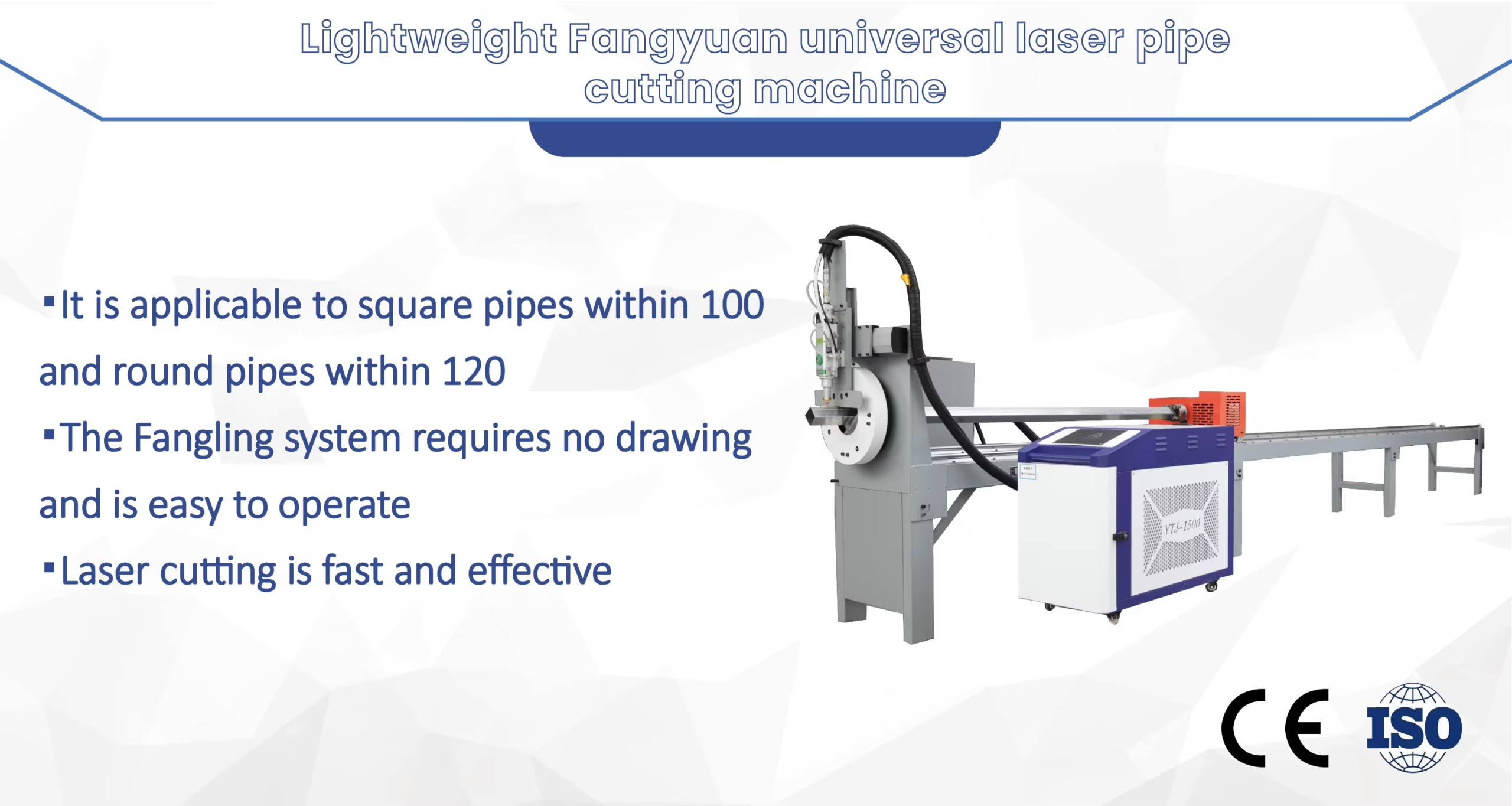
Mechanical Architecture of a 40kW Tube Laser
A machine capable of handling 40kW of laser power must be built with extreme structural rigidity. The bed of the machine is typically a heavy-duty, heat-treated steel frame designed to withstand the thermal stresses of continuous high-power operation. In the industrial parks of El Marqués and Balvanera, these machines are often the centerpieces of 24/7 production lines.
Advanced Chuck Systems and Material Support
Tube laser cutting requires the precise rotation and longitudinal movement of the workpiece. For a 40kW system, the chucks must be pneumatic or hydraulic with high clamping force to prevent slippage during rapid acceleration. The “four-chuck” system is often preferred, as it allows for “zero-tailing” (minimizing material waste) and provides superior support for long, heavy brass tubes that might otherwise sag and affect the focal point of the laser.
Dynamic Focusing Heads
The cutting head is the “brain” of the laser cutting system. At 40kW, the optics must be cooled with high-efficiency chillers. These heads feature auto-focusing capabilities that adjust the focal position in milliseconds, compensating for any irregularities in the tube’s roundness or wall thickness. This is particularly important for brass, where maintaining the exact focal point is the difference between a clean cut and a failed pierce.
Queretaro as a Strategic Hub for Laser Processing
Queretaro has positioned itself as the “Silicon Valley” of Mexican manufacturing. The state’s infrastructure supports the high electrical demands of 40kW laser cutting systems. Moreover, the proximity to major logistics routes allows manufacturers to source raw brass materials and ship finished components across North America with ease.
Integration with Industry 4.0
Most 40kW tube lasers installed in Queretaro are fully integrated into Industry 4.0 workflows. This includes cloud-based monitoring of gas consumption, cutting speeds, and maintenance intervals. For a factory manager in Queretaro, being able to track the laser cutting efficiency of a specific batch of brass tubes from a smartphone is no longer a luxury—it is a standard operational requirement. The software allows for complex nesting, ensuring that the maximum number of parts is extracted from every length of tube, which is vital given the fluctuating costs of copper-based alloys.
Maintenance and Operational Safety
Operating a 40kW laser requires a rigorous maintenance schedule. The high power levels put significant stress on the protective windows and the nozzle. In Queretaro, specialized technical support teams are often available to provide the necessary calibration and optical cleaning services. Safety is also paramount; the 40kW beam is invisible and can cause catastrophic damage if not properly contained. These machines are housed in fully enclosed Class 1 laser safety cabins with specialized viewing glass that filters out the specific wavelength of the fiber laser.
Gas Selection: Nitrogen vs. Oxygen
For brass laser cutting, the choice of assist gas is critical. Nitrogen is typically used for high-quality finishes, as it acts as a cooling agent and prevents combustion, leading to a “melt and blow” process. Oxygen can be used for thicker sections of carbon steel, but for brass, nitrogen at high pressure (often exceeding 20 bar) is the standard. This requires high-capacity gas storage and delivery systems, which are readily available through the robust industrial gas supply chain in Queretaro.
Economic Impact and Return on Investment (ROI)
While the initial capital expenditure for a 40kW tube laser is significant, the ROI is driven by throughput. A 40kW system can cut brass tubes up to five times faster than a 6kW system. In a high-volume production environment, this reduces the cost-per-part dramatically. For Queretaro-based companies, this technology allows them to outcompete international rivals by offering shorter lead times and higher precision.
Additionally, the versatility of the machine to handle not just brass, but also stainless steel, aluminum, and carbon steel, ensures that the machine remains occupied across different contracts. The ability to perform “one-hit” processing—where cutting, hole-punching, and beveling are all done in a single laser cutting cycle—eliminates the need for multiple machines and reduces labor costs.
Conclusion
The 40kW tube laser cutter is more than just a tool; it is a catalyst for industrial sophistication. In the hands of Queretaro’s engineers, it unlocks new possibilities in the design and manufacture of brass components. As the global market continues to demand lighter, stronger, and more complex tubular structures, the combination of ultra-high-power fiber lasers and Queretaro’s manufacturing expertise will remain at the forefront of the industrial world. For any facility looking to dominate the non-ferrous metal market, the transition to 40kW laser cutting is not just an upgrade—it is a necessity for the future.
















