
The Strategic Evolution of Laser Cutting in Monterrey’s Automotive Sector
The industrial landscape of Monterrey, Nuevo León, has undergone a radical transformation. As the primary hub for Mexico’s automotive manufacturing—bolstered by the presence of global giants and the impending arrival of next-generation electric vehicle production—the demand for precision, speed, and material versatility has never been higher. For Tier 1 and Tier 2 suppliers, the transition from traditional mechanical shearing or low-power plasma cutting to ultra-high-power fiber laser systems is no longer a luxury; it is a competitive necessity.
The 40kW Precision Laser System represents the current zenith of industrial fiber laser technology. Specifically engineered for the heavy-duty requirements of carbon steel processing, this system bridges the gap between massive throughput and micron-level accuracy. In a market where “Just-in-Time” delivery is the standard, the ability to process thick-plate carbon steel with minimal post-processing is the ultimate differentiator.
Engineering Architecture: The Tube-Welded Standard Bed
At the core of a 40kW system lies its structural foundation. While some manufacturers opt for cast iron beds, the engineering community in the automotive sector increasingly favors the Tube-Welded Standard Bed for its specific balance of rigidity, thermal management, and dynamic response.
The tube-welded bed is constructed using high-strength rectangular steel tubes, reinforced with internal stiffeners arranged in a cellular lattice. This design is not merely about supporting weight; it is about managing the immense kinetic energy generated by a gantry moving at speeds exceeding 120m/min with accelerations up to 2.0G.

From an engineering perspective, the tube-welded structure undergoes a rigorous stress-relief process. After welding, the bed is subjected to high-temperature annealing in a computer-controlled electric furnace. This process eliminates the internal residual stresses caused by the welding heat, ensuring that the bed will not deform over a decade of operation. For Monterrey’s factories, where ambient temperatures can fluctuate significantly, the thermal stability of a tempered tube-welded bed ensures that the laser’s focal point remains consistent, preventing “drift” during long production shifts.
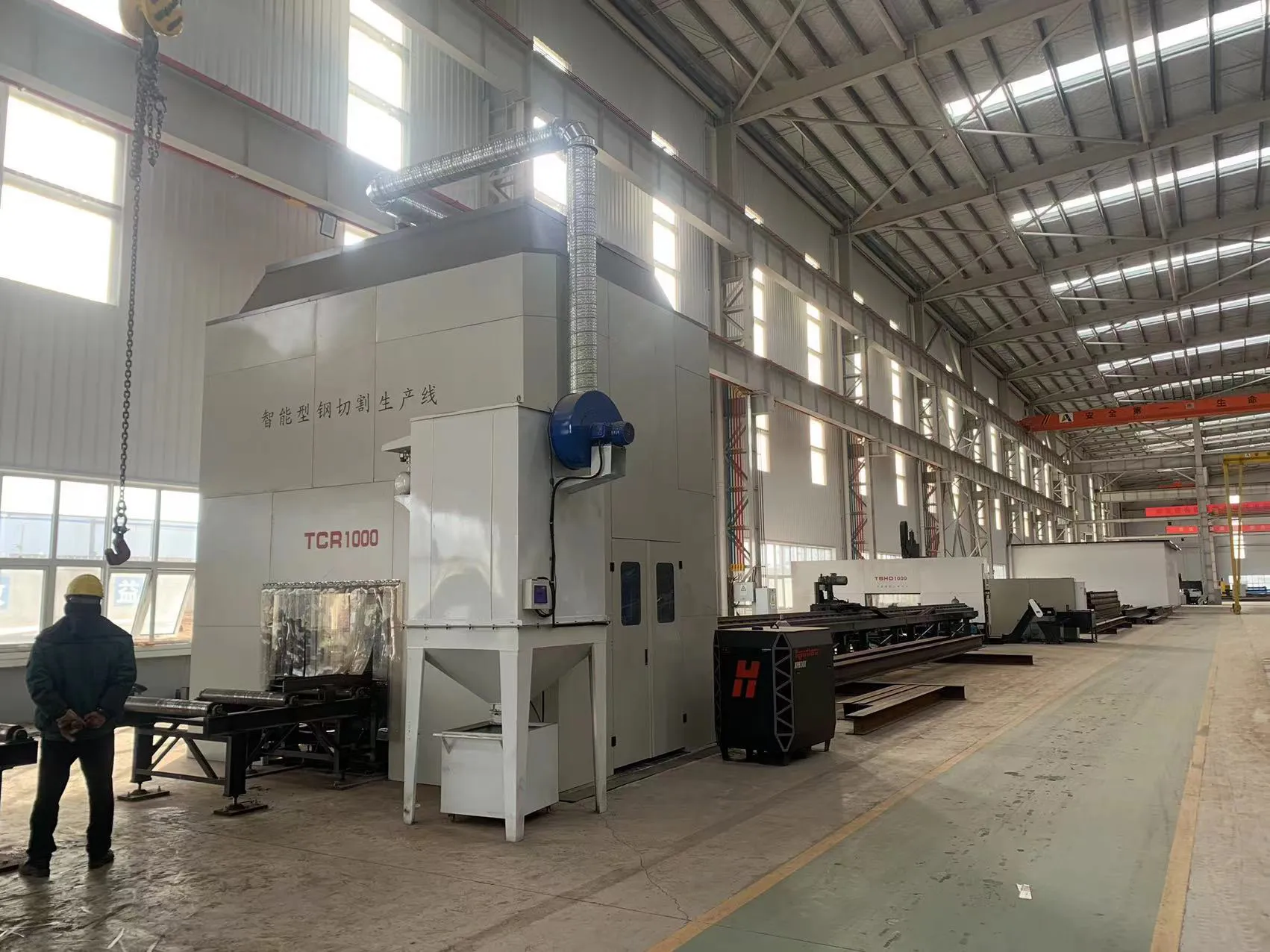
Furthermore, the hollow nature of the tube-welded design allows for superior integration of partitioned dust extraction systems. At 40kW, the volume of molten metal and fumes generated is substantial. A well-engineered bed uses the internal structural voids to facilitate high-velocity airflow, maintaining a clean environment and protecting the precision optical components from contamination.
40kW Performance Metrics: Redefining Carbon Steel Processing
Carbon steel is the backbone of automotive structural components, chassis parts, and heavy-duty brackets. The jump to 40kW power changes the physics of how this material is cut. Traditionally, thick carbon steel required oxygen-assisted cutting, which is limited by the chemical reaction speed of iron oxidation.
With 40kW of power, engineers can utilize High-Pressure Air Cutting or Nitrogen Cutting on carbon steel thicknesses that previously required oxygen. This offers three distinct advantages:
1. Speed: 40kW systems can cut 20mm carbon steel up to 300% faster than 12kW systems. In a high-volume Monterrey facility, this translates to tripling the output per square meter of floor space.
2. Edge Quality: High-power air cutting results in a smaller Heat-Affected Zone (HAZ). This preserves the metallurgical integrity of the carbon steel, which is critical for components undergoing subsequent welding or fatigue-loading.
3. Oxide-Free Surfaces: When using nitrogen or high-pressure air, the cut edge remains free of the oxide layer typical of oxygen cutting. This eliminates the need for secondary grinding or pickling before painting or welding, significantly reducing labor costs.
For thicknesses exceeding 30mm, 40kW power allows for “Bright Surface” oxygen cutting. By precisely controlling the laser’s power density and gas flow, the system produces a mirror-like finish on the cut edge, maintaining perpendicularity tolerances within ±0.1mm per 10mm of thickness.
Precision Dynamics and Motion Control Systems
Power without control is inefficient. To harness 40kW, the machine must utilize a motion control system capable of sub-millisecond response times. The precision of these systems in the Monterrey market is driven by high-end servo motors (typically Yaskawa or Delta) paired with precision helical rack and pinion sets.
The mechanical synchronization is managed by advanced CNC software, such as the HypCut or CypCut series, which features specialized algorithms for 40kW applications. These include:
– Leapfrog Processing: Minimizing the lift-and-drop time of the cutting head between contours, which can save hours of cycle time over a weekly production run.
– Active Anti-Collision: Using capacitive sensors to detect plate tipping in real-time, preventing damage to the expensive 40kW cutting head.
– Frequency-Shift Piercing: A multi-stage piercing process that uses variable frequency and power to “drill” through thick carbon steel in seconds without creating “crater” deformations.
Thermal Management in High-Output Environments
One of the most significant engineering challenges of a 40kW system is heat. The laser source itself, the cutting head, and the optical fibers generate massive amounts of thermal energy. A professional-grade system for the Monterrey market must be equipped with a dual-circuit industrial chiller.
The first circuit stabilizes the temperature of the fiber laser source, typically maintaining a window of ±0.5°C to ensure wavelength stability. The second circuit cools the cutting head optics. At 40kW, even 0.1% absorption of laser energy by a lens can lead to thermal lensing—a phenomenon where the lens deforms slightly, shifting the focus and ruining the cut. Advanced 40kW heads utilize “intelligent cooling” where water channels are integrated directly into the lens housing and the nozzle assembly.
Integration into Monterrey’s Automotive Supply Chain
For factory owners in Nuevo León, the 40kW laser is not just a tool; it is a strategic asset for “nearshoring” initiatives. As US-based OEMs look to shorten supply chains, Monterrey-based shops with 40kW capabilities can take on work that was previously outsourced to specialized heavy-plate processors.
The ability to handle “Tube and Plate” configurations on a single standardized bed further enhances flexibility. While the primary bed focuses on large carbon steel sheets, integrated rotary axes allow for the processing of structural tubing used in vehicle frames and roll cages. This versatility reduces the need for multiple machines, lowering the Total Cost of Ownership (TCO).
Data-Driven ROI: The Economics of 40kW
While the initial capital expenditure (CAPEX) for a 40kW system is higher than a 12kW or 20kW unit, the Operational Expenditure (OPEX) per part is significantly lower.
Consider a standard 25mm Carbon Steel bracket:
– 12kW System: Cutting speed of 0.8 m/min. Gas consumption (Oxygen) is high due to slow transit.
– 40kW System: Cutting speed of 3.5 m/min. Gas consumption per meter is reduced by 60% because the laser moves through the material four times faster.
When factoring in the reduction in secondary processing (grinding) and the ability to run 24/7 with an automated exchange table, most Monterrey-based facilities report a Return on Investment (ROI) within 14 to 18 months.
Technical Specifications for Engineering Evaluation
For engineers performing a technical audit of 40kW systems, the following parameters serve as the benchmark for “Precision Grade” equipment:
– Laser Source: Fiber Laser (IPG, Raycus, or nLIGHT) with a BPP (Beam Parameter Product) optimized for carbon steel.
– Positioning Accuracy: ±0.03mm.
– Repositioning Accuracy: ±0.02mm.
– Maximum Acceleration: 2.0G.
– Bed Material: Q235/Q345 Carbon Steel, Tube-welded and Annealed.
– Cooling System: 80,000 BTU+ Dual-circuit Refrigeration.
– Gas Control: Proportional valves for Nitrogen, Oxygen, and Air with digital pressure monitoring.
Conclusion: The Future of Metal Fabrication in Mexico
The 40kW Precision Laser System is a transformative technology for Monterrey’s industrial sector. By combining the structural integrity of the Tube-welded Standard Bed with the raw power of a 40,000-watt fiber source, manufacturers can achieve levels of productivity that were unthinkable five years ago.
For the automotive factory owner, this system provides the agility to switch between thin-gauge components and heavy structural plates with a single machine. For the engineer, it provides a stable, data-driven platform where precision is guaranteed by mechanical design rather than operator guesswork. As the Monterrey market continues to expand its footprint in the global automotive landscape, the 40kW laser will remain the cornerstone of high-efficiency carbon steel fabrication.
















