Technical Specifications of 30kW Fiber Laser Oscillators
High-Power Beam Dynamics
The 30kW precision laser system represents the pinnacle of high-power density engineering, specifically designed for high-throughput environments. At a 30,000-watt output, the fiber laser source utilizes a multi-module architecture where several 2kW to 4kW modules are combined via a high-power combiner into a single delivery fiber. For kitchenware manufacturing, the beam quality ($M^2$) is maintained typically below 1.5, ensuring a focused spot size that minimizes the Heat Affected Zone (HAZ). This power level is critical for maintaining high feed rates on galvanized steel, where the reflective nature of the zinc coating and the base carbon steel requires significant energy to initiate and maintain the melt pool.
Power Stability and Modulation
Precision in kitchenware—such as industrial sinks and commercial oven linings—requires power stability of $<\pm 1\%$. The 30kW systems utilize active power monitoring that adjusts the pump diode current in real-time to compensate for thermal lensing or aging components. Pulse width modulation (PWM) frequencies up to 50kHz allow for intricate "piercing" sequences, which are essential when starting a cut in the center of a galvanized sheet without causing "zinc-pop" or surface delamination.
Material Interaction: Processing Galvanized Steel
Zinc Vaporization Challenges
Galvanized steel presents a unique challenge in laser cutting due to the disparate melting points of the zinc coating (approx. 419°C) and the steel substrate (approx. 1500°C). When the 30kW beam interacts with the surface, the zinc vaporizes instantly. If the gas dynamics are not perfectly calibrated, this vapor can interfere with the beam path or become trapped in the kerf, leading to porosity or dross. The 30kW threshold allows for “high-speed vaporization,” where the beam moves fast enough that the zinc is cleared by the auxiliary gas before it can contaminate the molten steel.

Auxiliary Gas Optimization
For the kitchenware industry in Leon, where food-grade aesthetics are paramount, the choice of auxiliary gas is critical.
- Nitrogen (15-25 bar): Used for “high-pressure fusion cutting.” Nitrogen prevents oxidation, leaving a clean, silver edge that requires no post-processing before welding or painting. At 30kW, 3mm galvanized steel can be processed at speeds exceeding 45 meters per minute.
- Oxygen (0.5-3 bar): Primarily used for thicker plates, though rarely for kitchenware. Oxygen creates an exothermic reaction, increasing speed but leaving an oxide layer that must be removed for food-safety compliance.
- Compressed Air: A cost-effective alternative for Leon-based shops. With a 30kW source, high-pressure air (up to 30 bar) can achieve speeds comparable to Nitrogen while significantly reducing the cost per part.
Structural Engineering of the CNC Gantry
Acceleration and Jerk Control
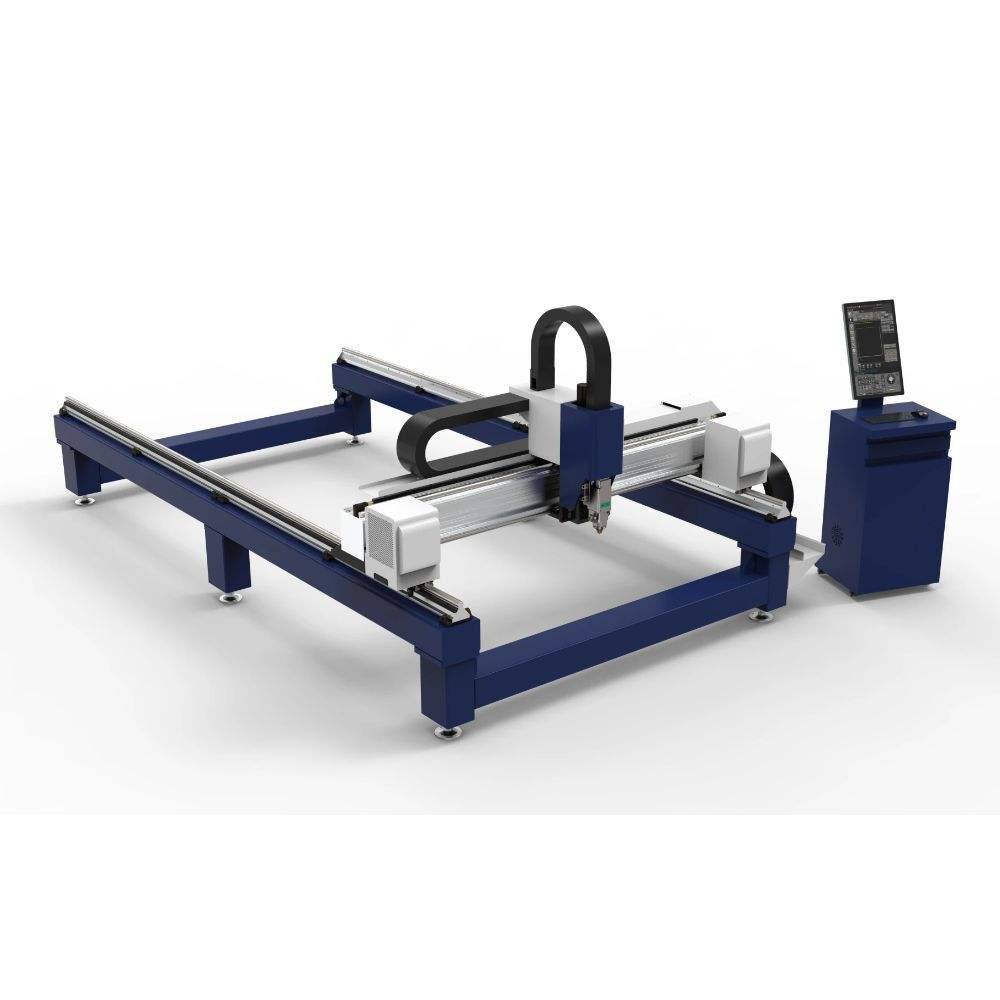
To handle the 30kW output, the machine frame must be exceptionally rigid. In Leon’s high-output kitchenware factories, machines often run 20-hour shifts. The gantry is typically constructed from aerospace-grade extruded aluminum or honeycomb-welded steel to minimize inertia. High-precision linear motors are preferred over rack-and-pinion systems at this power level to achieve accelerations of 2.0G to 4.0G. This ensures that the laser does not linger at corners, which would otherwise lead to “over-burning” on thin galvanized sheets.
Thermal Expansion Mitigation
Operating at 30kW generates significant ambient heat. The machine bed uses a segmented dust extraction system that also acts as a thermal heat sink. The optical head is equipped with dual-circuit water cooling—one for the protective windows and one for the collimating/focusing lenses. In the climate of Leon, Guanajuato, where ambient temperatures can fluctuate, integrated industrial chillers must maintain the deionized water within $\pm 0.5^\circ C$ to prevent beam shift.
Kitchenware Application Specifics
Precision for Commercial Grade Equipment
Leon’s industrial sector focuses heavily on professional kitchen equipment, including stainless and galvanized components for refrigeration and food preparation. The 30kW system allows for the nesting of complex parts with tolerances of $\pm 0.03mm$. This precision is vital for “slot-and-tab” assembly methods, which reduce the need for manual jigging and excessive welding.
Edge Quality and Food Safety
In kitchenware, a burr-free edge is not just an aesthetic requirement but a safety one. The high power density of a 30kW laser cutting process ensures that the dross (residual slag) is virtually non-existent. The kinetic energy of the high-pressure gas, combined with the high-fluidity melt pool created by the 30kW beam, results in a surface roughness ($Ra$) of less than 6.3 microns on galvanized edges.
Integration with Leon’s Manufacturing Ecosystem
Altitude and Atmospheric Considerations
Leon sits at approximately 1,815 meters above sea level. This altitude results in lower atmospheric pressure, which affects the cooling efficiency of air-cooled components and the density of compressed air used in the cutting process. Engineering a 30kW system for this region requires oversized air compressors and dryers to ensure that the “Effective Pressure” at the nozzle remains consistent with sea-level specifications. Furthermore, the electrical grid in the Bajío region can experience fluctuations; therefore, 30kW systems are integrated with high-capacity Voltage Regulators and UPS systems to protect the sensitive laser diodes.
Software and Nesting Efficiency
To maximize the ROI of a 30kW system, advanced CAD/CAM software is employed. Features such as “Common Line Cutting” and “Fly-Cutting” are essential. Fly-cutting allows the laser head to move in a continuous grid, pulsing the beam at high speeds without stopping at each hole. For kitchenware panels with numerous ventilation perforations, this can reduce processing time by up to 60% compared to traditional 6kW systems.
Optical Head Technology and Maintenance
Auto-Focus and Beam Shaping
The 30kW cutting head features automated focus adjustment, where the internal lens moves via a high-speed servo motor to find the optimal focal point based on the material thickness sensed by the capacitive nozzle. For galvanized steel, “Beam Shaping” technology is often utilized to change the energy distribution from a Gaussian (pointed) profile to a “Ring” or “Donut” profile. This wider energy distribution is more effective at vaporizing the zinc coating over a broader area, preventing it from re-depositing on the cut edge.
Protective Window Monitoring
At 30kW, even a microscopic speck of dust on the protective window can lead to catastrophic thermal failure. Modern systems include “Cover Glass Monitoring” sensors that detect back-reflection and temperature increases in the optics. In the dusty environments typical of heavy industrial zones in Leon, these systems are paired with positive-pressure HEPA filtration inside the laser cabinet to ensure the optical path remains pristine.
Gas Dynamics and Nozzle Design
Nozzle Geometry for Galvanized Sheets
The nozzle is the final interface between the laser and the workpiece. For high-power 30kW applications, “Double-Layer” nozzles are standard. The inner nozzle directs the laser beam and the high-pressure gas, while the outer nozzle creates a secondary curtain of gas to stabilize the airflow and shield the optics from splashes. This is particularly important when processing galvanized steel, as the zinc “spatter” is more volatile than standard carbon steel.
Consumption Metrics
Operating a 30kW system requires a robust gas infrastructure. For a kitchenware factory in Leon, this typically involves a bulk liquid Nitrogen tank. At full capacity, the system may consume between 40 and 80 cubic meters of Nitrogen per hour depending on the material thickness and nozzle diameter (typically 1.5mm to 3.0mm for this power range).
Calibration and Quality Control Protocols
Beam Alignment Verification
Daily calibration involves a “Tape Test” or a digital beam profiler to ensure the beam is centered perfectly within the nozzle orifice. Even a 0.1mm misalignment at 30kW can result in asymmetrical edges and accelerated nozzle wear.
Metric-Based Performance Tracking
Leon-based manufacturers utilize OEE (Overall Equipment Effectiveness) tracking integrated into the CNC. Key performance indicators for a 30kW laser cutting system include:
- Piercing Time: Should be $<0.1$ seconds for galvanized steel up to 6mm.
- Nozzle Life: Targeted at 8-12 hours of continuous cutting.
- Gas Ratio: Monitoring the liters of gas consumed per meter of cut to optimize cost.
Safety and Environmental Compliance
Class 4 Radiation Protection
The 1070nm wavelength of fiber lasers is invisible and highly dangerous to human eyesight. A 30kW system requires a fully enclosed Class 1 safety housing with OD6+ rated observation windows. In accordance with Mexican NOM (Normas Oficiales Mexicanas) and international safety standards, the system is equipped with interlocked doors and light curtains to prevent operation if the enclosure is breached.
Fume Extraction and Filtration
Processing galvanized steel releases zinc oxide fumes, which are toxic if inhaled (causing “metal fume fever”). The engineering setup in Leon must include a high-volume dust collector with a minimum airflow of 8,000 $m^3/h$. The filters must be PTFE-coated to prevent the fine, sticky zinc particles from clogging the media, ensuring consistent suction and a clean working environment for the operators.