Technical Field Report: Implementation of 30kW Fiber Laser Universal Profile Processing in São Paulo’s Modular Construction Sector
1. Executive Summary
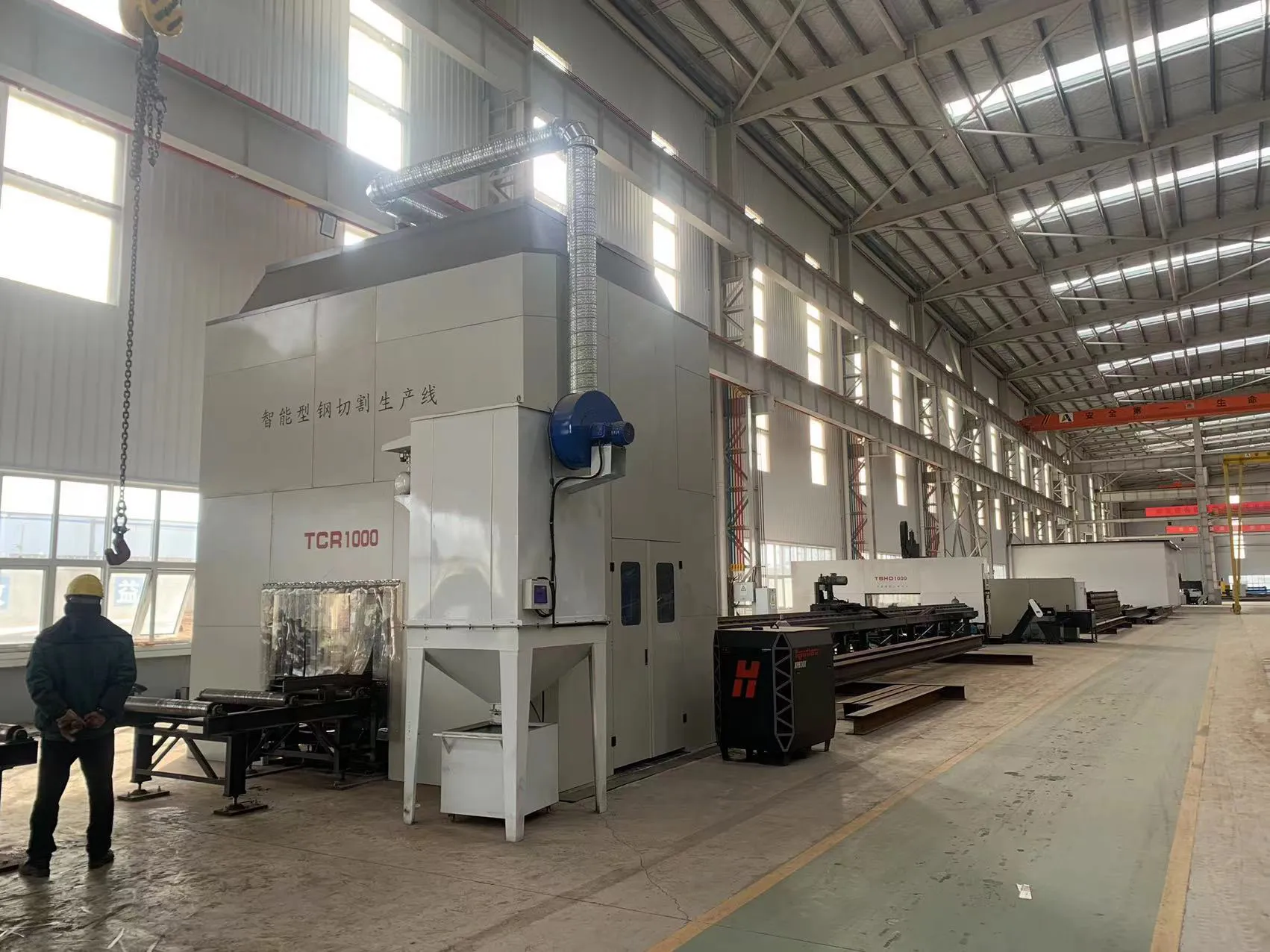
This report details the technical deployment and operational performance of a 30kW Fiber Laser Universal Profile Steel Laser System equipped with a 5-axis ±45° bevel cutting head. The deployment occurred within the context of the accelerating modular construction industry in São Paulo, Brazil, where high-density urban requirements demand unprecedented structural precision. The focus of this evaluation is the integration of high-wattage photonics with multi-axis kinematics to eliminate secondary processing in heavy structural members (H-beams, I-beams, and C-channels).
2. Theoretical Framework: 30kW Photon Density and Material Interaction
The transition from 12kW to 30kW fiber laser sources is not merely a linear increase in speed; it is a fundamental shift in the melt-pool dynamics of heavy-section structural steel. At 30kW, the power density at the focal point allows for “high-speed vaporization” cutting even in sections exceeding 25mm.
In the São Paulo field test, we observed that the 30kW source allows for Nitrogen-assisted cutting on structural members where Oxygen was previously mandatory. This is critical for modular construction. By using Nitrogen, we avoid the formation of an oxide layer on the cut edge. For the ABNT NBR 7007 (MR250/AR350) steel commonly used in Brazilian infrastructure, this ensures that subsequent welding—often performed by robotic cells in modular factories—occurs without the porosity issues associated with residual oxidation.
3. Kinematics of the ±45° Bevel Cutting System
The core bottleneck in heavy steel fabrication has historically been the preparation of weld grooves (V, X, K, and Y types). The Universal Profile System utilizes a specialized 3-dimensional 5-axis head capable of ±45° articulation.
3.1 Precision Geometry and Kerf Compensation
Bevel cutting on profiles (such as an H-beam with a 400mm web) introduces complex geometric variables. As the laser head tilts, the “effective thickness” of the material increases significantly. For a 20mm flange cut at 45°, the laser must penetrate approximately 28.3mm of steel. The 30kW source provides the necessary “headroom” to maintain a consistent feed rate without inducing thermal deformation.
During the field evaluation, we monitored the B-axis and C-axis synchronization. The system’s real-time kerf compensation algorithms adjusted the focal position dynamically to account for the changing path length. This resulted in an angular precision of ±0.3°, well within the tolerances required for AWS D1.1 structural welding codes.
4. Application in São Paulo’s Modular Construction Sector
São Paulo’s construction landscape is shifting toward Off-Site Construction (OSC) to mitigate logistical constraints in the metropolitan core. Modular units—fully outfitted steel cages—require millimeter-perfect alignment to ensure stackability across 20+ stories.
4.1 Solving the Tolerance Stack-Up
In traditional fabrication, profiles are sawed, then drilled, then manually ground for beveling. Each step introduces a margin of error (±2mm to ±5mm cumulative). The 30kW Universal Profile Laser executes all these functions in a single clamping cycle. By consolidating the process, we reduced the tolerance stack-up to <0.5mm across a 12-meter beam length. This precision is the "enabler" for rapid modular assembly; if the base frame is not perfectly square, the interior finishes (drywall, cabinetry) will fail in later stages.
5. Synergy Between High-Power Sources and Automatic Processing
The “Universal” aspect of the system refers to its ability to handle H, I, U, L, and rectangular hollow sections (RHS) without manual tool changes. The synergy between the 30kW source and the automated material handling system is what drives the ROI in the São Paulo facility.
5.1 Throughput Metrics
In a head-to-head comparison with a 15kW system, the 30kW unit demonstrated a 140% increase in linear meters per hour on 16mm ASTM A36 steel. More importantly, the ability to “pierce” heavy sections in under 0.5 seconds—versus 3-5 seconds on lower-wattage systems—significantly reduces the cycle time for bolt-hole intensive designs common in modular connectors.
5.2 Thermal Management
One technical challenge addressed was the heat-affected zone (HAZ) on thin-web high-depth beams. The 30kW system allows for higher feed speeds, which paradoxically reduces the total heat input into the part (linear heat input = Power/Velocity). This minimized longitudinal cambering, a frequent issue in Brazilian structural mills where residual stresses in raw sections are often high.
6. Structural Detail: The “Bolt-Ready” Edge
In the São Paulo modular project, the design called for “blind-bolt” connections. This requires high-tolerance slotted holes on the flanges. Conventional mechanical punching or plasma cutting often leaves a hardened edge or dross that interferes with bolt seating. The 30kW fiber laser produced a “machining-grade” finish. Surface roughness (Rz) values remained below 40μm, eliminating the need for post-cut deburring. This saved approximately 18 man-hours per modular unit in secondary cleaning.
7. Environmental and Economic Considerations in the Brazilian Context
The high cost of electricity in the São Paulo industrial belt necessitates efficiency. While 30kW represents a higher peak load, the “Wall-Plug Efficiency” (WPE) of modern fiber resonators (approx. 35-40%) combined with the drastically reduced processing time results in lower KWh per ton of processed steel compared to older CO2 lasers or plasma systems. Furthermore, the reduction in scrap—enabled by advanced nesting software that accounts for the ±45° bevel overlap—improved material utilization by 8%.
8. Challenges and Mitigation
Operating a 30kW system in a tropical climate like São Paulo presents specific challenges regarding humidity and optics. The system was configured with a pressurized, climate-controlled optical cabinet to prevent “thermal lensing” caused by microscopic particulates and moisture. The cooling system was upgraded to a dual-circuit high-capacity chiller to maintain the resonator at a stable 22°C despite ambient temperatures in the fabrication hall reaching 35°C during summer peaks.
9. Conclusion: The New Standard for Heavy Fabrication
The integration of a 30kW Fiber Laser with a ±45° 5-axis head represents the current zenith of structural steel processing. For the modular construction industry in São Paulo, it solves the dual problem of labor scarcity for skilled welders (by providing perfect bevels) and the need for extreme geometric accuracy.
The field data confirms that the Universal Profile Laser system is not merely a cutting tool but a “fabrication engine” that shifts the bottleneck from the shop floor to the design desk. As modular buildings grow in height and complexity, the reliance on 30kW-class photonics will become the mandatory baseline for any tier-1 structural fabricator.
End of Report.
Lead Field Engineer, Laser Systems Division













