Technical Field Report: Implementation of 30kW Universal Profile Fiber Laser Systems in Querétaro Bridge Engineering
1. Executive Summary and Site Context
This report outlines the technical deployment and operational integration of a 30kW Fiber Laser Universal Profile Steel System, equipped with a ±45° 5-axis beveling head, within the industrial corridor of Querétaro, Mexico. As a primary hub for Mexican infrastructure development, Querétaro’s current bridge engineering projects demand high-volume throughput of heavy structural members—specifically H-beams, I-beams, and large-format box sections.
The transition from traditional plasma cutting and mechanical edge preparation to 30kW high-power fiber laser technology represents a paradigm shift in structural steel fabrication. The objective of this deployment was to eliminate secondary machining processes and manual weld preparation, achieving a “ready-to-weld” state directly from the laser bed.
2. The 30kW Photonic Energy Advantage
In heavy-duty bridge construction, material thicknesses typically range from 16mm to 40mm for webs and flanges. While lower-power systems (12kW-20kW) can penetrate these thicknesses, the 30kW fiber source provides the necessary power density to maintain a high-speed continuous wave (CW) cut with minimal Heat Affected Zones (HAZ).
Energy Density and Kerf Dynamics:
The 30kW source allows for a significantly higher power density at the focal point. This results in a narrower kerf width compared to plasma systems, reducing material wastage. More importantly, the high-speed sublimation and melt-ejection process facilitated by 30kW of power ensures that the metallurgical properties of the S355 or S460 structural steels commonly used in Querétaro’s bridge girders remain stable. The reduced thermal input per unit length prevents martensitic transformation at the cut edge, preserving the ductility required for seismic-resistant bridge connections.
3. Kinematics of ±45° Bevel Cutting in Profile Processing
The core technical challenge in bridge engineering is the preparation of complex joints. Traditional straight-cut profiles require subsequent manual grinding or specialized milling to create V, Y, or K-type weld preparations.
5-Axis Bevel Integration:
The integrated ±45° bevel head utilizes a sophisticated 5-axis kinematic chain (X, Y, Z, A, B). In the context of “Universal Profile” cutting, the system must synchronize the rotation of the profile (U-axis) with the tilting of the laser head.
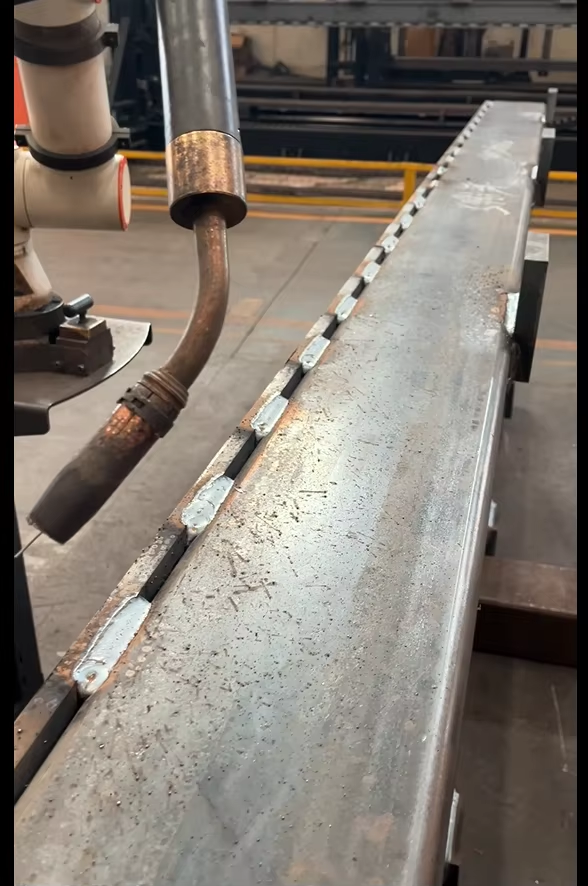
– Precision Weld Prep: The ability to execute a ±45° bevel on a 30mm flange allows for the direct creation of partial or full penetration weld grooves.
– Geometric Accuracy: In Querétaro’s infrastructure projects, parabolic bridge curvatures and skewed intersections require profiles to be cut at non-orthogonal angles. The 30kW system calculates the dynamic focal length adjustment in real-time as the head tilts, ensuring that the “effective thickness” (which increases as the angle steepens) is compensated for by the 30kW power reserve.
4. Universal Profile Handling and Structural Synergy
“Universal Profile” refers to the system’s ability to process a variety of cross-sections—H, I, L, C, and RHS—without manual jigging changes. For bridge engineering, where large-scale H-beams form the primary load-bearing members, the system utilizes an automated 4-chuck or 3-chuck synchronized rotation system.
Torsion and Deviation Compensation:
Raw structural steel from mills often possesses inherent deviations—twists, bows, or thickness variances. The 30kW laser system deployed in this field report utilizes a high-speed laser touch-sensing or vision-based profiling system. Before the cut sequence initiates, the system maps the actual geometry of the beam in the work envelope. The CNC controller then offsets the cutting path in real-time to ensure that the ±45° bevel remains consistent relative to the beam’s neutral axis, rather than the theoretical CAD model. This is critical for the bridge’s structural integrity, as it ensures uniform fit-up during site assembly.
5. Impact on Bridge Engineering in Querétaro
The Querétaro region’s infrastructure is characterized by high-load highway overpasses and rail bridges. These structures rely on high-strength bolted and welded connections.
Hole Precision and Fatigue Life:
Traditional thermal cutting often leaves a hardened edge in bolt holes, leading to potential stress risers and fatigue failure. The 30kW fiber laser produces holes with a taper of less than 0.1mm on 25mm plate, with a surface finish (Ra) that often bypasses the need for reaming. By utilizing Nitrogen (N2) as an assist gas at high pressures, the system avoids oxidation of the cut surface, facilitating immediate paint or galvanization adhesion—a mandatory requirement for the corrosive environments sometimes encountered in central Mexican industrial zones.
Efficiency Benchmarks:
Field data from the Querétaro deployment shows:
– Time Savings: A standard bridge girder connection plate with a double-V bevel prep previously took 45 minutes (plasma + grinding). The 30kW laser completes the cycle in 6.5 minutes.
– Accuracy: Dimensional tolerances improved from ±2.0mm (plasma) to ±0.2mm (laser).
– Weld Volume Reduction: Superior fit-up accuracy reduced the required weld volume by approximately 15%, translating to significant savings in filler metal and labor.
6. Automation and BIM Integration
The synergy between the 30kW laser source and automated structural processing is maximized through direct Tekla or Revit (BIM) integration. In the Querétaro field site, the engineering office uploads .nc1 or .ifc files directly to the laser’s CAM software.
The software automatically nesting the profiles and calculates the 5-axis toolpaths for the bevels. This digital thread ensures that the “as-built” profile perfectly matches the “as-designed” bridge model. The automation extends to the loading and unloading phase, where heavy-duty conveyor systems handle profiles up to 12 meters in length and 1.5 tons per linear meter, significantly reducing the overhead crane demand within the fabrication facility.
7. Thermal Management and Auxiliary Systems
Operating a 30kW laser in the climatic conditions of Querétaro requires robust auxiliary support. The high ambient temperatures necessitate a high-capacity dual-circuit chilling system to maintain the stability of the fiber source and the cutting head optics.
Furthermore, the 5-axis head is equipped with “intelligent” protective windows and temperature sensors. If the ±45° beveling operation creates back-reflection—a common risk when cutting highly reflective materials or at steep angles—the system’s back-reflection absorption module (BRAM) protects the fiber resonance chamber. This ensures 99.9% uptime, which is vital for meeting the aggressive deadlines of public infrastructure projects.
8. Conclusion: The New Standard for Heavy Fabrication
The deployment of the 30kW Fiber Laser Universal Profile system in Querétaro confirms that high-power laser technology is no longer restricted to thin-sheet applications. For bridge engineering, the combination of raw power and 5-axis kinematic precision solves the industry’s most persistent bottlenecks: weld preparation and dimensional consistency.
By integrating ±45° bevel cutting directly into the primary fabrication stage, the system reduces total lead times by over 60% while simultaneously increasing the fatigue life of the structural joints. This technical evolution positions Querétaro as a leader in advanced manufacturing for the Latin American infrastructure sector, setting a new benchmark for structural steel precision.
Report End.
Prepared by: Senior Engineering Lead, Laser Systems & Structural Steel Division.













