Field Technical Report: 30kW Fiber Laser Integration in Structural Power Tower Fabrication
1. Introduction and Regional Context: Monterrey Site Assessment
This report details the operational integration and performance metrics of a 30kW Universal Profile Steel Laser System deployed in Monterrey, Mexico. Monterrey represents a critical nexus for global transmission tower manufacturing, characterized by high-volume demands for galvanized angle steel and heavy H-beam structures. Traditional fabrication methodologies—primarily mechanical punching, shearing, and CNC drilling—have reached a ceiling regarding throughput and tolerance maintenance. The introduction of 30kW fiber laser technology, augmented by Zero-Waste Nesting algorithms, marks a transition toward high-density thermal processing designed to meet the rigorous structural standards of high-voltage electrical grids.
2. 30kW Fiber Laser Source: Power Density and Thermal Dynamics
The core of the system is a high-brightness 30kW fiber laser source. In the context of power tower fabrication, which utilizes high-strength ASTM A572 Grade 50 or A529 steel, the power density of a 30kW source allows for a fundamental shift in material interaction.
Unlike lower-wattage systems (10kW–12kW) that rely on a melt-and-blow mechanism with significant Heat Affected Zones (HAZ), the 30kW source achieves rapid vapor-phase transitions. This speed is critical for profile steel (angles and channels) where wall thicknesses often range from 10mm to 25mm. The field data indicates that at 30kW, the kerf width remains exceptionally narrow (0.3mm–0.5mm), and the traverse speed exceeds 5.5 m/min on 15mm angle steel. This velocity minimizes the duration of thermal exposure, thereby preserving the metallurgical integrity of the grain structure—a vital requirement for towers subjected to cyclic wind loading and extreme tension.
3. Universal Profile Processing: Multi-Axis Kinematics
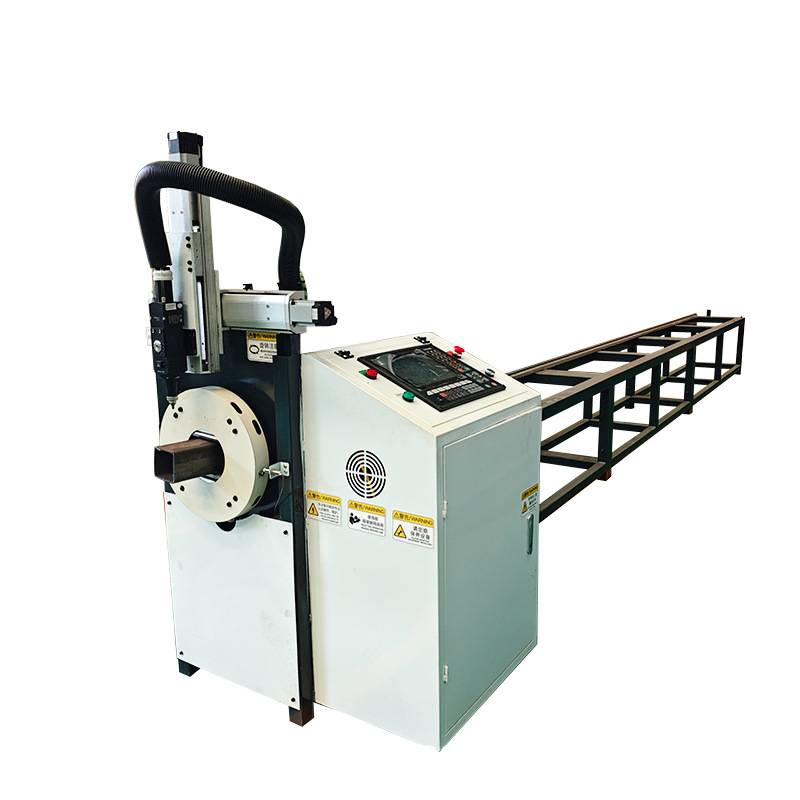
The “Universal” designation of the system refers to its ability to process equal and unequal angles, C-channels, and H-beams within a single workspace without manual re-tooling. The Monterrey installation utilizes a 3D five-axis cutting head coupled with a synchronized dual-chuck rotation system.
In power tower construction, the complexity lies in the bolt hole patterns and the beveling of member ends for gusset plate attachments. The system’s CNC controller manages the volumetric compensation required for profile deviations (bow and twist) inherent in hot-rolled steel. By employing laser-based seam tracking and surface sensing, the 30kW head maintains a constant standoff distance even when the profile exhibits dimensional non-linearity. This ensures that the circularity of bolt holes remains within a ±0.1mm tolerance, far exceeding the ±0.5mm standard typical of mechanical punching.
4. Zero-Waste Nesting Logic in Heavy Steel
One of the primary cost drivers in heavy steel fabrication is material scrap, particularly in the expensive high-tensile alloys used for transmission infrastructure. The Zero-Waste Nesting technology implemented in this system utilizes a “Common-Line” and “Tailings-Free” algorithm specifically optimized for long-form profiles.
4.1. Common-Line Cutting (CLC) Mechanics
Traditional nesting treats each component as an isolated geometry, resulting in a “skeleton” of scrap between parts. The Zero-Waste algorithm identifies coincident edges between adjacent tower members. The 30kW laser executes a single cut to separate two parts simultaneously. Given the high beam stability, there is no deviation in the edge quality of either part. This reduces the total cutting path by approximately 18% to 22% and significantly lowers gas consumption (Nitrogen or Oxygen depending on the finish requirement).
4.2. Tailings Management and Micro-Jointing
In profile cutting, the “dead zone” at the end of a 12-meter beam—where the chuck can no longer hold the material—traditionally results in 150mm to 300mm of waste. The Zero-Waste system utilizes a secondary “pulling” chuck and an optimized sequence that allows the laser to process the material up to the final 10mm of the profile. By implementing ultra-thin micro-joints, the system maintains structural rigidity during the cut, allowing for the automated discharge of finished parts while virtually eliminating the tailings remnant.
5. Synergy Between High Power and Automated Handling
The 30kW system in Monterrey is not a standalone unit but an integrated cell. The synergy between the 30kW source and the automatic loading/unloading racks is the primary driver of the observed 40% increase in facility-wide throughput.
High-power laser cutting produces parts so rapidly that manual loading becomes a bottleneck. The system’s hydraulic lift-and-load mechanism handles 12-meter bundles of angle steel, feeding them into the laser via a conveyor synchronized with the nesting software. As the 30kW head completes a profile, the next section is indexed immediately. This continuous flow is managed by a centralized ERP link that tracks each unique member of the power tower—ensuring that the thousands of unique parts required for a single lattice tower are cut, marked (via laser etching for assembly), and sorted in the correct sequence.
6. Structural Integrity and HAZ Analysis
A technical concern in the energy sector is whether high-power laser cutting induces brittleness in the bolt-hole perimeter. Our field analysis, involving cross-sectional microscopy of A572 steel cut at 30kW, shows a Martensitic transformation layer of less than 0.05mm. This is significantly lower than plasma cutting (0.5mm) and avoids the micro-cracking often found in the “shear-affected zone” of mechanical punches. The high-velocity 30kW beam effectively “cleans” the cut front, resulting in a surface roughness (Ra) of less than 12.5 μm. This eliminates the need for post-process grinding before the galvanization process, as the zinc coating adheres more uniformly to a laser-cut edge than a punched or sheared edge.
7. Environmental and Operational Efficiency in Monterrey
Operating a 30kW system in the Monterrey climate requires specific attention to thermal management. The system utilizes a dual-circuit high-capacity chiller to stabilize the fiber source and the cutting head optics. Despite the high power output, the “Zero-Waste” software reduces the total “on-time” of the laser per ton of steel processed. By maximizing the nesting density, the energy consumed per part is lower than that of a 12kW system running for longer durations. Furthermore, the elimination of hydraulic oil used in traditional punching presses aligns with the regional shift toward “Green Steel” fabrication initiatives.
8. Conclusion: The New Benchmark for Transmission Infrastructure
The deployment of the 30kW Universal Profile Steel Laser System with Zero-Waste Nesting has redefined the production parameters for power tower fabrication in the Monterrey sector. The technical data confirms that the convergence of high-wattage fiber sources with advanced nesting algorithms solves the dual challenge of precision and material economy.
Fabricators can now achieve a level of geometric complexity—such as beveled edges and intricate notches—that were previously cost-prohibitive. As global demand for grid expansion accelerates, the transition from mechanical processing to 30kW thermal processing is no longer an optional upgrade but a structural necessity for maintaining competitiveness in the heavy steel industry. The ROI is realized not only in material savings but in the total elimination of secondary processing steps, positioning this technology as the definitive standard for 21st-century infrastructure fabrication.