The Dawn of the 30kW Era in Structural Fabrication
For decades, the structural steel industry relied on plasma cutting or mechanical sawing and drilling. While functional, these methods lacked the surgical precision required for the burgeoning modular construction sector. The advent of the 30kW fiber laser has fundamentally rewritten the rules of what is possible. As a fiber laser expert, I have witnessed the transition from 6kW to 12kW, and now to the 30kW “sweet spot.”
At 30kW, the power density of the laser beam is so intense that it transitions from merely “melting” metal to “vaporizing” it with extreme efficiency. In the context of universal profile steel—which includes heavy H-beams, wide-flange I-beams, and thick-walled rectangular hollow sections (RHS)—the 30kW source provides the ability to pierce 50mm carbon steel in a fraction of a second. This power level allows for high-speed cutting with nitrogen or compressed air, resulting in a clean, oxide-free edge that is weld-ready immediately after the cut. For modular construction, where components must fit together with the precision of a Swiss watch, this level of edge quality is non-negotiable.
Universal Profile Processing: Beyond Flat Sheet Cutting
The “Universal Profile” designation refers to the system’s ability to handle the full spectrum of structural shapes used in modern architecture. Traditional lasers were limited to flat sheets. However, the systems currently being deployed in Monterrey feature multi-axis 3D cutting heads and sophisticated chuck systems that can rotate and feed profiles up to 12 meters in length.
A universal profile system equipped with a 30kW source can execute complex bevels, miter cuts, and interlocking “tab-and-slot” geometries on heavy beams. In modular construction, the complexity of the joint determines the speed of assembly. With a 30kW laser, we can cut “Bird’s Mouth” joints or complex copes into heavy steel sections that allow modules to snap together on-site. This eliminates the need for manual layout, jigging, and grinding, effectively moving the “intelligence” of the construction process from the job site to the fabrication shop.
Why Monterrey? The Nearshoring Epicenter for Modular Steel
Monterrey, Mexico, has solidified its reputation as the “Sultan of the North” for industrial manufacturing. Its proximity to the United States, combined with a robust domestic steel industry (led by giants like Ternium), makes it the ideal location for high-capacity laser centers.
The modular construction market in North America is demanding faster turnaround times and lower carbon footprints. By installing 30kW universal profile lasers in Monterrey, companies can leverage a highly skilled engineering workforce and a seamless supply chain. The region’s expertise in automotive manufacturing has bled into the structural sector, meaning the technicians operating these 30kW systems understand the rigorous tolerances required for “plug-and-play” modular units. Furthermore, the logistical advantage of shipping pre-cut, precision-indexed steel kits from Monterrey to major construction sites in Texas, Arizona, or California provides a significant competitive edge over traditional overseas fabrication.
The Science of Zero-Waste Nesting
One of the most significant advancements in these systems is the integration of AI-driven nesting software. In traditional fabrication, structural steel scrap rates can hover between 10% and 15%. When dealing with thousands of tons of steel for a modular high-rise, this waste represents a massive financial and environmental burden.
Zero-waste nesting algorithms work by analyzing the entire production queue rather than individual jobs. The software identifies smaller components—such as gussets, base plates, or connection brackets—and “nests” them into the “skeletons” or web-sections of larger beams that would otherwise be discarded.
The 30kW laser is crucial here because it allows for “common-line cutting.” Because the kerf (the width of the cut) is so narrow—often less than 0.5mm—two parts can share a single cut line. This is much more difficult with plasma, where the heat-affected zone (HAZ) and wider kerf require significant spacing between parts. By minimizing the spacing and utilizing every square millimeter of the profile, Monterrey-based fabricators are achieving material utilization rates exceeding 98%. In the era of “Green Building” certifications, this zero-waste approach is a powerful selling point.
Precision Engineering for Modular Efficiency
Modular construction relies on the concept of “Design for Manufacture and Assembly” (DfMA). In this paradigm, the building is treated like a product rather than a one-off project. The 30kW fiber laser is the ultimate tool for DfMA.
When cutting structural profiles, the laser system can simultaneously cut bolt holes, service openings for HVAC, and even etch part numbers or assembly instructions directly onto the steel. The accuracy of these holes is typically within ±0.1mm. This means that when a module is being assembled in a factory in Monterrey, the bolts slide through the holes without the need for reaming. When those modules are stacked on a construction site in a city like Denver or New York, the vertical alignment is perfect.
This level of precision also enables the use of “blind bolts” and other advanced fastening systems that are critical for modular units where access to the interior of a beam may be limited once the walls are installed. The 30kW laser makes these complex apertures possible in thick material that would destroy traditional drill bits or take far too long with lower-power lasers.
Thermal Management and Material Integrity
A common concern with high-power lasers is the heat-affected zone. As an expert, I emphasize that 30kW technology actually *reduces* the HAZ compared to lower-power options. This sounds counterintuitive, but it is due to the speed of the process. Because the 30kW beam travels so fast, the heat has less time to conduct into the surrounding material.
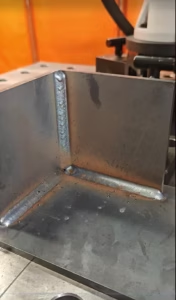
In structural steel, maintaining the metallurgical integrity of the beam is vital for seismic and load-bearing requirements. The rapid cooling and minimal thermal input of a 30kW fiber laser ensure that the steel’s yield strength and ductility remain within specification. This is particularly important for Monterrey’s exporters, who must meet stringent ASTM and AISC standards for the US market. The clean, vertical cuts produced by the fiber laser also ensure better weld penetration, reducing the failure rate of critical joints in the modular frame.
The Future: Integration with BIM and Digital Twins
The 30kW universal profile systems in Monterrey are not standalone machines; they are nodes in a digital ecosystem. Modern systems are directly integrated with Building Information Modeling (BIM) software. A structural engineer in Los Angeles can upload a Revit or Tekla model, and the nesting software in Monterrey can automatically generate the G-code for the laser.
This “File-to-Factory” workflow is the future of construction. It creates a digital twin of every beam cut. If a module is damaged during shipping, the digital twin allows the fabricator to pull the exact specifications and recut a replacement in minutes, knowing it will fit perfectly into the existing assembly. This level of responsiveness is only possible with the speed and reliability of a 30kW fiber source.
Conclusion: A New Standard for Global Construction
The deployment of 30kW Fiber Laser Universal Profile systems in Monterrey represents more than just an upgrade in machinery; it represents a new philosophy in building. By merging the raw power of 30,000 watts of light with the intelligence of zero-waste nesting and the logistical prowess of Northern Mexico, the industry is overcoming the traditional barriers of cost and waste in modular construction.
As modular units become more complex and the demand for high-density, sustainable housing grows, the precision of the fiber laser will be the foundation upon which these structures are built. For the developer, it means faster ROI. For the architect, it means greater design freedom. For the environment, it means a significant reduction in industrial waste. Monterrey has positioned itself at the center of this revolution, proving that the future of construction is not just built—it is laser-cut.