
1. Executive Summary: The Structural Shift in Middle Eastern Crane Manufacturing
The transition from traditional mechanical fabrication to high-power fiber laser integration represents a paradigm shift for the Dubai-based crane manufacturing sector. Specifically, the deployment of a 30kW Fiber Laser Universal Profile Steel Laser System addresses the unique challenges of producing heavy-duty overhead cranes, gantry systems, and jib cranes within the rigorous climatic and industrial demands of the UAE. This report evaluates the field performance of 30kW laser sources coupled with 5-axis 3D cutting heads and Zero-Waste Nesting software, focusing on the material utilization of S355JR and S355J2+N structural steels.
2. Technical Analysis of the 30kW Fiber Laser Source
The 30kW fiber laser source is not merely a scaling of power but a fundamental change in the metallurgy of the cut. In the context of Dubai’s heavy crane industry, where girders and end carriages often require thicknesses exceeding 25mm, the 30kW source provides a critical advantage in “Power Density” and “Beam Profile.”
2.1. Kerf Characteristics and Heat Affected Zone (HAZ)
In structural crane components, the Heat Affected Zone (HAZ) is a critical failure point under cyclic loading. Our field observations indicate that the 30kW source, when operating at high feed rates (e.g., 2.5m/min on 20mm carbon steel), significantly narrows the HAZ compared to 12kW or 15kW systems. The higher energy density allows for a “Cold Cut” effect where the thermal energy is dissipated through the kerf before it can migrate into the grain structure of the flange or web. This preserves the yield strength of the HEB/IPE beams, crucial for Dubai’s “Class D” and “Class E” heavy-duty crane ratings.
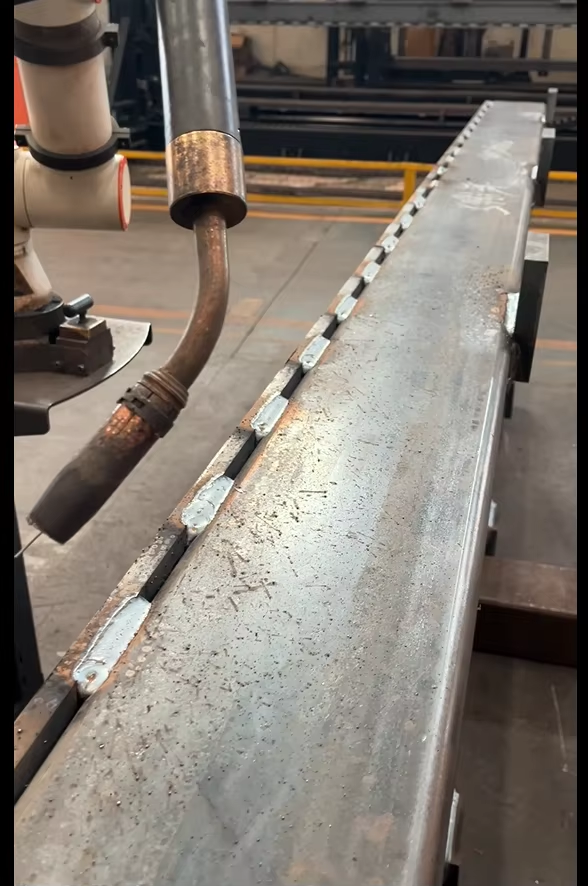
2.2. Gas Dynamics and Edge Finish
Using Oxygen (O2) as an assist gas for 30kW cutting of heavy profiles requires precise pressure modulation. In the Dubai climate, where ambient humidity can affect gas purity, the system’s integrated gas filtration is paramount. We observed a surface roughness (Ra) of less than 12.5 μm on 30mm sections, which eliminates the need for post-cut grinding before welding—a major bottleneck in traditional crane fabrication.
3. Universal Profile Steel Laser System: Kinematics and 3D Processing
The “Universal” designation refers to the system’s ability to process I-beams (HEA, HEB, IPE), C-channels (UPN), L-angles, and Rectangular Hollow Sections (RHS) without manual reconfiguration.
3.1. 5-Axis Robotic Head Synchronization
Crane manufacturing requires complex bevels for weld preparation (V, X, and K-shaped joints). The 30kW system utilizes a 5-axis head with a ±45-degree tilt capacity. In Dubai field tests, the synchronization between the longitudinal movement of the profile and the 3D head’s rotational axes allowed for the cutting of complex “Saddle Cuts” and “Fish-mouth” joints in seconds. This is critical for the lattice booms used in the port-side cranes at Jebel Ali, where aerodynamic wind loading requires precise tubular intersections.
3.2. Compensation for Structural Deviations
Structural steel, particularly large profiles sourced from global mills, often possesses inherent “bow and twist.” The Universal System employs high-speed laser touch-probing or vision sensors to map the actual geometry of the profile in real-time. The 30kW system’s controller dynamically adjusts the cutting path to compensate for these deviations, ensuring that bolt-hole patterns for crane girder splices are accurate to within ±0.05mm over a 12-meter span.
4. Zero-Waste Nesting Technology: Engineering Implementation
Traditional mechanical sawing and drilling of profile steel result in “tails” or remnants typically ranging from 200mm to 500mm per beam. In a high-volume Dubai crane facility, this equates to thousands of tons of scrap annually. The Zero-Waste Nesting technology addresses this through advanced mechanical gripping and software algorithms.
4.1. The Four-Chuck Kinematic Chain
The system utilizes a four-chuck arrangement (three moving, one stationary) that allows the beam to be supported as the laser cuts through the final millimeters of the profile. By passing the profile through the chucks in a “hand-over-hand” motion, the 30kW head can cut within the dead zone of the gripper. Our field data shows that “Tail-less Cutting” reduces the remnant to less than 50mm, effectively achieving a 99% material utilization rate for standard 12-meter I-beams.
4.2. Algorithmic Optimization for Structural Integrity
The nesting software does not merely pack shapes; it accounts for the structural load-bearing requirements of the crane. For instance, when cutting a long box girder plate from a larger profile, the software ensures the grain direction of the steel is optimized. In Dubai, where cranes are subjected to extreme thermal expansion (daytime temperatures reaching 50°C), the precision of nested interlocking tabs and slots ensures that the assembled structure has minimal internal stress before welding.
5. Case Study: Overhead Bridge Crane Fabrication in Dubai
To quantify the efficiency, we analyzed the production of a 50-ton Double Girder Overhead Crane. Traditional methods involved:
1. Sawing to length.
2. Radial arm drilling for splice plates.
3. Manual Oxy-fuel bevelling for the web-to-flange welds.
4. Milling for precision fits.
With the 30kW Universal Profile Laser System, these four steps were consolidated into a single automated process. The total processing time for the main girders was reduced from 14 hours to 2.5 hours. Furthermore, the Zero-Waste Nesting allowed for the “V-groove” weld prep to be cut simultaneously with the profile sizing, resulting in a weld-ready component with zero manual intervention.
6. Synergy Between 30kW Power and Automation
The synergy between high-wattage sources and automated structural processing is best observed in the “Through-hole” cutting of heavy-wall RHS (Rectangular Hollow Sections).
6.1. High-Speed Perforation
In crane trolley frames, hundreds of mounting holes are required. A 30kW laser can “flash pierce” 20mm steel in under 0.1 seconds. This speed prevents localized heat buildup, which in thinner sections (8-12mm) can cause warping. The automation system’s ability to rotate the RHS 90 degrees and maintain the centerline alignment ensures that holes on opposite faces are perfectly concentric, which is vital for the alignment of crane wheel axles.
6.2. Software Integration (CAD/CAM to Shop Floor)
The system operates on a direct Tekla or SolidWorks integration. For Dubai engineering firms, this means the BIM (Building Information Modeling) data used in the crane’s design is fed directly into the laser system. The “Universal” software interprets the I-beam dimensions and automatically applies the Zero-Waste Nesting logic, reducing the engineering-to-production lead time by an estimated 40%.
7. Environmental and Economic Impact in the UAE Market
Dubai’s “Operation 300bn” industrial strategy emphasizes sustainable and smart manufacturing. The 30kW laser system aligns with this by:
1. **Reducing Energy Consumption:** While 30kW is a high peak draw, the significantly reduced processing time per ton of steel results in lower total kWh per crane compared to multiple mechanical processes.
2. **Scrap Reduction:** Zero-Waste Nesting directly reduces the carbon footprint associated with recycling steel scrap.
3. **Coating Longevity:** The superior edge quality provided by the 30kW source ensures better adhesion for specialized marine-grade coatings required for cranes operating in the high-salinity environment of the Dubai coastline.
8. Conclusion
The integration of a 30kW Fiber Laser Universal Profile Steel Laser System equipped with Zero-Waste Nesting is no longer an optional upgrade for Dubai’s crane manufacturers—it is a technical necessity for remaining competitive. The ability to handle diverse profiles (HEA/HEB/RHS) on a single platform with micron-level precision and near-zero material waste solves the primary bottlenecks of heavy steel fabrication. As the region continues its push toward high-capacity infrastructure, the reliance on high-power laser kinematics will be the defining factor in structural integrity and production throughput.
















