The Dawn of 30kW Power in Rosario’s Industrial Corridor
Rosario has long been the heart of Argentina’s metallurgical prowess. Historically driven by agricultural machinery and civil infrastructure, the region’s engineering firms are now facing a global challenge: the need to build larger, more resilient bridges faster and with a lower carbon footprint. The introduction of the 30kW Fiber Laser Universal Profile Steel Laser System is the answer to this call.
In the realm of fiber lasers, 30kW represents a “super-power” threshold. While 10kW or 12kW systems have become standard for medium-gauge work, 30kW allows for the effortless slicing of ultra-thick carbon steels and high-strength alloys—up to 80mm or more—which are the bread and butter of bridge engineering. This isn’t just about raw force; it’s about the energy density of the beam. A 30kW fiber laser concentrates an immense amount of photonic energy into a microscopic spot, allowing for a “keyhole” welding or cutting effect that minimizes the Heat Affected Zone (HAZ). For bridge components like gusset plates and main girders, a smaller HAZ translates to better fatigue resistance and structural longevity.
Universal Profile Processing: Beyond Flat Sheets
Bridge engineering rarely relies on flat plates alone. The complexity of modern cable-stayed or truss bridges involves a sophisticated mix of H-beams, I-beams, U-channels, and heavy-walled square tubing. Traditional fabrication of these profiles involved multiple steps: mechanical sawing to length, manual layout, drilling for bolt holes, and oxy-fuel torching for notches or bevels.
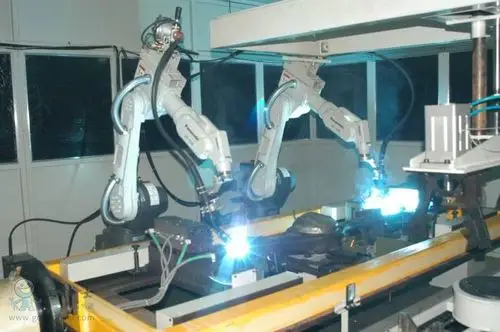
The Universal Profile Steel Laser System revolutionizes this by utilizing multi-axis robotic heads or 5-axis cutting bridges. In a single setup, the 30kW laser can cut a 12-meter I-beam to length, pierce dozens of high-precision bolt holes with tolerances of ±0.1mm, and create complex 45-degree bevels for weld preparation. This consolidation of processes reduces material handling time by up to 70%, a critical factor for large-scale bridge projects in the Santa Fe province where deadlines are often dictated by seasonal river levels and logistical windows.
Zero-Waste Nesting: The Economic Imperative
In large-scale bridge engineering, material costs can account for 60% of the total project budget. Conventional nesting techniques often leave behind “skeletons” of scrap metal that are sold for a fraction of their original cost. The “Zero-Waste” philosophy integrated into this 30kW system utilizes advanced AI-driven CAD/CAM software to optimize every millimeter of the steel profile.
Zero-waste nesting in profile cutting involves sophisticated algorithms that “stitch” parts together. For instance, the end-cut of one bridge brace becomes the starting cut for the next, known as common-line cutting. Furthermore, the software can nest smaller components—like washers or reinforcement tabs—within the “dead zones” of larger cutouts. When dealing with 30kW power, the kerf (the width of the cut) is so narrow and the precision so high that parts can be packed with unprecedented density. For an engineering firm in Rosario, this means the difference between purchasing 100 tons of steel or 85 tons for the same output, directly impacting the competitiveness of their bids for national infrastructure tenders.
Enhancing Structural Integrity for Bridge Engineering
Bridges are dynamic structures subject to constant vibration, wind loads, and thermal expansion. The quality of the cut edge is paramount. Traditional plasma or oxy-fuel cutting creates a rough, serrated edge with significant dross and a deep HAZ that can act as a precursor for stress fractures.
The 30kW fiber laser produces an almost “mirror-like” finish on the cut edge. The high-pressure nitrogen or oxygen assist gas clears the molten metal instantly, leaving a surface that often requires zero post-processing. In bridge engineering, this is vital for fatigue-critical members. When a hole is laser-pierced rather than drilled or punched, the internal walls of the hole are smoother and harder, reducing the likelihood of crack initiation over the 50-to-100-year lifespan of the bridge. Furthermore, the 30kW system’s ability to perform precision beveling ensures that full-penetration welds are more consistent, reducing the failure rate during X-ray or ultrasonic weld inspections.
Rosario’s Strategic Advantage and the “Green” Construction Shift
As Argentina looks toward more sustainable construction practices, the efficiency of the 30kW fiber laser fits the “Green Bridge” initiative. Fiber lasers are significantly more energy-efficient than CO2 lasers, converting more wall-plug power into light. When combined with zero-waste nesting, the environmental impact of the fabrication process is drastically reduced.
For the city of Rosario, becoming a hub for this technology means it can serve not just local projects like the expansion of the Circunvalación or new crossings over the Parana, but also export fabricated steel components to neighboring MERCOSUR partners. The precision of the 30kW system allows for “Lego-like” assembly on-site. Bridge sections can be fabricated in a controlled factory environment in Rosario and transported to the site, where they bolt together with perfect alignment, reducing the need for dangerous and imprecise field-welding.
The Role of AI and Real-Time Monitoring
A 30kW system is a massive investment, and in the industrial sectors of Rosario, uptime is everything. Modern universal profile systems are equipped with “Smart Sensors” that monitor the health of the cutting head, the purity of the gas, and the consistency of the beam in real-time.
If the laser detects a slight deviation in the material’s composition (common in recycled structural steel), it automatically adjusts its frequency and power output to maintain cut quality. This level of automation means that a single operator can oversee the production of complex bridge components that would have previously required a team of ten specialists. The integration of IoT (Internet of Things) allows Rosario-based firms to provide “digital twins” of their components, giving bridge inspectors a full data log of how every single beam was cut, the temperature it reached, and the exact batch of steel it originated from.
Conclusion: The Future Spans from Here
The 30kW Fiber Laser Universal Profile Steel Laser System is more than just a tool; it is a catalyst for a new era of Argentine civil engineering. By combining the brute force of 30,000 watts of light with the surgical precision of zero-waste nesting, Rosario’s engineers are now equipped to build the next generation of infrastructure. These bridges will be stronger, lighter, and more cost-effective, standing as a testament to the power of light and the ingenuity of the Rosario industrial spirit. As the first beams are cut and the first spans are raised, it is clear that the future of bridge engineering in the Southern Cone has been forged by the fiber laser.