
1.0 Technical Overview: The 30kW Profile Processing Paradigm
The integration of 30kW fiber laser sources into universal profile steel processing represents a significant shift in structural engineering, particularly within the heavy-duty requirements of the Middle Eastern railway sector. In Dubai, where railway infrastructure projects—ranging from the Etihad Rail expansion to Metro extensions—demand extreme durability and precision under high-salinity and high-temperature conditions, traditional mechanical processing (drilling, sawing, and manual beveling) no longer meets the required throughput or tolerance benchmarks.
The 30kW Fiber Laser Universal Profile Steel Laser System is engineered to handle massive cross-sections, including H-beams, I-beams, U-channels, and L-angles, with wall thicknesses exceeding 25mm. At 30kW, the power density allows for high-speed sublimation cutting and high-pressure nitrogen fusion cutting, significantly reducing the Heat Affected Zone (HAZ) compared to plasma or oxy-fuel methods. This preservation of the steel’s metallurgical properties is critical for railway load-bearing structures that must withstand cyclic loading and thermal expansion in the UAE climate.
2.0 Kinetic Analysis of the Infinite Rotation 3D Head
The core technological differentiator in this system is the Infinite Rotation 3D Head. Traditional 5-axis laser heads are often limited by cable-wrap constraints, requiring “unwinding” cycles that interrupt the cutting path and introduce mechanical lag. In the context of heavy profile steel—where complex geometries such as cope cuts, bolt holes, and weld preparations must be executed across multiple planes—the infinite rotation capability is essential.
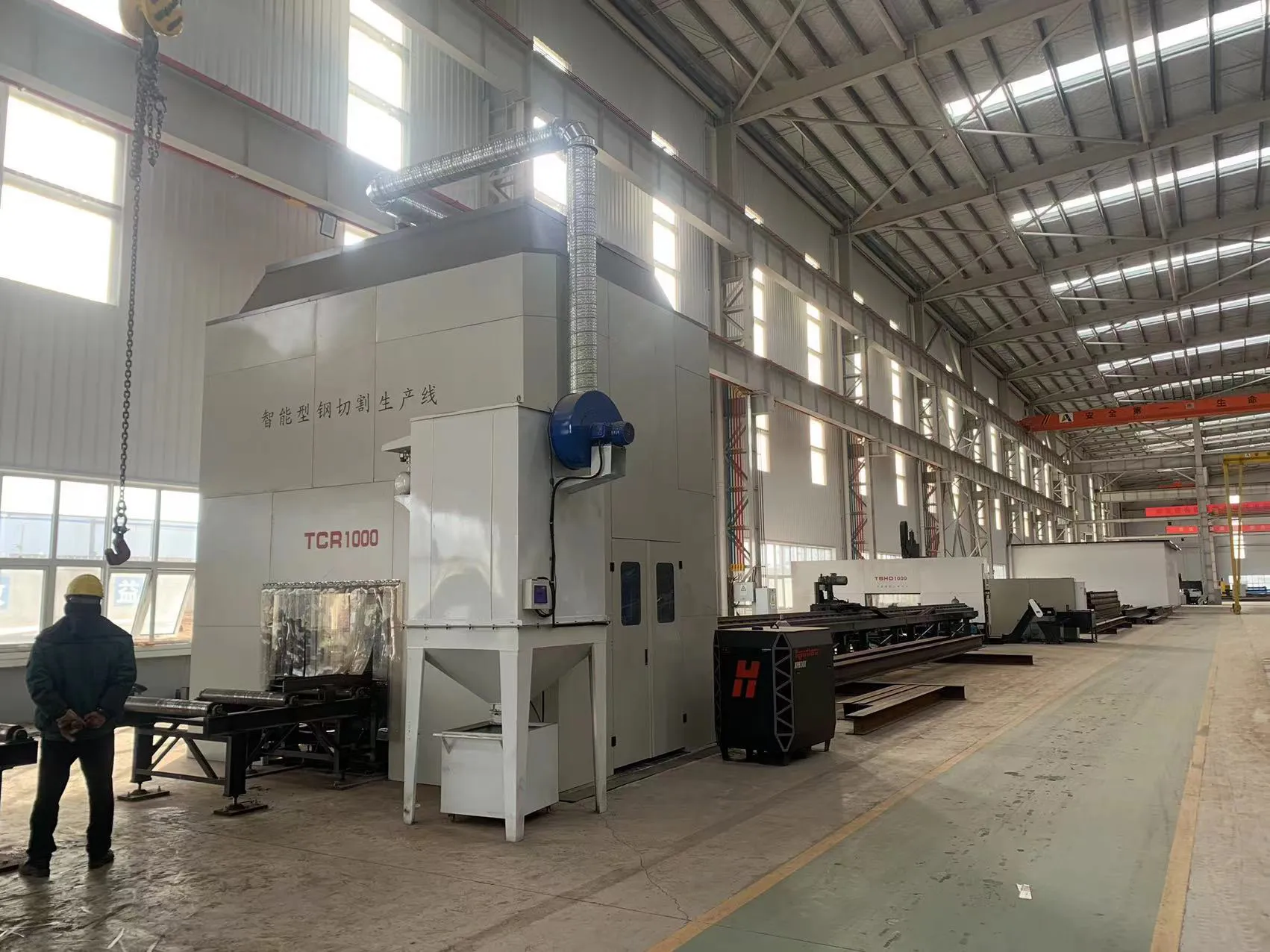
2.1 Mechanical Decoupling and Toolpath Optimization
The infinite rotation mechanism utilizes high-torque direct-drive motors and advanced slip-ring technology (or specialized fiber-optic rotaries) to allow the B-axis and C-axis to rotate without physical limits. This allows for continuous beveling (±45°) on all four sides of a structural beam in a single program sequence. For Dubai’s railway infrastructure, where bridge girders and track supports require precise 45-degree chamfers for full-penetration welding, the 3D head eliminates the need for secondary manual grinding. The precision of the 3D head ensures that the root gap in welded assemblies is maintained within a ±0.1mm tolerance, a requirement for high-stress rail components.
2.2 Solving Geometric Interference
One of the primary challenges in profile processing is “flange interference.” The 3D head’s compact architecture and sophisticated collision-avoidance algorithms allow the nozzle to maintain an optimal standoff distance even when cutting near the web-to-flange transition of an H-beam. By employing real-time capacitive height sensing alongside the 3D kinematics, the system compensates for material deviations (bow and twist) common in hot-rolled structural steel, ensuring the focal point remains consistent throughout the 3D toolpath.
3.0 Application in Dubai Railway Infrastructure
Dubai’s infrastructure landscape presents unique challenges: extreme ambient temperatures (reaching 50°C), fine particulate ingress (sand), and high humidity. The deployment of the 30kW system in this environment requires a specific technical configuration to ensure the longevity of the laser source and the accuracy of the structural output.
3.1 Structural Load and Material Specifications
Railway bridge supports and station skeletal frameworks in the region utilize high-tensile carbon steel (e.g., S355JR or S355J2). The 30kW power allows for “single-pass” processing of thick-webbed profiles used in gantry supports. In the fabrication of rail sleepers and electrification masts, the system’s ability to laser-cut complex slot-and-tab configurations allows for “self-jigging” assemblies. This reduces the reliance on heavy-duty welding jigs and minimizes the internal stresses typically introduced during the assembly of large-scale railway components.
3.2 Environmental Resilience and Thermal Control
A critical component of the field report in Dubai is the thermal management of the 30kW source. The system utilizes a dual-circuit high-capacity industrial chiller with ±0.5°C stability. Given the high ambient heat, the laser head’s internal optics—specifically the protective windows and collimating lenses—are prone to thermal lensing. The Infinite Rotation 3D Head integrates real-time temperature monitoring and pressurized gas-path cooling to prevent focal shift, which is vital for maintaining cut quality over long-duration shifts on heavy-duty profiles.
4.0 Synergy Between 30kW Fiber Sources and Automation
The “Universal” aspect of this system refers to its ability to transition between different profile types without hardware reconfiguration. This is achieved through the synergy of the 30kW source and an automated material handling gantry equipped with hydraulic centering and rotation units.
4.1 Throughput and Efficiency Gains
In traditional fabrication, a single H-beam requiring hole patterns and beveling would pass through three different machines. The 30kW Laser System consolidates this into a single station. Technical data indicates that for a standard 12-meter structural beam, the 30kW laser reduces processing time by approximately 75% compared to plasma-based systems. The high power allows for higher feed rates on the 2D sections of the profile, while the 3D head manages the complex geometry transitions without slowing down for “unwinding” maneuvers.
4.2 Assist Gas Dynamics at 30kW
The efficiency of the 30kW system is heavily dependent on the gas dynamics within the 3D head. For railway steel, oxygen-assisted cutting is often used for thickness, but nitrogen or air-assisted cutting at 30kW provides a “clean” edge that requires no post-cut treatment before galvanization or painting—a standard requirement for Dubai’s corrosion-resistant infrastructure. The system’s CNC integrates a dynamic gas pressure controller that adjusts the barometric output based on the 3D head’s angle, ensuring the kerf remains clear of dross regardless of the nozzle’s orientation relative to gravity.
5.0 Precision Requirements in Heavy Steel Processing
Precision in railway engineering is non-negotiable. The Infinite Rotation 3D Head addresses two specific issues: bolt-hole integrity and weld-ready beveling.
5.1 Bolt-Hole Geometry
Railway track joints and support structures rely on high-strength friction-grip (HSFG) bolts. Traditional thermal cutting often produces tapered holes, which compromise the bolt’s load distribution. The 30kW laser, coupled with the precision of the 3D head’s Z-axis compensation, produces holes with near-zero taper. The 3D head can also execute countersinking and counterboring operations through precise laser ablation paths, which were previously only possible via CNC machining.
5.2 Weld Preparation Accuracy
For the Dubai Metro extensions, structural integrity is verified through non-destructive testing (NDT), including ultrasonic and X-ray inspections of welds. The 30kW laser’s ability to create complex V, Y, K, and X-type bevels with the Infinite Rotation head ensures that the fit-up is perfect. This leads to a significant reduction in weld defects (such as lack of fusion or inclusions) because the laser-cut edge is free of the carbonization and nitriding often found in plasma-cut edges.
6.0 Technical Conclusion and Field Assessment
The field evaluation of the 30kW Fiber Laser Universal Profile Steel Laser System in Dubai confirms its status as a critical asset for modern railway infrastructure. The infinite rotation technology resolves the mechanical bottleneck of traditional 3D cutting, while the 30kW power source provides the necessary energy density to process heavy profiles at industrial scales.
From a senior engineering perspective, the system’s primary value lies in its “Total Process Control.” By integrating material sensing, infinite-axis kinematics, and high-wattage fiber laser delivery, the system eliminates the cumulative errors inherent in multi-stage processing. As the region continues to expand its rail networks, the adoption of this technology will be the benchmark for projects requiring high throughput, extreme precision, and structural longevity in harsh environments. The synergy between the 30kW source and the 3D head is not merely an incremental improvement; it is a fundamental shift in how heavy structural steel is prepared for the most demanding engineering applications on the planet.
















