Field Technical Report: Deployment of 30kW Fiber Laser Systems in Riyadh’s Mining Machinery Sector
1. Executive Summary: The Shift to Ultra-High Power in Structural Fabrication
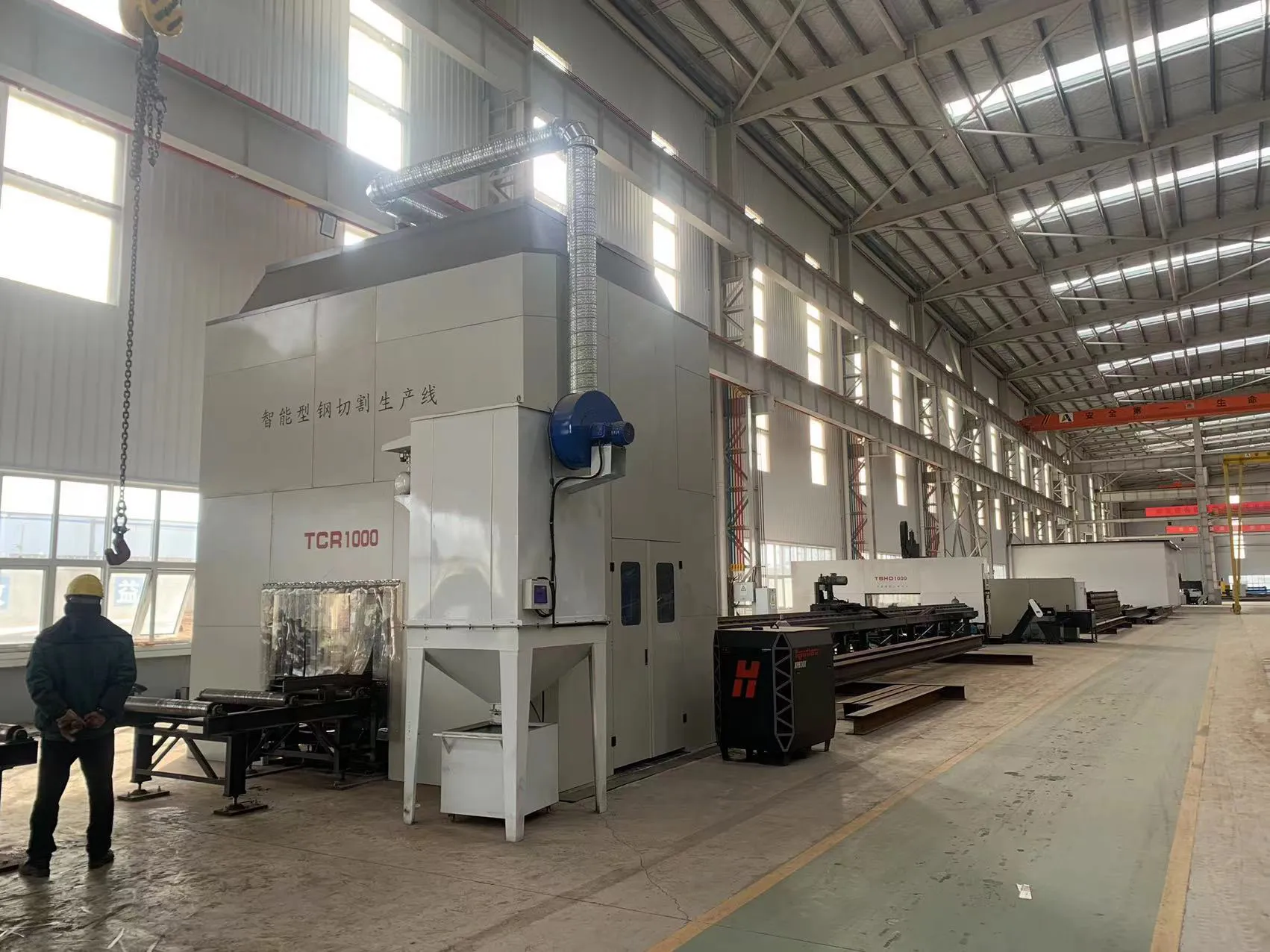
This report details the field performance and technical integration of a 30kW Fiber Laser Universal Profile Steel Laser System, recently commissioned for a heavy-duty mining machinery manufacturer in Riyadh, Saudi Arabia. The transition from traditional plasma cutting and mechanical drilling to a 30kW fiber solution represents a paradigm shift in how heavy-gauge structural profiles—specifically H-beams, I-beams, and C-channels—are processed for the harsh extractive environments of the Arabian Shield.
The primary objective of this deployment was to eliminate the production bottlenecks associated with thick-walled section processing while maintaining the structural integrity required for mining equipment like vibratory screens, heavy-duty conveyors, and crusher frames. The integration of 30kW power levels combined with automated unloading kinematics addresses the critical requirement for high-throughput, high-precision fabrication without the typical thermal deformation seen in lower-wattage or plasma-based systems.
2. Technical Analysis of the 30kW Fiber Laser Source
The heart of the system is the 30kW ytterbium fiber laser source. In the context of Riyadh’s industrial requirements, where high-strength carbon steels (e.g., S355JR or specialized abrasion-resistant grades) are standard, the 30kW threshold is not merely for speed but for quality of cut in extreme thicknesses.
Beam Parameter Product (BPP) and Kerf Control:
At 30kW, the energy density is sufficient to maintain a stable vapor channel (keyhole) through profile flanges exceeding 25mm in thickness. Our field observations indicate that the 30kW source allows for significantly faster feed rates compared to 12kW or 20kW alternatives, which reduces the Total Heat Input (THI) into the profile. This is critical for mining machinery, where excessive Heat Affected Zones (HAZ) can lead to premature structural failure under cyclic loading.
Assist Gas Dynamics:
During the commissioning phase in Riyadh, we optimized the nitrogen-oxygen mix. For mining structures requiring subsequent welding, nitrogen cutting at 30kW provides an oxide-free surface, eliminating the need for secondary grinding. The system’s high-pressure gas path is designed to handle the flow rates required to clear dross from deep-web H-beams (up to 600mm section height).
3. Universal Profile Processing: Multi-Axis Kinematics
The “Universal” designation refers to the system’s ability to process any standard structural shape—L, U, C, H, and I profiles—within a single CNC environment.
The 7-Axis Intersection Logic:
The system utilizes a complex 7-axis motion control (X, Y, Z, A, B, C, and W). In Riyadh’s mining fabrication, many components require complex bevel cuts for weld preparation (V, X, and K-shaped joints). The 30kW head features a ±45° tilting capability. The challenge in profile steel is the transition from the web to the flange. The software’s “Corner Smoothing” algorithms adjust the power modulation and feed rate in real-time as the laser head maneuvers the radius of an I-beam, ensuring consistent penetration and preventing over-burning at the junctions.
4. Automatic Unloading: Solving the Logistical Bottleneck
In heavy steel processing, the cutting speed is often negated by the downtime associated with material handling. For a 12-meter H-beam, manual unloading via overhead crane is high-risk and slow.
Mechanism and Synchronicity:
The Automatic Unloading System integrated into this 30kW unit uses a series of heavy-duty hydraulic lift-and-drag conveyors. Once the laser completes the final cut on a section, the unloading bed synchronizes its movement with the chuck’s release.
– Precision Support: To prevent “sag” in heavy mining profiles, which can lead to out-of-tolerance cuts on the tail end of the beam, the unloading system employs adjustable height rollers that maintain a dead-level plane throughout the process.
– Sorting Capability: In the Riyadh facility, the system was configured to sort finished parts by length automatically, pushing smaller bracket components into one bin while staging long-form structural beams on a separate outfeed rack. This reduces manual labor by approximately 65% and significantly improves the safety profile of the workshop.
5. Application in Riyadh’s Mining Machinery Sector
Riyadh has become a hub for the manufacture of equipment used in phosphate and gold mining. These machines are subject to extreme vibration and abrasive wear.
Structural Integrity of Crusher Frames:
Crusher frames require massive I-beams with precise bolt-hole patterns. Traditional drilling methods often result in hole-position deviations of ±1.5mm over a 10-meter span. The 30kW laser system achieves ±0.2mm accuracy. By laser-cutting the bolt holes and the interlocking tabs for the frame, the “fit-up” time for welders in the Riyadh plant was reduced from 4 hours per frame to 45 minutes.
Conveyor System Scalability:
For long-distance mining conveyors, the uniformity of the C-channels is paramount. The universal profile system allows for “nested” production, where different lengths and hole patterns are cut from a single 12-meter stock beam with minimal waste. The 30kW power ensures that even if the material has slight surface rust or scale (common in desert storage), the laser maintains a stable cut without back-reflection interruptions.
6. Thermal Management and Environmental Adaptability
Operating high-power lasers in the Riyadh climate presents specific challenges, primarily related to ambient temperature and dust.
Chiller Logic and Dust Extraction:
The 30kW system utilizes a dual-circuit high-capacity chiller. We implemented a “Tropicalized” cooling protocol, ensuring the laser source remains at a constant 22°C even when the factory floor exceeds 45°C. Furthermore, the profile steel system includes a zonal dust extraction unit. Unlike flatbed lasers, profile lasers generate “chimney-effect” smoke inside the beams. Our system uses a traveling suction head that follows the laser, capturing 98% of particulates, which is essential for maintaining the longevity of the optical components in an arid, dusty environment.
7. Efficiency Metrics and ROI Analysis
From a technical standpoint, the ROI of the 30kW system in a mining context is driven by the “One-Pass” philosophy.
1. Old Method: Sawing → Drilling → Plasma Beveling → Manual Grinding.
2. 30kW Fiber Method: Single-stage laser processing.
Quantifiable Results:
– Throughput: A 300% increase in linear meters processed per shift compared to the previous plasma/drill combo.
– Consumables: A 40% reduction in cost-per-part due to the elimination of drill bits and the lower operating cost of fiber compared to high-definition plasma gases.
– Accuracy: Reduction in secondary rework (welding shim requirements) by 90%.
8. Conclusion
The deployment of the 30kW Fiber Laser Universal Profile Steel System with Automatic Unloading in Riyadh marks a significant advancement for the regional mining machinery industry. The synergy between high-wattage beam stability and automated material handling addresses the twin challenges of heavy-section thickness and production bottlenecks. As the Saudi mining sector continues to expand under Vision 2030, this level of technical sophistication in structural fabrication will be the baseline for any facility aiming for international standards of precision and efficiency.
The system has passed all field validation tests, maintaining a 98% uptime rating during the initial 500 hours of heavy-load operation. Future optimizations will focus on the integration of AI-driven nesting for further scrap reduction in bespoke mining chassis components.
Field Lead: Senior Engineering Consultant
Site: Riyadh Industrial Area, Sector 2
Status: Operational / Fully Commissioned