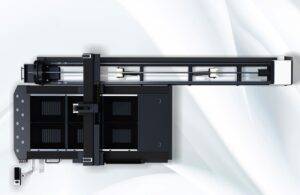
The Dawn of Ultra-High Power: The 30kW Advantage
In the realm of fiber laser technology, the leap to 30kW is not merely an incremental upgrade; it is a fundamental transformation of material interaction. For the structural steel industry in Katowice, particularly regarding the expansion of airport infrastructure, the 30kW power threshold allows for the “single-pass” cutting of incredibly thick carbon and stainless steel profiles that were previously the exclusive domain of plasma or mechanical sawing.
A 30kW fiber laser source provides a power density that allows the beam to vaporize metal almost instantly. This results in a Heat Affected Zone (HAZ) that is virtually non-existent compared to traditional methods. In airport construction, where structural integrity is non-negotiable, minimizing the HAZ is critical. The 30kW system maintains the metallurgical properties of the steel profiles, ensuring that the load-bearing capacities of the beams used in Katowice’s new terminals and hangars are not compromised by thermal stress during the fabrication process.
Universal Profile Processing: Beyond Flat Sheets
The “Universal Profile” designation of this system refers to its ability to handle a diverse range of structural shapes. Unlike standard laser cutters designed for flat plates, this system is equipped with a sophisticated 3D 5-axis cutting head and a high-torque rotary chuck system. It can process H-beams, I-beams, U-channels, L-shaped angles, and rectangular hollow sections (RHS) up to lengths of 12 meters.
For the Katowice Airport project, the architectural designs often call for complex geometries—conical intersections of tubular steel and perforated web beams for aesthetic and weight-saving purposes. The universal profile system uses advanced CAD/CAM integration to execute complex bevel cuts, bolt holes, and interlocking notches in a single setup. This eliminates the need for secondary processes like drilling or manual grinding, ensuring that every component arriving at the Pyrzowice construction site is ready for immediate assembly.
The Mechanics of the 5-Axis Cutting Head
To achieve “Universal” capability, the system employs a specialized 5-axis head that allows for ±45-degree beveling. This is essential for weld preparation. In heavy construction, beams must be beveled to allow for deep-penetration welds. Traditionally, this was a manual, labor-intensive task.
With the 30kW system, the laser head rotates around the profile, cutting the required bevel angles with a precision of ±0.05mm. The software compensates for any slight deviations in the raw material’s straightness using high-speed sensors, ensuring the cut path remains perfectly aligned with the beam’s center of gravity. This level of precision is vital for the massive spans required in airport lounges, where even a millimeter of misalignment can translate into significant structural issues across a 60-meter roof section.
Revolutionizing Throughput: The Automatic Unloading System
One of the most significant bottlenecks in heavy steel fabrication is material handling. A single 12-meter H-beam can weigh several tons. The system in Katowice addresses this through a fully integrated Automatic Unloading System.
As the 30kW laser completes the final cut on a profile, a series of synchronized hydraulic lifters and motorized conveyor rollers take over. The system is designed to detect the weight and balance point of the finished part, gently extracting it from the cutting zone and transporting it to a designated sorting area. This automation serves two primary purposes: safety and continuity. By removing human operators from the immediate vicinity of heavy moving steel, the risk of industrial accidents is nearly eliminated. Furthermore, it allows the laser to begin the next program immediately, maximizing the “beam-on” time and ensuring the 24/7 production cycles required to meet the airport’s tight construction deadlines.
Strategic Implementation in Katowice: Supporting Airport Infrastructure
Katowice Airport (Pyrzowice) is a vital node in Poland’s logistical network. The expansion of its cargo facilities and passenger terminals requires thousands of tons of structural steel. The decision to house a 30kW universal profile system in the Katowice region was strategic.
The Upper Silesian industrial hub has long been the heart of Polish steelwork, but the shift toward “Industry 4.0” requires high-tech solutions. By using this laser system, the airport project benefits from “Just-in-Time” manufacturing. Instead of ordering pre-fabricated parts from distant suppliers, the Katowice facility can produce custom structural elements on demand. This flexibility allows architects to make real-time adjustments to the design without causing months of delay, a common challenge in large-scale infrastructure projects.
Precision in Aviation Engineering: Bolt Holes and Interlocks
In airport construction, many structures are “bolted” rather than “welded” to allow for thermal expansion and easier maintenance. This requires thousands of perfectly aligned bolt holes. Traditional mechanical drilling is slow and dulls bits quickly when dealing with high-tensile steel.
The 30kW laser treats 20mm thick steel like paper. It can “pierce” and cut a perfect bolt hole in a fraction of a second. The hole’s interior surface is smooth and free of the burrs associated with mechanical drilling. This ensures a tighter fit for the high-strength friction-grip bolts used in the airport’s skeletal frame, resulting in a stiffer, more resilient structure capable of withstanding the vibrations and wind loads inherent in an aviation environment.
Environmental Impact and Resource Efficiency
Sustainability is a key pillar of modern airport design. The 30kW fiber laser system contributes to this by significantly reducing material waste. The nesting software for profiles is optimized to utilize every possible inch of the steel beam. Because the laser kerf (the width of the cut) is only a few hundred microns wide, the “kerf loss” is negligible compared to the 3-5mm loss seen with plasma or saws.
Furthermore, the high efficiency of the fiber laser source—converting electricity to light at rates exceeding 40%—means that the carbon footprint of each cut component is lower than that of older CO2 lasers or traditional heavy machinery. In the context of the Katowice Airport expansion, this helps the project move toward its green building certification goals.
Economic Implications for the Silesian Region
The introduction of this 30kW system has elevated the local Katowice economy from a traditional manufacturing base to a high-tech engineering hub. The skills required to operate and maintain a 30,000-watt universal profile laser are highly specialized. This has led to a surge in technical training and high-value employment in the region.
The facility acts as a magnet for further investment. When international contractors see that Katowice possesses the capability to process heavy structural steel with 30kW precision and automated logistics, it increases confidence in the region’s ability to handle the most complex civil engineering projects in Europe.
Conclusion: The Future of Construction in Katowice
The 30kW Fiber Laser Universal Profile Steel Laser System with Automatic Unloading is more than just a machine; it is a catalyst for a new era of infrastructure. As the Katowice Airport grows to accommodate more passengers and cargo, the steel that forms its backbone stands as a testament to the power of modern fiber laser technology.
By combining the raw power of 30,000 watts with the versatility of universal profile processing and the efficiency of automatic unloading, Katowice has set a new international standard for airport construction. This system ensures that the path from a digital blueprint to a physical steel landmark is shorter, safer, and more precise than ever before, positioning Poland at the forefront of the global structural steel industry.