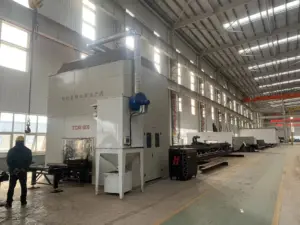
The Evolution of Power: Why 30kW is the New Standard for Profiles
For decades, the structural steel industry relied on 2kW to 6kW lasers, which were primarily restricted to thin-sheet applications. As fiber laser technology matured, the industry saw a rapid ascent to 10kW, then 20kW, and now the 30kW threshold. In the context of the Hamburg Airport construction project, 30kW is not merely a number—it is a functional necessity for universal profile processing.
A 30kW fiber laser provides a power density that allows for the instantaneous sublimation of thick-walled steel. When dealing with universal profiles (such as HEB 600 or IPE 400 beams used in airport support structures), the laser must penetrate sections that can exceed 30mm to 50mm in thickness depending on the angle of the cut. The 30kW source allows for high-speed “flying cuts” on these heavy sections, significantly reducing the “time-per-hole” or “time-per-miter” compared to traditional plasma systems. Furthermore, the beam quality of a 30kW source ensures a narrow kerf width, which is essential for the tight tolerances required in modern modular construction where beams must slot together with millimeter precision.
Precision Engineering for Hamburg’s Aviation Infrastructure
Hamburg Airport (Flughafen Hamburg) serves as a critical node in European travel, and its ongoing infrastructure upgrades demand materials that can withstand immense dynamic loads. The universal profiles processed for this project—ranging from roof trusses for new terminals to reinforced supports for cargo bays—require more than just straight cuts. They require complex beveling for weld preparations, interlocking notches, and precise bolt-hole arrays.
Using a 30kW universal profile laser system allows Hamburg-based contractors to move from raw material to a finished, assembly-ready component in a single stage. In traditional workflows, a beam would be sawed to length, moved to a drilling station, and then manually ground for weld prep. The 30kW laser system performs all these functions—cutting, drilling, and beveling—in one continuous automated cycle. This precision ensures that when the steel arrives at the airport construction site, it fits perfectly, reducing the need for on-site adjustments, which are costly and logistically difficult in a functioning airport environment.
The Universal Profile Challenge: 5-Axis 3D Cutting Dynamics
Unlike flat-bed lasers, a universal profile system must navigate the complex geometry of structural steel. This involves a sophisticated 5-axis or 6-axis robotic cutting head that can rotate around the beam’s flanges and webs. At 30kW, the management of the “back-reflection” and gas dynamics becomes a major engineering feat.
In Hamburg’s project, the laser system utilizes high-pressure oxygen or nitrogen-assist gases to clear the molten pool. The 30kW power enables “Nitrogen Cutting” on thicker sections than ever before, which results in an oxide-free edge. For airport construction, where many steel elements are exposed to the elements or require high-quality paint/coating finishes, an oxide-free edge is vital. It eliminates the need for secondary shot-blasting or cleaning, as the paint adheres perfectly to the laser-cut surface. The 3D head’s ability to maintain a constant standoff distance even while transitioning from the thick flange of an H-beam to its thinner web is controlled by ultra-fast capacitive sensors, ensuring the 30kW energy is always perfectly focused.
Automatic Unloading: Redefining Logistics and Safety
The “Universal” aspect of the system refers to its ability to handle various shapes, but the “Automatic Unloading” aspect is what drives the ROI (Return on Investment) for large-scale projects. A single 12-meter I-beam can weigh several tons. Manually moving these pieces after cutting is slow and presents significant safety risks to personnel.
The system deployed in Hamburg features an integrated chain-driven unloading conveyor and hydraulic lift-arm system. Once the 30kW laser completes the final cut, the automated system identifies the part weight and dimensions, then uses synchronized rollers and lateral pushers to move the finished profile to a designated collection zone. This happens while the next raw beam is already being loaded into the chucks. This “buffer” logic allows the laser to maintain a high “arc-on” time. For the Hamburg airport project, where thousands of tons of steel must be processed on a strict timeline, the elimination of manual crane intervention during the unloading phase increases throughput by roughly 40-50%.
Integration with BIM and Digital Twin Technology
Modern airport construction relies heavily on Building Information Modeling (BIM). Every beam in the Hamburg project exists as a digital entity before it is physically cut. The 30kW laser system is integrated directly with this BIM software (such as Tekla Structures or Autodesk Revit).
The software converts the 3D architectural models into NC (Numerical Control) code that the laser understands. This seamless digital thread ensures that the 30kW laser executes every bolt hole and miter cut exactly as designed by the structural engineers. Furthermore, the system can etch part numbers, QR codes, and assembly instructions directly onto the steel profiles. This “smart marking” is invaluable at the construction site; workers can scan a beam and immediately see its exact position in the airport’s structural grid via a tablet, drastically reducing assembly errors and ensuring that the high-power precision of the laser translates into a high-quality finished building.
Sustainability and Economic Efficiency
In the current European economic climate, particularly in a forward-thinking city like Hamburg, sustainability is as important as speed. The 30kW fiber laser is significantly more energy-efficient than the CO2 lasers of the past. Fiber technology boasts a wall-plug efficiency of about 40-50%, meaning more electricity is converted into cutting light and less is wasted as heat.
Moreover, the precision of the 30kW laser allows for “common-line cutting” and advanced nesting on profiles. By optimizing how parts are cut from a standard 12-meter or 15-meter beam, the software can minimize scrap. In a project as vast as an airport expansion, even a 5% reduction in steel waste equates to hundreds of tons of material saved and a significant reduction in the project’s overall carbon footprint. Additionally, because the laser-cut edges are so clean, the consumption of grinding disks and other consumables is virtually eliminated, making the 30kW universal profile system the most “green” choice for heavy-duty steel fabrication.
The Future of Infrastructure Construction
The deployment of a 30kW fiber laser with automatic unloading in Hamburg represents the vanguard of “Industry 4.0” in the construction sector. As airport designs become more complex—moving away from simple boxes toward organic, aerodynamic shapes—the demand for precision-cut structural steel will only grow.
The 30kW universal profile laser system is more than a cutting tool; it is a high-speed manufacturing center. By combining the raw power needed to slice through heavy steel with the intelligence of automated unloading and BIM integration, it allows Hamburg to build faster, safer, and more sustainably. For the airport, this means shorter construction windows, fewer flight disruptions, and a structure that is built to the highest possible standards of German engineering. This technology sets a new benchmark for how global cities will approach massive infrastructure projects in the decades to come.