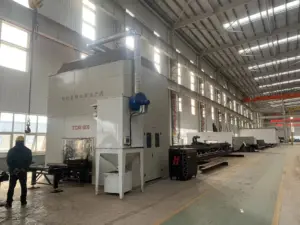
The Evolution of Heavy Structural Fabrication in Dammam
Dammam has long served as the industrial gateway to the Kingdom of Saudi Arabia, acting as a critical hub for the oil, gas, and logistics sectors. However, the current national emphasis on the Saudi Landbridge Project and the expansion of the North-South Railway has shifted the spotlight toward advanced steel fabrication. Traditionally, the processing of heavy profiles for railway bridges, station frameworks, and rolling stock components relied on a fragmented workflow: mechanical sawing, followed by radial drilling, and manual oxy-fuel or plasma beveling for weld preparation.
The introduction of the 30kW Fiber Laser Universal Profile Steel Laser System changes this dynamic entirely. In the harsh, high-ambient-temperature environment of the Eastern Province, the efficiency of fiber laser technology—specifically at the 30kW threshold—offers a level of thermal stability and processing speed that legacy systems cannot match. This machine is not merely a cutter; it is a comprehensive fabrication center that consolidates multiple stages of production into a single automated cycle.
The Power of 30kW: Redefining Thickness and Speed
In the realm of fiber lasers, power is the primary determinant of both “limit thickness” and “economical thickness.” A 30kW source provides a massive leap over the 12kW and 15kW systems commonly found in the region. For railway infrastructure, which utilizes thick-walled structural steel, this power is essential.
At 30kW, the laser can penetrate heavy-duty carbon steel profiles up to 50mm or even 80mm with extreme precision. However, the real advantage for a Dammam-based facility is the speed at which it processes 15mm to 30mm sections. By operating well below its maximum limit, the 30kW system ensures a smaller Heat Affected Zone (HAZ), resulting in superior metallurgical integrity. In railway applications—where vibration and dynamic loading are constant—maintaining the original material properties of the steel is vital for long-term safety and structural longevity.
Mastering Complexity with ±45° Bevel Cutting
The most significant bottleneck in traditional steel fabrication is weld preparation. For structural joints in railway bridges or locomotive frames, steel profiles must be beveled to allow for full-penetration welds. Historically, this required secondary grinding or the use of manual plasma torches, both of which introduce human error and significant labor costs.
The 30kW system’s 5-axis cutting head, capable of ±45° beveling, solves this problem at the source. The system can execute V, X, Y, and K-shaped bevels with mathematical precision. Because the laser head can tilt while orbiting the profile, it creates perfectly chamfered edges even on the inner flanges of an H-beam. This “weld-ready” output means that components coming off the laser bed in Dammam can be moved directly to the welding robots or manual stations without any further edge dressing. This acceleration of the production pipeline is critical when meeting the tight deadlines of national infrastructure projects.
Universal Profile Processing: H, I, U, and L Sections
Railway infrastructure does not live on flat plates alone. It is built on a foundation of complex 3D profiles. The “Universal Profile” designation of this laser system refers to its specialized chucking and software environment, designed to handle:
- H-Beams and I-Beams: Used for heavy support columns and bridge girders.
- C-Channels and U-Sections: Essential for rolling stock chassis and station roofing.
- Angle Iron and Square/Rectangular Tubing: Used in signaling gantries and station interiors.
The system utilizes a series of high-precision pneumatic chucks that can rotate and feed these heavy sections (often up to 12 meters in length) through the cutting zone. Sophisticated sensors compensate for the “bow and twist” inherent in hot-rolled steel, ensuring that the laser always maintains the perfect focal point relative to the material surface. For a contractor in Dammam, this means the ability to cut complex bolt-hole patterns, drainage slots, and interlocking miters in a single continuous process.
Strategic Impact on Saudi Railway Infrastructure
The Kingdom’s railway ambitions are among the most significant in the world. The Saudi Landbridge Project, connecting the Port of Dammam on the Arabian Gulf to Jeddah on the Red Sea, requires thousands of kilometers of track and dozens of support facilities.
1. **Bridge Girders and Supports:** The ability to cut thick-walled H-beams with pre-beveled edges allows for faster assembly of rail overpasses and bridges.
2. **Rolling Stock Localization:** As Saudi Arabia seeks to localize the assembly of freight and passenger wagons, the 30kW laser provides the capability to cut the high-tensile steel frames required for locomotive durability.
3. **Station Architecture:** The iconic designs of modern Saudi rail stations require complex geometric steel skeletons. The 5-axis bevel head allows for the intricate miter cuts needed for architecturally exposed structural steel (AESS).
By localizing this technology in Dammam, the dependence on imported pre-fabricated steel is reduced. This not only lowers logistics costs but also aligns with the “In-Kingdom Total Value Add” (IKTVA) programs, fostering a high-tech domestic manufacturing base.
Overcoming Environmental Challenges in the Eastern Province
Operating a 30kW fiber laser in Dammam presents unique environmental challenges, specifically extreme heat, humidity, and fine sand/dust. A “Railway-Grade” system must be engineered with these factors in mind.
Modern 30kW systems installed in the region feature hermetically sealed laser sources and air-conditioned electrical cabinets. The cooling system (chiller) is often oversized to ensure that even when the ambient temperature exceeds 45°C, the laser diodes and the cutting head remain at a stable 20-25°C. Furthermore, advanced dust extraction systems are integrated to handle the high volume of particulate matter generated when vaporizing thick steel, ensuring a clean working environment and protecting the sensitive optics from contamination.
Economic and Operational ROI
While the capital expenditure (CAPEX) for a 30kW universal profile laser is significant, the return on investment (ROI) for railway projects is achieved through three primary avenues:
**1. Reduced Labor and Secondary Operations:** By combining sawing, drilling, and beveling into one machine, the labor requirement for a fabrication line can be reduced by up to 70%.
**2. Material Utilization:** Advanced nesting software for profiles minimizes “short ends” and scrap. In the high-volume world of railway steel, a 5% improvement in material yield translates to millions of Riyals in savings over the life of a project.
**3. Accuracy and Assembly Speed:** Laser-cut parts are accurate to within 0.1mm. This precision ensures that when parts are sent to the construction site—perhaps hundreds of kilometers away in the desert—they fit together perfectly the first time, eliminating the need for costly on-site modifications.
Conclusion: The Future of Rail Fabrication
The deployment of a 30kW Fiber Laser Universal Profile system in Dammam is more than an upgrade in machinery; it is an upgrade in industrial capability. As the railway tracks spread across the Peninsula, the speed, precision, and versatility of this system will be the silent engine driving the infrastructure forward. For the experts and engineers in Dammam, this technology offers the tools to transform raw steel into the skeletal framework of a modern, connected Saudi Arabia, ensuring that the Kingdom’s rail network is built to the highest global standards of safety and efficiency.