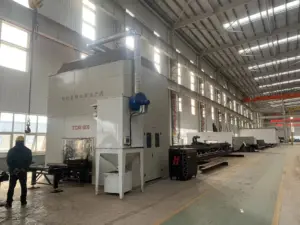
The Dawn of Ultra-High Power: Why 30kW is the New Standard for Dubai
In the world of fiber lasers, the leap from 12kW to 30kW is not merely an incremental upgrade; it is a generational shift in capability. For the crane manufacturing sector in Dubai, where structural integrity is non-negotiable, the 30kW power source provides the “thermal punch” required to slice through 30mm to 50mm carbon steel plates with the same ease that a lower-powered laser cuts sheet metal.
The primary advantage of 30kW in a heavy-industry hub like Dubai is the drastic reduction in the Heat Affected Zone (HAZ). In crane manufacturing, the metallurgical properties of the steel are critical. Excessive heat from slower plasma or oxy-fuel cutting can compromise the tensile strength of the steel. The 30kW fiber laser moves at such high velocities that the heat is localized, preserving the structural “temper” of the beams and plates. Furthermore, the 30kW source allows for high-pressure air cutting on thicknesses that previously required expensive oxygen or nitrogen, significantly lowering the operational cost per meter in a competitive market.
The Universal Profile Advantage: Processing Beams and Channels
Crane manufacturing relies heavily on structural profiles—H-beams, I-beams, U-channels, and square tubing. Traditionally, these required multiple machines: a saw for length, a drill for bolt holes, and a manual torch for notches. The “Universal Profile” aspect of this 30kW system integrates all these processes into a single workstation.
Equipped with advanced rotary chucks and synchronized 4-axis or 5-axis motion, the system can rotate massive beams while the laser head moves in tandem. This allows for complex geometries, such as interlocking joints and weight-reduction cutouts, to be executed with sub-millimeter precision. In Dubai’s fast-paced construction environment, the ability to feed a raw 12-meter H-beam into the machine and receive a fully finished, notched, and drilled structural component at the other end is a game-changer for project timelines.
Mastering the ±45° Bevel: Weld Preparation Redefined
In crane engineering, welds are the points of most frequent failure. To ensure safety, “Full Penetration” welds are required, which necessitate precise beveling of the edges before joining. The ±45° Bevel Cutting capability of the 30kW system is perhaps its most vital feature for the Dubai manufacturing sector.
Traditional beveling is a labor-intensive secondary process involving manual grinding or specialized milling machines. The 5-axis 30kW laser head can perform V, X, Y, and K-shaped bevels during the initial cutting phase. Because the laser is a non-contact tool, it maintains a consistent angle even across uneven thick-plate surfaces. This “weld-ready” output means that components can move directly from the laser bed to the welding robot or manual welding station without any intermediary cleaning or grinding. This precision ensures that the crane’s girders and boom sections can withstand the massive dynamic loads they are designed for in Dubai’s ports and construction sites.
Engineering for the Middle Eastern Climate
Operating a 30kW fiber laser in Dubai presents unique environmental challenges. The extreme ambient temperatures, which can exceed 50°C in the summer, along with high humidity and airborne dust, require a specialized machine architecture.
The Universal Profile Steel Laser Systems deployed in this region feature high-capacity dual-circuit industrial chillers specifically designed for “desert-spec” performance. These chillers manage the temperature of both the laser source and the cutting head optics with extreme precision. Furthermore, the machine’s critical electronics and the laser source itself are housed in IP65-rated, air-conditioned cabinets to prevent dust ingress and thermal fluctuations. For a crane manufacturer, this means the machine can maintain a 24/7 duty cycle even during the height of the Middle Eastern summer, ensuring that production quotas for major infrastructure projects are never missed.
Precision in Crane Girder and Boom Construction
Cranes, especially the massive overhead bridge cranes and tower cranes seen in the UAE, require exceptionally long, straight girders. Any deviation in the cut or a slight warp in the material can lead to catastrophic structural failure or premature wear on the crane’s trolleys.
The 30kW laser system utilizes high-precision rack-and-pinion drives and linear encoders to maintain accuracy over long distances (often up to 24 meters or more). When cutting the side plates for a crane girder, the laser ensures that every bolt hole and every edge is perfectly aligned. This level of precision facilitates the use of modular “bolt-together” designs, which are becoming increasingly popular in Dubai due to their ease of transport and assembly on-site. The high wattage also allows for “shimmer-free” edges on thick sections, which reduces stress concentration points—a critical factor in the fatigue life of a crane.
Economic Impact: ROI and the “Operation 300bn” Strategy
The UAE’s “Operation 300bn” is a national strategy to increase the industrial sector’s contribution to the GDP. Investing in a 30kW Universal Profile laser system aligns perfectly with this goal by boosting local manufacturing self-sufficiency.
While the initial capital expenditure for a 30kW system is significant, the Return on Investment (ROI) is accelerated by three factors:
1. **Material Savings:** Advanced nesting software for profiles and plates minimizes scrap, which is vital given the fluctuating price of high-grade structural steel.
2. **Labor Reduction:** One laser operator can replace a team of five or six workers previously dedicated to sawing, drilling, and grinding.
3. **Throughput:** A 30kW laser can cut 20mm steel up to 5 times faster than a 6kW laser and 3 times faster than a 12kW laser, effectively tripling the factory’s capacity without increasing its footprint.
Software Integration and Industry 4.0
The modern 30kW system in Dubai is not a standalone tool; it is a node in a connected factory. Using CAD/CAM integration specifically tailored for structural steel (such as Tekla or Revit), crane designers can send 3D models directly to the laser. The software automatically calculates the bevel angles, the rotation of the beams, and the optimal nesting.
This digital workflow is essential for the complex, bespoke crane systems required for Dubai’s specialized industries, such as aluminum smelting or oil and gas. It allows for “Just-In-Time” manufacturing, where components are cut only as they are needed for assembly, reducing the need for massive inventories and improving the cash flow of the manufacturing enterprise.
Future Outlook: Setting a Global Benchmark
As Dubai continues to position itself as a global hub for logistics and smart city infrastructure, the demand for high-performance lifting equipment will only grow. The 30kW Fiber Laser Universal Profile Steel Laser System with ±45° Bevel Cutting represents the pinnacle of current fabrication technology.
By adopting this technology, Dubai-based crane manufacturers are not just competing on a local level; they are setting a global benchmark for quality and efficiency. The ability to produce “Made in UAE” cranes that meet the most stringent European and American safety standards—thanks to the precision of ultra-high-power laser cutting—marks a new chapter in the region’s industrial story. The synergy of 30,000 watts of light, sophisticated 5-axis kinematics, and the ambition of Dubai’s manufacturing sector is creating a future where the sky is truly the limit for structural engineering.