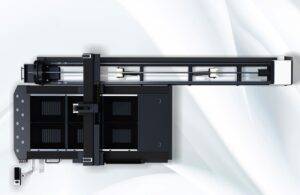
The Dawn of 30kW Fiber Laser Technology in Saudi Heavy Industry
The industrial sector in Dammam, particularly within the 1st and 2nd Industrial Cities, has long been the backbone of the Kingdom’s infrastructure development. As the demand for sophisticated material handling solutions—such as overhead gantry cranes, tower cranes, and portal cranes—increases, the limitations of traditional manufacturing methods have become apparent. Traditional mechanical sawing, drilling, and plasma cutting often result in slow throughput, significant secondary processing, and thermal deformation.
The introduction of the 30kW Fiber Laser Universal Profile System changes this equation. A 30kW laser source is not merely an incremental upgrade from 12kW or 20kW systems; it is a transformative leap in power density. At 30,000 watts, the laser can penetrate thick-walled structural steel (up to 50mm and beyond) with a narrow kerf width and a minimal heat-affected zone (HAZ). For crane manufacturers in Dammam, where structural reliability is non-negotiable, the ability to cut through heavy-duty H-beams and I-beams without compromising the grain structure of the steel is a decisive advantage.
Universal Profile Processing: Engineering Versatility
Crane manufacturing requires a diverse array of structural shapes: H-beams for main girders, I-beams for runways, C-channels for cross-bracing, and square or rectangular hollow sections (RHS/SHS) for leg structures. Traditionally, these would require different machines or manual layouts.
A “Universal” profile system utilizes advanced chucking mechanisms and multi-axis heads to handle these geometries in a single setup. The system in Dammam is designed to support profiles up to 12 or 15 meters in length, feeding them through a rotating chuck system that maintains sub-millimeter concentricity. This “all-in-one” approach means that a crane girder can have its bolt holes, utility pass-throughs, and end-miters cut in a single continuous process. This eliminates the “work-in-progress” (WIP) lag that occurs when moving massive steel components between sawing, drilling, and oxy-fuel stations.
The Critical Role of ±45° Bevel Cutting in Weld Preparation
In crane manufacturing, the weld is the most critical point of potential failure. To ensure deep-penetration welds that can withstand dynamic loading and fatigue, the edges of the steel profiles must be beveled. Historically, this was done using manual grinding or specialized beveling machines—processes that are labor-intensive, dusty, and prone to human error.
The ±45° bevel cutting head on a 30kW fiber laser allows for the creation of V, X, Y, and K-type joints directly during the cutting cycle. By tilting the laser head up to 45 degrees, the system can create precise chamfers on the edges of heavy plates and profiles. Because the 30kW source maintains high cutting speeds even at an angle (where the “effective thickness” of the material increases), the productivity gains are enormous.
Furthermore, the precision of a laser-cut bevel ensures a perfect “fit-up.” In the assembly of a large crane box girder, even a 2mm gap caused by an imprecise bevel can lead to increased weld volume, higher heat input, and potential distortion. The 30kW laser ensures that parts fit together like a jigsaw puzzle, reducing the amount of filler wire required and significantly lowering the time spent by certified welders on each joint.
Optimizing Operations in Dammam’s Industrial Environment
Dammam serves as a strategic gateway for the oil, gas, and logistics sectors. Crane manufacturers here face unique challenges, including high ambient temperatures and the need for rapid turnaround to support regional megaprojects like NEOM and the expansion of King Abdulaziz Port.
The 30kW system is engineered with robust cooling solutions—high-capacity industrial chillers—to ensure the laser source remains stable even when the external temperature exceeds 45°C. Additionally, the move toward fiber laser technology aligns with the Kingdom’s sustainability goals. Compared to CO2 lasers or plasma systems, fiber lasers have a significantly higher wall-plug efficiency, consuming less electricity per meter of cut. In a high-output facility in Dammam, this translates to substantial annual savings in utility costs and a reduced carbon footprint.
Impact on Crane Structural Integrity and Safety
Safety is the primary metric in crane engineering. The precision of the 30kW fiber laser enhances safety in several ways:
1. **Elimination of Micro-cracking:** Unlike mechanical shearing or high-heat plasma, the fiber laser’s concentrated energy minimizes the duration of heat exposure. This prevents the formation of brittle martensite layers at the cut edge, which can be a starting point for fatigue cracks in crane structures.
2. **Precision Hole Cutting:** Cranes rely on high-strength bolted connections. The laser system can cut bolt holes with a tolerance of ±0.1mm, ensuring that bolts are perfectly seated and load distribution is uniform across the flange.
3. **Consistency:** Automation removes the “Friday afternoon” variability of manual work. Every component produced in the Dammam facility is a digital twin of the CAD model, ensuring that the final crane assembly meets the exact specifications of international standards like FEM or CMAA.
Advanced Software Integration and Industry 4.0
A 30kW universal profile system is only as capable as the software that drives it. In the Dammam installation, the system is integrated with sophisticated nesting and CAD/CAM software. This allows engineers to import 3D models of entire crane assemblies. The software automatically calculates the optimal cutting path, manages the rotation of the profile, and compensates for any slight deviations in the raw material (such as beam camber or twist) using touch-probe or laser sensors.
This integration facilitates a “Just-In-Time” (JIT) manufacturing workflow. When a specific crane order is received, the system can prioritize the necessary profiles, minimizing inventory costs and maximizing the utilization of raw steel. In an era where steel prices can be volatile, the ability to reduce scrap through intelligent nesting is a vital competitive advantage for Dammam’s manufacturers.
Maintenance and Technical Support in the Eastern Province
The complexity of a 30kW 5-axis system requires a dedicated maintenance ecosystem. Being located in Dammam provides proximity to specialized technical support teams and spare parts hubs. Expert maintenance for these systems involves regular calibration of the optical path, monitoring of the gas pressure (usually Nitrogen for clean cuts or Oxygen for thick mild steel), and ensuring the rack-and-pinion drive systems are free of dust—a constant challenge in desert environments.
The use of “smart” heads with integrated sensors allows for real-time monitoring of the protective window, temperature, and focus position. If the system detects a deviation, it can alert the operator before a part is scrapped, further ensuring the high-efficiency standards required by the crane industry.
Conclusion: Powering the Future of Saudi Construction
The deployment of a 30kW Fiber Laser Universal Profile Steel Laser System with ±45° Bevel Cutting in Dammam is more than a capital investment; it is a statement of intent. It signals that Saudi crane manufacturers are no longer content with following international standards—they are setting them.
By streamlining the transition from raw steel to finished structural components, this technology provides the Eastern Province with the tools to build the cranes that will, in turn, build the cities of the future. The synergy of ultra-high power, multi-axis flexibility, and local industrial expertise ensures that Dammam remains at the forefront of the global heavy engineering sector, delivering cranes that are stronger, safer, and more precisely engineered than ever before.