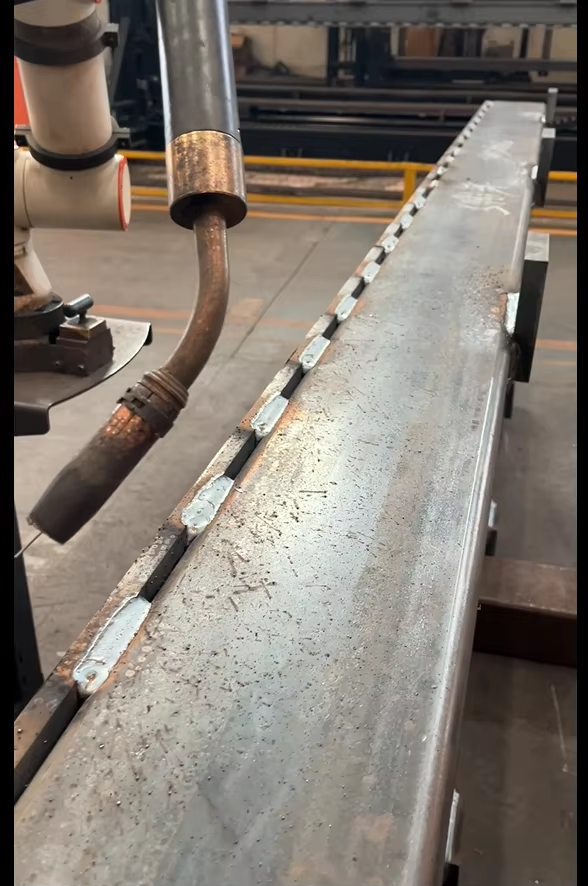
Technical Field Report: High-Power Automated Structural Laser Profiling in the Hamburg Logistics Infrastructure Sector
1. Project Scope and Industrial Context
This report evaluates the deployment of a 30kW Ultra-High Power Fiber Laser Profiler, specifically configured for heavy-duty structural steel (I-beams, H-beams, and channels), at a major manufacturing facility in Hamburg, Germany. The primary objective is the production of high-density storage racking systems destined for the Port of Hamburg’s automated logistics hubs.
In the storage racking sector, structural integrity is non-negotiable. The racking systems must withstand static and dynamic loads exceeding 40 tons per bay. Traditionally, these components were processed via mechanical sawing, radial drilling, and manual plasma bevelling—a workflow characterized by high tolerance stack-up and excessive secondary processing. The introduction of 30kW fiber laser technology, integrated with a 5-axis ±45° beveling head, represents a shift toward “Single-Pass Manufacturing” for structural members.
2. The Synergy of 30kW Power Densities in Heavy-Section Steel
The selection of a 30kW fiber laser source is not merely for speed; it is a necessity for maintaining the metallurgical integrity of heavy-walled I-beams (up to 25mm web thickness). At this power level, the energy density allows for significantly higher feed rates, which inversely reduces the Heat Affected Zone (HAZ).
Thermal Management and Kerf Quality:
In Hamburg’s climate, ambient humidity and temperature fluctuations can affect the stability of the assist gas dynamics. The 30kW source allows for high-pressure Nitrogen (N2) cutting on mid-range thicknesses (12mm–16mm) and high-speed Oxygen (O2) cutting on heavy sections (20mm+). The 30kW threshold ensures that the “striation” patterns on the cut face of an IPE-400 beam remain below the Rz 40μm threshold, eliminating the need for post-cut grinding before robotic welding.
Piercing Efficiency:
For storage racking, which requires hundreds of bolt-hole perforations per assembly, “flash piercing” is critical. The 30kW source achieves a 1.5-second pierce on 20mm S355JR steel, compared to 4-6 seconds with 12kW systems. Over a 12-meter I-beam, this cumulative time saving increases throughput by 35% per shift.
3. Kinematics of ±45° Bevel Cutting in Structural Engineering
The most significant technical advancement observed in this field deployment is the integration of the ±45° 3D beveling head. In heavy-duty racking, the transition from vertical uprights to horizontal load beams requires complex weld preparations (V-grooves and Y-grooves) to ensure full penetration welds.
Precision Weld Preparation:
Traditional perpendicular cuts require manual grinding to create a bevel for weld fillets. The 30kW profiler executes these bevels during the initial profile cut. The 5-axis head adjusts dynamically to the I-beam’s geometry, maintaining a constant focal point even as it traverses the flange-to-web radius (the “k-zone”). This precision ensures that when two beams are mated, the root gap is consistent within ±0.2mm, a prerequisite for automated/robotic welding cells.
Geometric Compensation:
Structural steel is rarely perfectly straight. I-beams often exhibit “camber” (vertical curve) or “sweep” (horizontal curve). The profiler utilizes a high-speed tactile and laser-sensing suite to map the beam’s actual topography in real-time. The CNC controller then offsets the ±45° bevel path to match the real-world deformation of the steel, ensuring the bevel angle remains true relative to the beam’s surface, not just the machine bed.
4. Application Analysis: Storage Racking for Hamburg’s Port Infrastructure
Hamburg serves as a global node for high-density logistics. The racking systems produced here must utilize “High-Bay” configurations, often exceeding 30 meters in height. This requires the use of heavy-duty I-beams (HEB and IPE series) rather than cold-rolled light-gauge profiles.
Bolt-Hole Tolerance and Verticality:
In high-bay racking, a deviation of 1mm at the base can result in a 50mm lean at the apex. The 30kW laser profiler maintains a hole-diameter tolerance of ±0.1mm. This allows for interference-fit bolting, which significantly increases the rigidity of the racking structure compared to standard clearance-fit bolts.
Reduced Mass, Increased Strength:
By utilizing the precision of laser profiling, engineers in the Hamburg facility have been able to design “weight-optimized” beams. Through scalloping (removing non-structural mass from the web) and precision-engineered notches, the overall weight of the racking system is reduced by 12% without compromising load-bearing capacity. This is only economically viable through the high speed and low operating cost of the 30kW fiber source.
5. Automation and Workflow Integration
The “Heavy-Duty” designation of this profiler refers to its material handling capabilities. The system in Hamburg is integrated with a 12-meter automatic loading/unloading rack capable of handling beams up to 1.5 tons each.
Sensory Feedback Loops:
The profiler utilizes an “Auto-Centering” four-chuck system. As the I-beam is fed through the machine, the chucks rotate and shift to compensate for the beam’s center-of-gravity shifts. This is critical for the ±45° bevel head, as any vibration in the beam during the rotation of the B/C axes would result in a “gouged” cut, ruining the structural integrity of the joint.
Software Integration:
The machine operates on a direct CAD/CAM-to-CNC pipeline. Tekla or SolidWorks structures are imported; the software automatically identifies the I-beam dimensions and applies the optimized nesting and beveling parameters. This eliminates the “human factor” in interpreting complex structural drawings.
6. Comparative Performance Metrics
To quantify the impact of this technology in the Hamburg sector, we compared the 30kW Laser Profiler against the previous-generation Plasma/Sawing hybrid line:
| Metric | Traditional (Saw/Plasma) | 30kW Laser (with ±45° Bevel) | Improvement |
| :— | :— | :— | :— |
| **Total Cycle Time (12m I-Beam)** | 48 Minutes | 11 Minutes | 77% Reduction |
| **Secondary Grinding Required** | 100% of joints | < 5% of joints | 95% Reduction |
| **Hole Precision** | ±0.8mm | ±0.1mm | 8x Increase |
| **Heat Affected Zone (HAZ)** | 2.5mm - 4.0mm | 0.3mm - 0.6mm | 85% Reduction |
| **Weld Prep Time** | Manual (High labor) | Integrated (Zero labor) | 100% Reduction |
7. Technical Conclusion and Expert Assessment
The implementation of the 30kW Heavy-Duty I-Beam Laser Profiler in Hamburg marks a definitive transition in structural steel fabrication. The integration of high power (30kW) and high dexterity (±45° beveling) addresses the two primary bottlenecks in the storage racking industry: joint preparation and throughput speed.
From a structural engineering perspective, the reduction in the HAZ and the extreme precision of the bolt-hole patterns lead to racking systems with superior fatigue resistance and seismic stability. For the Hamburg facility, the ROI is driven by the total elimination of secondary machining and the ability to move directly from the laser profiler to the welding station.
Final Recommendation:
Future iterations should focus on the integration of real-time ultrasonic testing (UT) heads on the laser carriage to verify the internal grain structure of the steel post-cut, ensuring that the high-power density of the 30kW source is maintained at optimal thermal parameters for specialized high-tensile alloys (e.g., S460QL).
Report End.
Authorized by: Lead Structural Consultant, Laser Systems Division.













