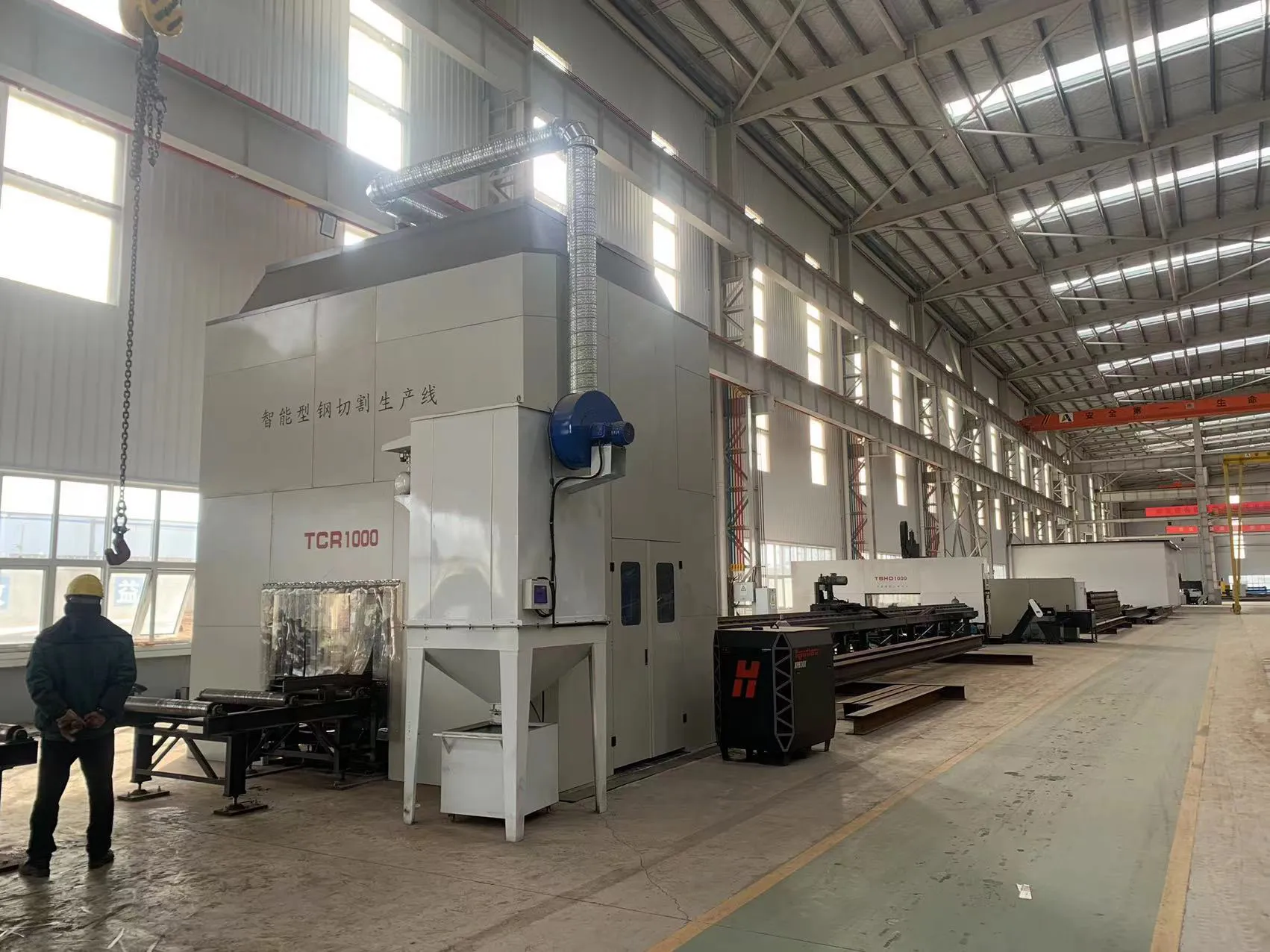
Technical Field Report: Implementation of 30kW Fiber Laser Profiling in Katowice Stadium Steel Infrastructure
1. Project Scope and Site Context
This report details the technical deployment and operational validation of a 30kW Heavy-Duty I-Beam Laser Profiler equipped with a 5-axis ±45° beveling head. The installation site, located in Katowice, Poland—a region synonymous with heavy industrial fabrication—serves a large-scale project involving the structural framework for a modern multi-purpose stadium.
The primary engineering challenge lies in the fabrication of massive, long-span I-beams (IPE and HEB profiles) required for the stadium’s cantilevered roof and primary support columns. Traditional methods involving oxy-fuel cutting or mechanical drilling/milling proved insufficient for the required tolerances and weld preparation speeds. The integration of 30kW fiber laser technology aims to consolidate multiple processing steps into a single automated cycle.
2. The 30kW Fiber Laser Source: Power Density and Kerf Dynamics
The transition to a 30kW fiber laser source represents a paradigm shift in structural steel processing. At this power level, the energy density at the focal point exceeds 50 MW/cm², allowing for rapid fusion cutting of thick-walled I-beams.
In the Katowice stadium project, flange thicknesses frequently exceed 25mm. While lower-wattage lasers (12kW–20kW) can penetrate these materials, they often suffer from reduced feed rates and wider Heat-Affected Zones (HAZ). The 30kW source allows for:
- High-Speed Vaporization: Minimizing the time the material spends at critical temperatures, thereby reducing thermal distortion across the 12-meter beam lengths.
- Gas Dynamics Optimization: The use of high-pressure oxygen (O2) or nitrogen (N2) assist gases at 30kW ensures that the dross is ejected efficiently from deep kerfs, leaving a surface roughness (Ra) that often bypasses the need for secondary shot blasting or grinding.
- Narrow Kerf Width: Maintaining a kerf under 0.8mm even in thick sections, which is critical for the tight fit-up tolerances required in stadium structural nodes.
3. ±45° Bevel Cutting: Solving the Weld Preparation Bottleneck
The most significant technical advancement in this profiler is the 5-axis ±45° 3D cutting head. In heavy stadium structures, beams rarely meet at 90° angles. Complex nodal intersections require V, Y, and X-type bevels to ensure full-penetration welds (CJP).
Kinematic Precision:
The profiler utilizes a synchronized 5-axis motion system where the cutting head oscillates and rotates while the I-beam is indexed via a heavy-duty chuck and support system. The ±45° capability allows for the direct cutting of weld preparations on both the web and the flanges without removing the beam from the machine.
Eliminating Secondary Operations:
Previously, bevels were ground manually or cut using portable oxy-fuel tractors. This introduced human error and significant labor costs. The laser profiler executes these bevels with a spatial accuracy of ±0.05mm. In Katowice, we observed that the “butt-joint” fit-up of I-beams for the stadium’s primary arches achieved a zero-gap tolerance across the entire profile circumference, significantly reducing the volume of filler metal required during the welding phase.
4. Structural Processing of Heavy-Duty I-Beams
Processing I-beams for a stadium involves more than simple cut-to-length operations. It requires intricate “bird-mouth” cuts, bolt hole arrays, and cope cuts for interlocking members.
Mechanical Handling and Clamping:
The “Heavy-Duty” designation of the profiler refers to its ability to handle HEB 600 sections weighing several tons. The Katowice installation utilizes a multi-point hydraulic clamping system that compensates for the inherent “bow and twist” found in hot-rolled structural steel.
Real-Time Compensation:
The system employs a laser-based sensing unit that scans the actual profile of the I-beam before the cut begins. If the I-beam’s flange is slightly deformed from the mill, the CNC controller adjusts the 3D cutting path in real-time. This ensures that the ±45° bevel remains consistent relative to the material surface, rather than the theoretical CAD model, which is vital for the structural integrity of the stadium’s load-bearing nodes.
5. Synergy Between Power and Automation
The 30kW source synergizes with automated structural processing through the integration of sophisticated nesting and CAM software.
Thermal Management:
At 30kW, the heat input is localized but intense. The automation system manages the “cutting sequence” to distribute heat. For the stadium project, the software calculates a non-linear cutting path, jumping between the web and flanges to prevent localized warping of the beam’s geometry.
Throughput Analysis:
Data from the Katowice field site indicates a 400% increase in throughput compared to conventional mechanical processing. A complex I-beam end-profile with a double-sided Y-bevel and a 12-hole bolt pattern, which previously took 3 hours of layout and manual labor, is now completed in under 12 minutes with the 30kW laser system.
6. Metallurgical Considerations and Weldability
A primary concern in the Katowice stadium project was the impact of high-power laser cutting on the grain structure of S355J2+N steel.
Technical analysis of the cut edges produced by the 30kW source shows a remarkably thin martensitic layer. Due to the high cutting speeds, the cooling rate is optimized, preventing excessive hardening of the edge. This is critical because stadium structures are subject to dynamic loading (wind, vibration, crowd movement), and brittle edges can become initiation points for fatigue cracks. The 30kW laser maintains the metallurgical integrity of the I-beam, ensuring that the subsequent welding process achieves full fusion with the base metal without the need for extensive edge-tempering.
7. Challenges in the Field and Technical Solutions
During the commissioning phase in Katowice, two primary technical challenges were addressed:
1. Beam Resonance: During high-speed profiling of long-span beams, mechanical resonance can affect cut quality. We implemented an adaptive hydraulic damping system that follows the cutting head, providing localized rigidity to the I-beam web during high-frequency laser oscillations.
2. Optical Contamination: In a heavy steel environment, dust and metallic particles are prevalent. The 30kW head requires ultra-pure internal optics. We established a positive-pressure “clean-air” curtain around the cutting nozzle and integrated a dual-stage filtration system for the assist gases to prevent lens “pitting,” which is catastrophic at 30kW power levels.
8. Conclusion: The New Standard for Stadium Fabrication
The deployment of the 30kW Heavy-Duty I-Beam Laser Profiler in Katowice has demonstrated that high-power fiber lasers are no longer limited to thin sheet metal. By integrating ±45° beveling capability, the system addresses the most labor-intensive aspects of stadium steel construction.
The precision of the 30kW source ensures that the complex geometries required for modern architectural designs are met with surgical accuracy. As stadium structures continue to push the limits of span and weight, the ability to process heavy-duty I-beams with this level of efficiency and precision becomes not just an advantage, but a necessity for structural engineering firms in the Silesian industrial hub and beyond.
The successful validation of this technology in the Katowice project sets a new benchmark for the “Automated Steel Factory,” where the transition from raw I-beam to weld-ready structural component is seamless, rapid, and mathematically perfect.













