The Dawn of Ultra-High Power in Sao Paulo’s Industrial Heartland
Sao Paulo stands as the epicenter of South American logistics, a city where the demand for robust railway infrastructure is perpetually increasing. To meet the expansion goals of regional rail links and the modernization of urban transit systems like the CPTM and the Metrô, the fabrication of structural steel must evolve. Enter the 30kW Fiber Laser Heavy-Duty I-Beam Laser Profiler.
For years, the industry relied on 6kW or 12kW systems, which were efficient for thin plates but struggled with the massive cross-sections required for railway girders. The leap to 30kW is not merely a linear upgrade in power; it is a fundamental shift in what is possible. In the context of Sao Paulo’s heavy industry, this power level allows for the high-speed processing of carbon steel thicknesses that were previously the exclusive domain of mechanical saws and thermal oxy-fuel cutting. The 30kW source provides the energy density required to maintain a stable kerf even in the thickest sections of an I-beam’s web and flange.
Precision Engineering: The ±45° Bevel Advantage
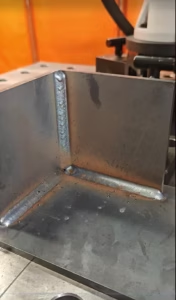
In railway infrastructure, the strength of a structure is only as good as its welds. Traditional straight-cut profiling requires a secondary process—manual grinding or machining—to create the bevels necessary for deep-penetration welding. The 30kW profiler eliminates this bottleneck through its integrated 5-axis cutting head.
The ability to perform ±45° bevel cutting on-the-fly is a game-changer for Sao Paulo’s fabricators. Whether creating V, Y, X, or K-shaped grooves, the laser head adjusts its orientation dynamically as it traverses the complex geometry of the I-beam. This precision ensures that when two massive structural components meet, the fit-up is perfect. This reduces the volume of filler wire required and minimizes the heat-affected zone (HAZ), resulting in stronger, more reliable joints for bridges and overhead electrification masts that must withstand decades of vibration and load-cycling.
Architectural Mastery of Heavy-Duty Profiling
Handling an I-beam that can weigh several tons requires more than just a powerful laser; it requires a specialized mechanical ecosystem. These heavy-duty profilers utilize sophisticated “chuck” systems—often three or four large-scale pneumatic or hydraulic rotators—that synchronize to move the beam through the cutting zone with sub-millimeter accuracy.
In the fabrication shops of Guarulhos or ABC Paulista, these machines are transforming raw 12-meter I-beams into finished components in a single pass. The machine’s software compensates for the inherent deviations in heavy structural steel, such as “camber” or “sweep.” By using touch-probes or laser sensors to map the actual profile of the beam before cutting, the 30kW system ensures that bolt holes, notches, and bevels are placed exactly where they belong relative to the beam’s center line, regardless of mill tolerances.
Impact on Railway Infrastructure and Rolling Stock
The railway sector demands high-volume production of standardized yet complex parts. The 30kW laser profiler excels in several specific applications:
1. **Bridge Girders:** Large I-beams used in railway overpasses require intricate cutouts for stiffeners and cross-bracing. The 30kW laser slices through these sections with a speed that plasma cannot match, leaving a mirror-like finish that requires zero post-processing.
2. **Sleeper Supports and Track Hardware:** Precision-cut holes for heavy-duty bolting are essential. The laser’s ability to maintain circularity in thick material ensures that structural integrity is never compromised by jagged hole edges.
3. **Rolling Stock Chassis:** The frames of freight wagons and passenger cars are built from high-strength structural profiles. The ±45° beveling allows for streamlined assembly of these frames, reducing the overall weight of the vehicle while maintaining structural rigidity.
Economic and Environmental Efficiency in the Brazilian Context
For Sao Paulo-based enterprises, the move to 30kW fiber lasers is also an economic imperative. Brazil’s electricity costs and the price of raw steel mean that “scrap-reduction” and “energy-per-cut” are vital metrics.
Fiber lasers are significantly more energy-efficient than older CO2 lasers or even high-definition plasma systems when factoring in the speed of the cut. A 30kW laser can cut 20mm carbon steel several times faster than a 12kW system, meaning the “time-on-beam” is reduced, lowering the total kVA consumed per part. Furthermore, the precision of the laser allows for tighter nesting of parts and fewer “off-cuts,” maximizing the utility of every ton of steel processed.
In a city like Sao Paulo, where environmental regulations are becoming increasingly stringent, the fiber laser offers a cleaner alternative. It produces fewer fumes than oxy-fuel and eliminates the need for the chemical baths often associated with traditional machining and de-burring, aligning railway expansion with modern ESG (Environmental, Social, and Governance) goals.
Addressing the Technical Challenges of 30kW Systems
Operating at 30kW is not without its challenges. The optics must be of the highest quality to prevent “thermal shift,” where the heat from the laser beam slightly deforms the focusing lens, causing the focal point to drift. Modern profilers in the Sao Paulo market utilize “intelligent” cutting heads equipped with real-time monitoring sensors. These sensors track the temperature of the protective windows and the status of the beam, automatically adjusting the focus to maintain a consistent cut quality.
Furthermore, the gas dynamics at 30kW are critical. Whether using oxygen for exothermic cutting of carbon steel or nitrogen for high-pressure melting, the nozzle design must be perfect. Expert operators in Brazil are now trained to use “high-speed nozzles” that optimize gas flow, ensuring that the molten dross is ejected cleanly from the bottom of the cut, even during high-angle beveling where the “effective thickness” of the material increases significantly.
Integration with Industry 4.0
The modern 30kW I-beam profiler is a data-driven machine. In the smart factories of Sao Paulo, these systems are integrated into the broader ERP (Enterprise Resource Planning) and BIM (Building Information Modeling) workflows. A structural engineer can design a complex railway junction in 3D software, and that data can be fed directly to the laser profiler.
The machine’s controller calculates the complex kinematics required to move the heavy beam and the 5-axis head in unison. This “Digital-to-Steel” pipeline eliminates human error in measurement and layout, which is traditionally where most fabrication delays occur. For massive projects like the “Trem Intercidades” (TIC) connecting Sao Paulo to Campinas, this level of digital integration is essential for meeting aggressive construction timelines.
The Future of Rail Fabrication in Brazil
As Sao Paulo continues to lead the way in Latin American infrastructure, the role of ultra-high-power fiber lasers will only grow. We are already seeing the emergence of 40kW and 50kW systems, but the 30kW remains the current “sweet spot” for ROI, balancing power with manageable operational costs.
The 30kW Fiber Laser Heavy-Duty I-Beam Laser Profiler with ±45° Bevel Cutting is more than just a tool; it is a catalyst for a more robust, efficient, and modern railway network. By providing the means to process heavy structural steel with the precision of a surgeon and the speed of a jet, it ensures that the backbone of Brazil’s transport infrastructure is built to last for the next century. For the engineers and fabricators of Sao Paulo, the message is clear: the future of rail is forged in light.