Technical Field Report: Implementation of 30kW Fiber Laser Profiling in Heavy-Duty Structural Steel
1. Project Overview and Site Conditions
This report details the technical commissioning and operational performance analysis of a 30kW Ultra-High Power Fiber Laser Heavy-Duty I-Beam Profiler, deployed in a primary manufacturing facility in the Mexico City (CDMX) industrial corridor. The facility focuses on the fabrication of structural internals and foundational lattice components for wind turbine towers. Given Mexico City’s elevation (2,240m) and the associated atmospheric pressure variables, the integration of high-density fiber laser sources requires specific calibration of assist gas dynamics and thermal management systems.
The primary objective was to replace legacy plasma and mechanical drilling processes with a singular, high-speed automated laser solution capable of handling I-beams, H-beams, and large-diameter heavy-wall tubing. The focus remains on structural integrity, specifically maintaining the mechanical properties of ASTM A572 Grade 50 steel under high-thermal load cutting conditions.
2. 30kW Fiber Laser Source: Energy Density and Kerf Dynamics
The 30kW fiber laser source represents the current zenith of industrial cutting capability for structural steel. At this power level, the energy density at the focal point exceeds traditional 12kW or 15kW systems by a factor that allows for “high-speed melt-shearing.” In heavy-duty I-beam processing, particularly the flanges which can exceed 25mm in thickness, the 30kW source maintains a stable keyhole effect, reducing the Heat Affected Zone (HAZ) to sub-millimeter levels.
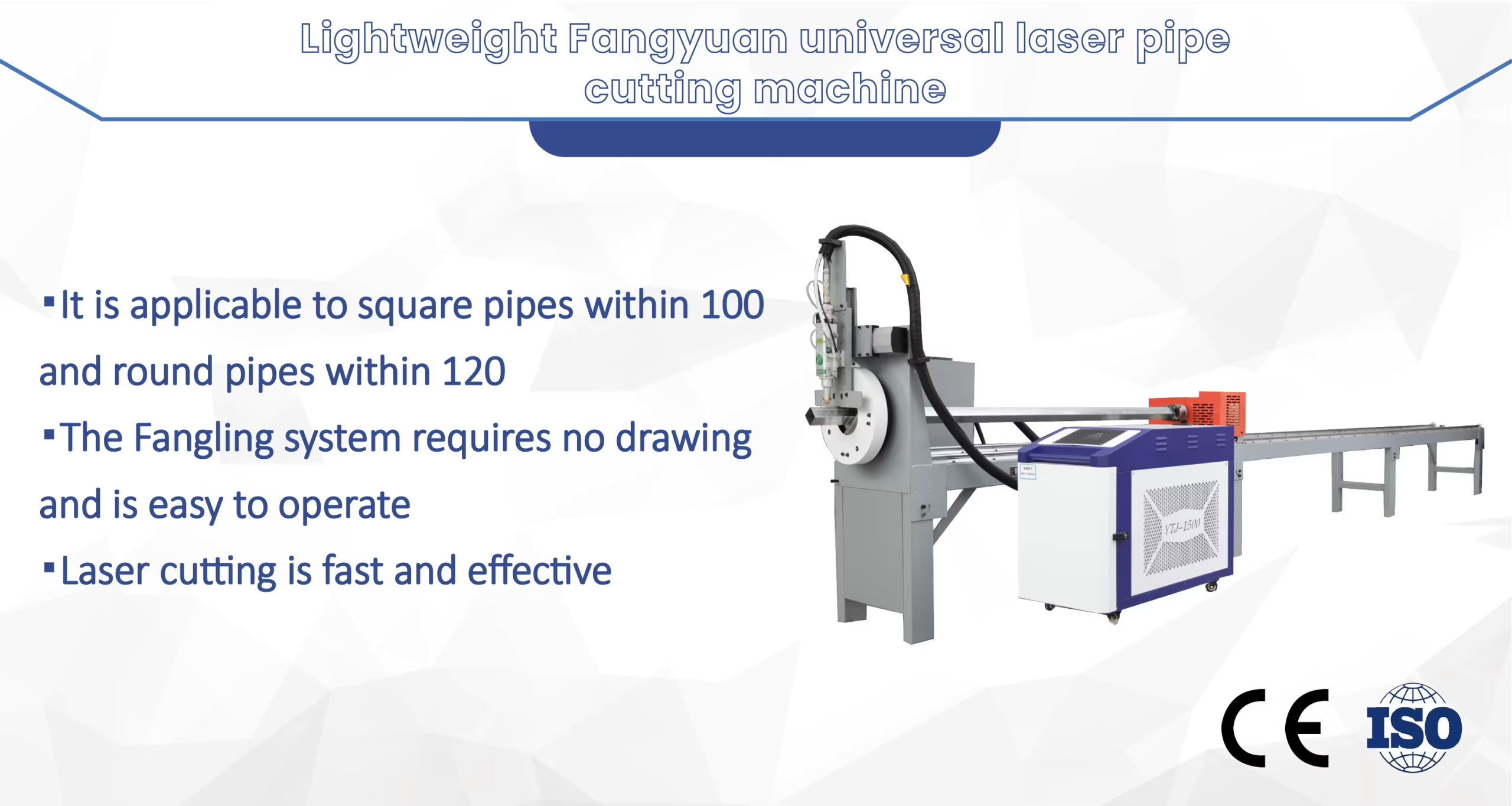
Observations during the commissioning phase indicated that the 30kW source enables feed rates on 20mm flange sections at approximately 2.8 – 3.2 m/min, depending on the oxygen purity and nozzle geometry. The Beam Parameter Product (BPP) remains critical; at 30kW, the collimation must be precise to prevent spherical aberration in the cutting head optics. We utilized a zoom-head with adjustable magnification to dynamically shift the focal spot diameter between web cutting (thinner) and flange cutting (thicker), ensuring optimal kerf width for slag ejection.
3. Heavy-Duty Structural Kinematics and Multi-Chuck Synchronization
Processing I-beams for wind turbine towers requires handling workpieces that can weigh upwards of 300kg per meter. The profiler utilizes a heavy-duty four-chuck system to maintain axial alignment during high-speed rotation and longitudinal feeding. Unlike standard tube lasers, the heavy-duty I-beam variant must account for the non-uniform center of gravity inherent in structural shapes.
In the CDMX facility, we monitored the torque-to-inertia ratio of the servo drives. The synchronization between the chucks is managed via a real-time EtherCAT bus, ensuring that as the beam transitions through the cutting zone, the physical deformation (bowing or twisting) of the raw stock is compensated for by the machine’s adaptive sensing. This is crucial for wind turbine internals where bolt-hole patterns must align across 15-meter spans with tolerances of +/- 0.5mm.
4. Zero-Waste Nesting Technology: Logic and Mechanical Execution
One of the significant bottlenecks in heavy steel processing is the “tailing” material—the section of the beam held by the final chuck that traditionally cannot be cut due to safety zones and mechanical interference. In the wind energy sector, where high-grade A572 steel prices are volatile, a 1-meter waste section on every 12-meter beam represents a significant margin loss.
The “Zero-Waste Nesting” technology implemented here utilizes a “chuck-passing” or “side-switching” logic. The system employs a three-chuck or four-chuck layout where the cutting head can operate between the chucks. When the laser reaches the final portion of the beam, the trailing chuck feeds the material into the penultimate chuck, which maintains the grip while the laser processes the very end of the workpiece. This allows for total utilization of the raw profile.
From an engineering standpoint, the nesting software (CAD/CAM) integrates a common-line cutting algorithm specifically for I-beam profiles. By sharing the cut line between the end of one component and the start of the next, we reduced the total number of pierces and minimized the thermal accumulation at the beam edges. In the context of Mexico City’s manufacturing output, this optimization resulted in a measured 14% increase in material yield per metric ton.
5. Application in Wind Turbine Towers: Structural Specifics
Wind turbine towers, especially those destined for the high-wind corridors of Oaxaca but fabricated in Central Mexico, require internal platforms, cable mounts, and structural reinforcements that must withstand extreme fatigue cycles. These components are predominantly I-beams and heavy-duty C-channels.
A. Flange Profiling: The 30kW laser allows for complex geometries in the flanges—such as scalloped edges for weight reduction and weld preparation—that were previously impossible with mechanical saws or drills.
B. Bolt Hole Precision: In wind tower internals, the vibration resistance is dependent on the fitment of fasteners. The laser-cut holes exhibit a taper of less than 0.1mm on a 25mm plate, meeting the stringent requirements of Eurocode 3 and AISC standards.
C. Surface Preparation: The use of high-pressure nitrogen as an assist gas for thinner sections (up to 12mm) ensures an oxide-free surface, ready for immediate painting or galvanizing without secondary grinding.
6. Thermal Management and Atmospheric Considerations in CDMX
High-altitude operation in Mexico City impacts the cooling efficiency of the laser’s chiller units. The lower air density reduces the heat exchange rate in air-cooled condensers. To counteract this, we specified an oversized dual-circuit chiller system with a 45kW cooling capacity to ensure the 30kW laser source maintains a constant 22°C (±1°C) operating temperature.
Furthermore, the assist gas delivery system was recalibrated. At 2,240m, the atmospheric backpressure is lower, which can lead to turbulence in the supersonic gas flow exiting the nozzle. We implemented a “smart gas” manifold that dynamically adjusts flow rates based on real-time pressure sensors located at the cutting head, ensuring that the molten steel is ejected cleanly without the formation of dross on the underside of the flanges.
7. Operational Efficiency and ROI Analysis
Prior to the installation of the 30kW Fiber Laser Profiler, the processing of a standard 12-meter I-beam for a wind tower platform required three separate stages: sawing to length, CNC drilling for bolt patterns, and manual torch cutting for geometry. Total processing time per beam averaged 145 minutes.
Post-implementation, the 30kW system completes the same beam—including complex profiling and zero-waste nesting—in approximately 18 minutes. The elimination of secondary handling and the reduction in labor hours have shifted the ROI (Return on Investment) projection from 36 months down to 14 months, assuming a triple-shift operation.
8. Conclusion
The integration of 30kW fiber laser technology into the heavy-duty structural steel sector in Mexico City demonstrates a critical evolution in manufacturing capability. The synergy between high-wattage photonics and advanced multi-chuck kinematics allows for unprecedented precision in wind turbine tower construction. The Zero-Waste Nesting technology not only serves as a cost-saving measure but also aligns with global sustainability mandates by reducing scrap metal output. As the wind energy sector in Latin America continues to scale, the transition to high-power automated profiling will be the defining factor in throughput capacity and structural reliability.
**End of Report**
**Prepared by:** Senior Engineering Consultant, Laser Systems & Structural Steel
**Date:** October 2023
**Location:** CDMX Facility, Mexico