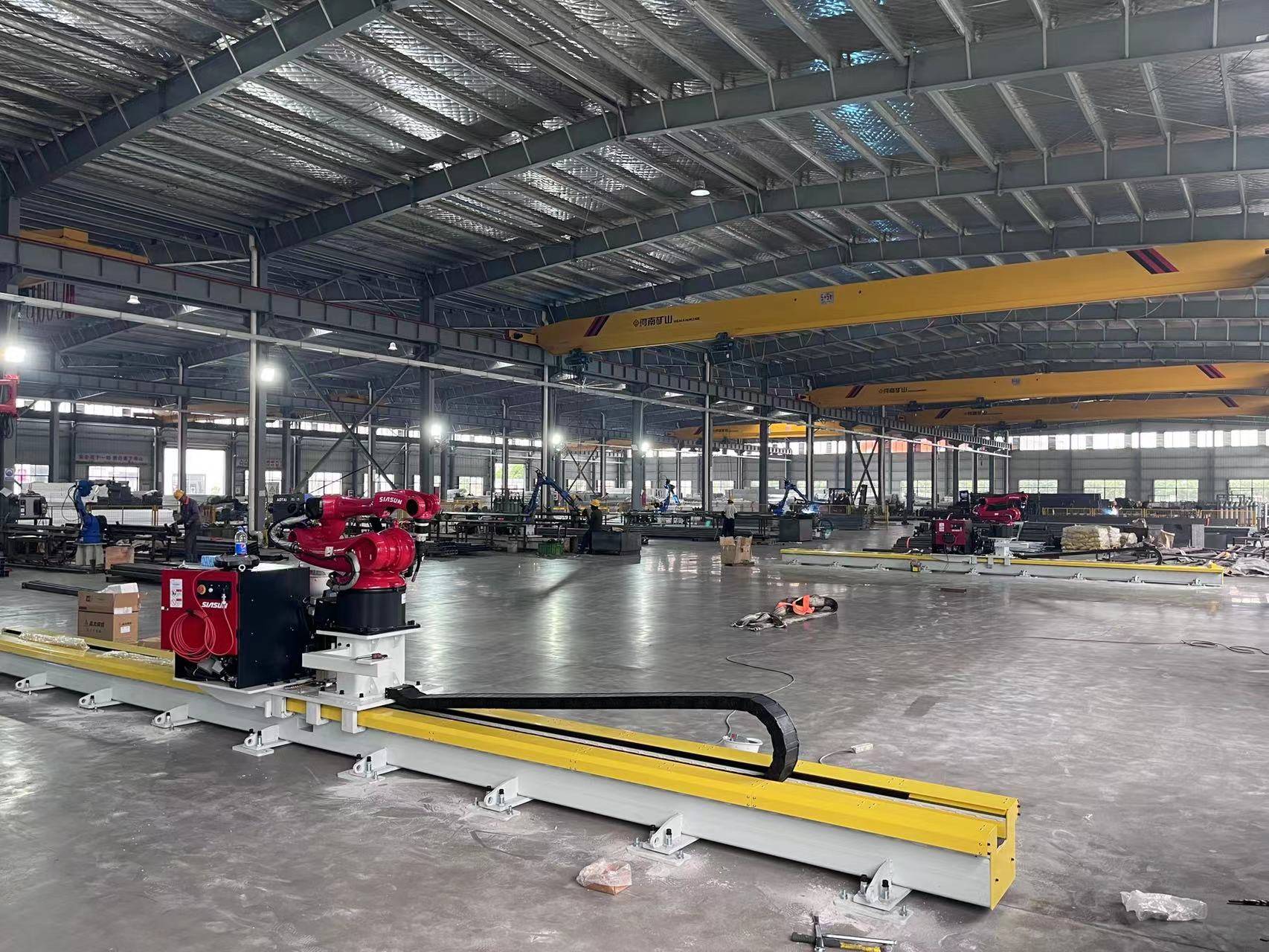
The Industrial Renaissance of Casablanca: A Hub for Railway Excellence
Casablanca has long served as the beating heart of Morocco’s industrial sector, but the current decade has seen its role evolve from a regional trade port to a sophisticated manufacturing powerhouse. At the center of this evolution is the ambitious expansion of the national railway network (ONCF). To meet the stringent deadlines and the high-quality standards required for modern rail infrastructure—ranging from high-speed track supports to massive urban transit interchanges—traditional fabrication methods are no longer sufficient.
The introduction of the 30kW Fiber Laser Heavy-Duty I-Beam Laser Profiler represents a paradigm shift. Historically, structural steel fabrication for railways relied on mechanical sawing, drilling, and plasma cutting. While functional, these methods introduced significant thermal deformation and required multiple stages of secondary processing. In the high-stakes environment of Casablanca’s industrial zones, the move to 30kW fiber laser technology allows for the consolidation of these processes into a single, automated workflow, ensuring that Morocco remains at the forefront of African infrastructure development.
Unleashing the Power: The 30kW Fiber Laser Advantage
In the realm of fiber lasers, power is not merely about speed; it is about the “thickness-to-quality” ratio. A 30kW laser source provides an extraordinary power density that fundamentally changes how structural steel—specifically I-beams, H-beams, and heavy channels—is processed.
At 30,000 watts, the laser can effortlessly penetrate carbon steel sections up to 50mm thick with a surgical precision that was previously unthinkable. For railway infrastructure, where structural members must withstand immense dynamic loads, the Heat Affected Zone (HAZ) is a critical factor. Lower-power lasers or plasma cutters often create a significant HAZ that can lead to embrittlement or micro-cracking. The 30kW source, through its sheer velocity and concentrated energy beam, minimizes the time the material is exposed to heat, preserving the metallurgical integrity of the I-beam’s web and flanges.
Furthermore, the 30kW threshold enables “high-pressure air cutting” on thicknesses where oxygen or nitrogen were previously mandatory. This reduces the cost per part significantly, a vital advantage for large-scale public works projects in Casablanca where budget efficiency is as important as structural safety.
Precision Profiling of Heavy-Duty I-Beams
Processing structural steel for railways involves more than just straight cuts. It requires complex geometry: coping, beveling for weld preparation, bolt-hole synchronization, and intricate cutouts for utility pass-throughs. The Heavy-Duty I-Beam Laser Profiler is specifically engineered to handle the physical mass of these components, which can often reach lengths of 12 meters or more and weights of several tons.
The machine’s architecture utilizes a 3D five-axis cutting head, allowing the laser to rotate around the beam’s profile. This enables the machine to cut the top and bottom flanges as well as the web in a single program cycle. For railway bridges and station frameworks, where precision alignment is non-negotiable, the ability to laser-cut bolt holes with a tolerance of +/- 0.1mm ensures that site assembly is seamless. This eliminates the need for “on-site reaming” or corrective welding, which are common bottlenecks in Moroccan infrastructure projects.
Zero-Waste Nesting: Economics Meets Ecology
Material costs represent the largest overhead in railway fabrication. Structural steel is a global commodity, and price fluctuations can jeopardize the feasibility of large-scale projects. This is where “Zero-Waste Nesting” software becomes the silent hero of the 30kW profiler.
Traditional nesting for I-beams often results in significant “drop” or scrap ends—sometimes up to 10% of the raw material. The advanced nesting algorithms integrated into these high-power systems utilize “common line cutting” and “butt-end optimization.” By analyzing the entire production queue, the software can nest multiple different parts—for example, short bracing sections and long primary rafters—onto a single beam with millimetric gaps.
In the context of Casablanca’s push toward “Green Industry,” zero-waste nesting is not just an economic strategy; it is an environmental imperative. By reducing scrap, the carbon footprint associated with steel production and recycling is mitigated. The 30kW laser’s efficiency ensures that every centimeter of imported or locally rolled steel is utilized to its maximum potential, directly supporting Morocco’s sustainable development goals.
Revolutionizing Railway Infrastructure Components
The applications of this technology within the railway sector are vast. Beyond the obvious structural beams for stations and depots, the 30kW profiler is instrumental in creating:
1. **Catenary Masts:** The vertical supports for overhead power lines require precise tapering and mounting holes to withstand wind loads and wire tension.
2. **Bogie Frames:** The heavy steel frames for rolling stock demand high-strength welds. The 30kW laser provides perfect bevels, ensuring 100% weld penetration and long-term durability.
3. **Switch and Crossing Components:** These complex geometries are subject to constant friction and impact. Laser profiling allows for the use of hardened alloys that are difficult to machine mechanically but respond perfectly to fiber laser thermal processing.
4. **Acoustic Barriers and Bridge Decking:** Massive quantities of repetitive structural elements can be produced at speeds that keep pace with the rapid track-laying schedules of the ONCF.
Overcoming Challenges: The Casablanca Industrial Environment
Operating a 30kW laser in a coastal, industrial city like Casablanca presents unique challenges, primarily regarding humidity and power stability. Expert integration involves sophisticated chiller systems to maintain the laser source at a constant temperature and advanced filtration to protect the optics from the saline air of the Atlantic coast.
Furthermore, the transition to such high-power machinery requires a localized focus on skill development. The implementation of these machines in Casablanca is typically accompanied by intensive training programs for Moroccan engineers and technicians. This fosters a local ecosystem of expertise, ensuring that the maintenance and optimization of these complex systems are handled by a domestic workforce, further strengthening the “Made in Morocco” initiative.
Safety and Compliance in the Rail Sector
Railway infrastructure is governed by some of the world’s strictest safety standards, such as EN 1090 for structural steel and ISO 3834 for welding. The 30kW fiber laser profiler aids in compliance by providing digital traceability. Every cut, every hole, and every bevel is recorded by the CNC system. If a structural issue is identified years later, the digital “birth certificate” of the component—detailing the exact laser parameters and material batch—can be retrieved.
The precision of laser cutting also ensures that the fatigue life of the steel is not compromised. Mechanical shearing or poor-quality plasma cuts can leave micro-burrs or jagged edges that act as stress concentrators. The smooth, glass-like finish of a 30kW laser cut significantly reduces the risk of fatigue crack initiation, a critical factor for infrastructure that must last for 50 to 100 years.
Conclusion: The Future of Moroccan Fabrication
The deployment of a 30kW Fiber Laser Heavy-Duty I-Beam Profiler with Zero-Waste Nesting is more than a purchase of industrial equipment; it is a strategic investment in the future of Morocco’s connectivity. By centering this technology in Casablanca, the nation secures its ability to build faster, stronger, and more sustainably.
As the rails extend from Tangier to Agadir and beyond, the precision of the fiber laser will be embedded in every kilometer of the journey. For the fiber laser expert, the sight of a 30kW beam slicing through heavy steel is a vision of industrial efficiency. For the citizens of Morocco, it is the sound of progress—a promise of a modernized, world-class railway infrastructure built with the highest levels of technological integrity and environmental responsibility. Through this intersection of high-power photonics and heavy engineering, Casablanca is not just participating in the global industrial stage; it is setting the pace for the entire continent.