The Dawn of Ultra-High Power in the Eastern Province
Dammam has long been the heartbeat of the global energy industry, serving as the primary logistics and fabrication hub for Saudi Aramco and the numerous offshore projects dotting the Arabian Gulf. Traditionally, the fabrication of heavy structural steel—specifically I-beams, H-beams, and C-channels—relied on plasma cutting or mechanical sawing and drilling. While reliable, these methods often lacked the precision required for the complex geometries and tight tolerances of modern offshore platform design.
The introduction of the 30kW Fiber Laser Heavy-Duty I-Beam Laser Profiler changes the calculus entirely. At 30,000 watts, the laser source delivers an energy density capable of vaporizing thick-walled structural steel at speeds that leave traditional methods obsolete. In a region where time-to-market for energy infrastructure translates directly to economic throughput, the ability to cut, bevel, and mark a 12-meter I-beam in a single automated pass is transformative.
The Technical Superiority of 30kW Fiber Laser Sources
Why 30kW? In the world of fiber lasers, power correlates not just to the thickness of the material, but to the quality and speed of the cut. For offshore platforms, structural members are frequently composed of high-strength carbon steel with thicknesses exceeding 20mm to 40mm.
A 30kW source allows for “high-speed fusion cutting,” which significantly reduces the Heat Affected Zone (HAZ). In offshore engineering, minimizing the HAZ is critical; excessive heat can alter the metallurgical properties of the steel, leading to brittleness and potential failure under the extreme stress and corrosive conditions of the sea. The 30kW fiber laser maintains the structural integrity of the I-beam while providing a mirror-like finish on the cut edge, often eliminating the need for secondary grinding or finishing.
Furthermore, the beam quality (BPP) of modern 30kW sources is optimized to maintain a consistent kerf width throughout the depth of the cut. This is essential when processing large-scale I-beams where the laser must often travel through varying thicknesses due to the web and flange geometry.
3D Profiling: The Geometry of Offshore Success
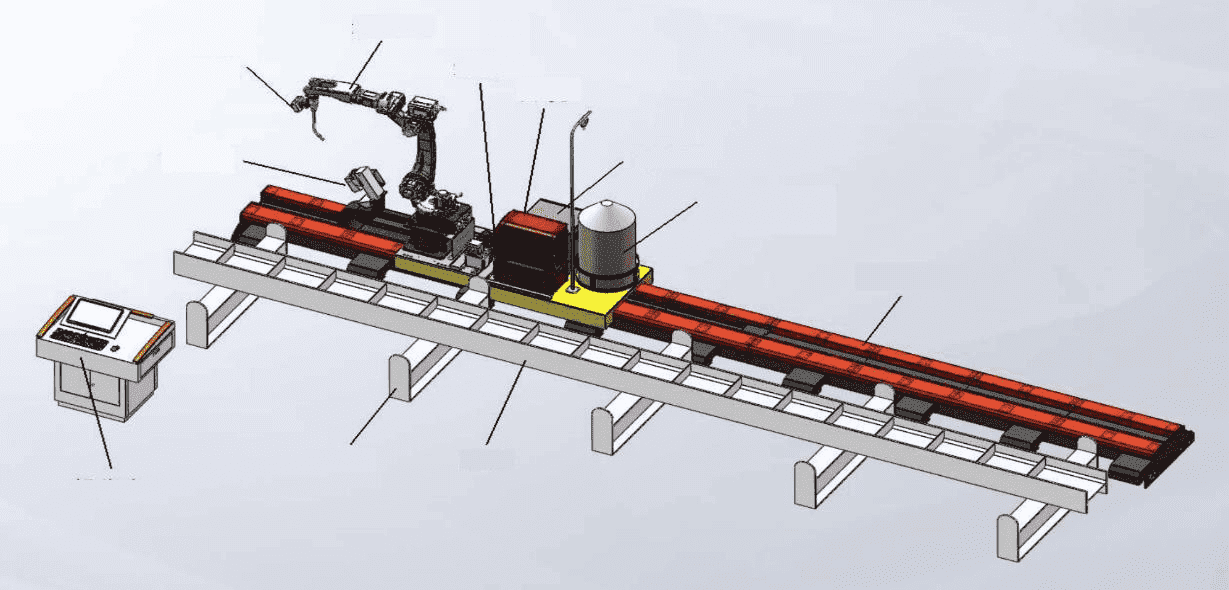
Offshore platforms are marvels of structural engineering, requiring complex intersections of beams and pipes to withstand wave loads and seismic activity. A heavy-duty I-beam laser profiler is not a simple flatbed machine; it is a multi-axis robotic powerhouse.
Equipped with a 5-axis or 6-axis cutting head, these machines can perform complex beveling—V-cuts, Y-cuts, and K-cuts—directly onto the flanges and webs of I-beams. For Dammam’s fabricators, this means that parts coming off the laser are “weld-ready.” In the past, creating a 45-degree bevel on a heavy H-beam required manual torching and hours of labor. Today, the 30kW profiler executes these geometries with sub-millimeter accuracy, ensuring that when the components arrive at the shipyard at King Abdulaziz Port, they fit together perfectly, reducing “re-work” to near zero.
Automation and the Power of Automatic Unloading
In the heavy-duty sector, the “bottleneck” is rarely the cutting speed alone; it is the material handling. An I-beam used for an offshore jacket can weigh several tons. Manually moving these sections using overhead cranes is dangerous, slow, and prone to damaging the material.
The inclusion of an Automatic Unloading System is what elevates this machine from a tool to a production cell. As the 30kW laser finishes the final cut, a series of synchronized hydraulic lift-arms and conveyor systems take over. These systems are designed to support the weight of the beam across its entire length, preventing bowing or scratching.
In the high-heat environment of Dammam, reducing manual labor near the cutting zone also improves worker safety and comfort. The automated system categorizes the finished parts and moves them to a designated staging area, allowing the machine to immediately begin the next program. This “lights-out” manufacturing capability is essential for meeting the aggressive deadlines of offshore commissioning cycles.
Environmental Resilience: Engineering for the Dammam Climate
Operating high-precision fiber lasers in the Eastern Province presents unique challenges, specifically extreme ambient temperatures and fine desert dust. A 30kW laser generates significant internal heat and requires a sophisticated cooling architecture.
The heavy-duty profilers deployed in Dammam are equipped with industrial-grade, dual-circuit chillers and hermetically sealed cabinets. The optical path is kept under constant positive pressure with filtered nitrogen to prevent the ingress of dust, which could otherwise lead to catastrophic “thermal lensing” or damage to the laser’s protective windows.
Moreover, the “heavy-duty” aspect of the machine’s bed is critical. The frame is typically heat-treated and stress-relieved to ensure that the expansion and contraction caused by Dammam’s diurnal temperature shifts do not affect the machine’s calibration. This mechanical stability ensures that a beam cut at 10:00 AM matches a beam cut at 10:00 PM with total repeatability.
Impact on the Offshore Supply Chain in Saudi Arabia
The deployment of these machines in Dammam significantly localizes the supply chain for the oil and gas sector. Previously, complex structural sections might have been imported from specialized fabricators in Europe or East Asia. By housing 30kW laser profiling capabilities locally, Saudi firms can respond to design changes in real-time.
For offshore platforms, which often require bespoke modifications based on the specific seabed conditions of a field (such as the Safaniyah or Manifa fields), local high-speed fabrication is a strategic advantage. It reduces shipping lead times and carbon footprints, contributing to the “In-Kingdom Total Value Add” (IKTVA) program.
The Synergy of Software and Hardware
A 30kW laser is only as smart as the software driving it. Modern profilers use advanced CAD/CAM integration specifically designed for structural steel (such as Tekla or Lantek). These systems allow engineers to import the entire 3D model of an offshore platform and “nest” the components across hundreds of I-beams to minimize scrap.
In Dammam’s competitive landscape, the ability to save 5% on raw material through intelligent nesting on a multi-million dollar project can be the difference between a winning and losing bid. The software also manages the 30kW power modulation, slowing down for intricate bolt holes and accelerating for long straight cuts, ensuring optimal gas consumption and edge quality.
Conclusion: The Future of Maritime Fabrication
The 30kW Fiber Laser Heavy-Duty I-Beam Laser Profiler with Automatic Unloading is more than just a piece of machinery; it is an industrial statement. For the offshore industry in Dammam, it represents the move toward a future where “Heavy Industry” and “High Tech” are synonymous.
As offshore platforms move into deeper waters and face harsher conditions, the demand for precision-engineered structural steel will only increase. By investing in ultra-high-power laser technology, Dammam’s fabrication hubs are not only securing their place as leaders in the Arabian Gulf but are also setting a global benchmark for how the energy infrastructure of tomorrow is built today. The combination of 30,000 watts of power and seamless automation ensures that the Kingdom remains at the cutting edge—quite literally—of the global energy transition.