The Dawn of Ultra-High-Power Laser Fabrication in Morocco
Casablanca has long been the beating heart of Morocco’s industrial ambition. As the city expands and the demand for rapid, sustainable infrastructure grows, the construction industry is pivoting toward modular methods. At the center of this revolution is the 30kW Fiber Laser Heavy-Duty I-Beam Laser Profiler. For years, the industry relied on plasma cutting or mechanical processing, which, while functional, lacked the finesse and speed required for modern high-tolerance modular assembly.
A 30kW laser source is not merely an incremental upgrade; it is a generational leap. At 30,000 watts, the laser beam possesses the energy density to vaporize thick structural steel almost instantaneously. For Casablanca’s steel fabricators, this means the ability to cut through the thickest flanges of heavy-duty I-beams (up to 40mm or more) with a heat-affected zone (HAZ) so minimal that it preserves the structural integrity of the steel. This is critical in modular construction, where every beam must fit into a pre-designed matrix with zero margin for error.
Engineering the 30kW I-Beam Profiler: Precision in Three Dimensions
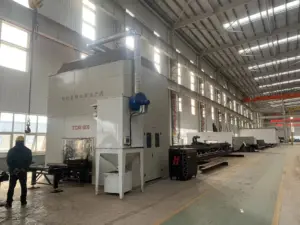
Processing an I-beam is significantly more complex than cutting a flat sheet of metal. It requires a machine capable of navigating the “web” and the “flanges” of the beam simultaneously. The heavy-duty profilers deployed in Casablanca feature advanced 5-axis or 6-axis 3D cutting heads. These heads can tilt and rotate, allowing the laser to perform complex “cope” cuts, bevels for welding preparation, and perfect bolt holes on all sides of the beam in a single pass.
The 30kW power allows for “flying cuts,” where the laser maintains high speeds even when navigating the transitions between the web and the flange. In the context of modular construction, this precision is transformative. When beams are pre-cut with integrated interlocking joints and precision-aligned holes, the onsite assembly time in Casablanca’s construction zones is reduced by up to 50%. The modular units—whether they are for offshore housing, industrial warehouses, or affordable urban apartments—can be bolted together with the ease of a high-tech “Meccano” set.
The Role of Automatic Unloading in Industrial Throughput
High-speed cutting is useless if the material handling becomes a bottleneck. A 12-meter structural I-beam is a massive, unwieldy piece of hardware. In traditional shops, moving these beams requires overhead cranes, multiple operators, and significant downtime. The integration of an Automatic Unloading System specifically designed for heavy-duty profiles changes the economic equation of the workshop.
In a typical Casablanca facility equipped with this technology, the process is seamless. Once the 30kW laser completes its 3D profiling, hydraulic lifters and synchronized conveyor systems move the finished beam out of the cutting zone. Sensors detect the weight and center of gravity, ensuring the beam is placed safely on the discharge racks without damaging the precision-cut edges. This automation reduces the labor-to-output ratio significantly and, perhaps more importantly, enhances workplace safety. In an era where “Industry 4.0” is the goal for Moroccan manufacturing, removing manual intervention from the handling of multi-ton steel beams is a vital step forward.
Modular Construction: Why Casablanca is the Ideal Hub
Morocco’s “Plan d’Accélération Industrielle” (Industrial Acceleration Plan) has positioned Casablanca as a strategic gateway between Europe and Sub-Saharan Africa. The city’s proximity to major ports and its growing network of high-speed rail and highways demand infrastructure that can be deployed quickly.
Modular construction is the answer to this demand. By fabricating the steel “skeletons” of buildings in a controlled factory environment in Casablanca using 30kW lasers, developers can bypass the delays often caused by Morocco’s seasonal weather or onsite logistics. The 30kW laser ensures that every modular component is a perfect carbon copy of the digital twin created in the CAD/CAM software. This level of repeatability is what allows a 10-story modular office building to be erected in a matter of weeks rather than years.
Technical Advantages: Beyond Just Speed
As a fiber laser expert, I often emphasize that the move to 30kW is also an environmental and economic decision. Fiber lasers are significantly more energy-efficient than older CO2 lasers or plasma cutters. The “wall-plug efficiency” of a 30kW fiber source means less electricity is wasted as heat, which is a major consideration for Casablanca’s industrial zones looking to reduce their carbon footprint.
Furthermore, the quality of the cut produced by a 30kW laser on an I-beam is “weld-ready.” This means the edge is so clean that it requires no secondary grinding or cleaning. In the modular construction workflow, this eliminates an entire stage of production. When you multiply those saved minutes by thousands of beams, the Return on Investment (ROI) for a 30kW system becomes clear within the first 18 to 24 months of operation.
Impact on the Local Labor Market and Skill Acquisition
The introduction of such high-end machinery into Casablanca is also elevating the local workforce. Operating a 30kW 3D laser profiler requires a blend of traditional structural engineering knowledge and advanced digital literacy. Moroccan engineers and technicians are becoming specialists in CNC programming, nesting optimization, and laser maintenance. This shift from “manual labor” to “technological oversight” is creating a new tier of high-paying industrial jobs, further cementing Casablanca’s status as a technological leader in the region.
Overcoming the Challenges of Heavy-Duty Profiling
Of course, operating a 30kW system comes with its own set of challenges. The sheer intensity of the laser requires robust machine beds that can withstand the weight of heavy I-beams without deforming. The machines used in Casablanca are built with high-manganese steel frames, heat-treated to ensure long-term stability.
Additionally, the cooling systems (chillers) must be top-tier to maintain the stability of the 30kW source. In the North African climate, where temperatures can soar, these systems are engineered with oversized heat exchangers to ensure the laser operates at peak efficiency 24/7. The “heavy-duty” moniker isn’t just marketing; it refers to the machine’s ability to survive the rigors of a high-output industrial environment.
The Future: From Casablanca to the World
The 30kW Fiber Laser Heavy-Duty I-Beam Laser Profiler with Automatic Unloading is more than a machine; it is a catalyst for economic growth. As Casablanca continues to modernize, the ability to export high-precision modular steel components to the rest of Africa and Europe will become a major economic driver.
We are seeing a move toward “smarter” modular units—buildings that are not just quickly assembled, but are stronger, lighter, and more complex in design. The 30kW laser makes these designs possible. Whether it’s creating intricate architectural facades on structural beams or ensuring the perfect fit for a seismic-resistant modular hospital, the precision of fiber laser technology is the foundation upon which Casablanca’s future is being built.
In conclusion, the convergence of high-power laser physics and heavy-duty mechanical automation is transforming the Moroccan construction landscape. The 30kW laser profiler is the ultimate tool for a city that refuses to slow down, providing the speed, precision, and efficiency required to turn the vision of modular, sustainable urban development into a reality.