The Dawn of High-Power Laser Fabrication in Ho Chi Minh City
Ho Chi Minh City (HCMC) stands as a testament to rapid urbanization, where the demand for bridges, flyovers, and elevated transit systems is at an all-time high. Historically, the fabrication of heavy structural steel—specifically I-beams, H-beams, and U-channels—relied on plasma cutting or mechanical sawing. While functional, these methods often left substantial Heat Affected Zones (HAZ), required extensive secondary grinding, and lacked the precision necessary for complex interlocking bridge designs.
The arrival of 30kW fiber laser technology has fundamentally altered this equation. As a fiber laser expert, I have witnessed the transition from 6kW and 12kW systems to the current 30kW standard. In the context of HCMC’s bridge engineering sector, this is not just an incremental upgrade; it is a disruptive evolution. A 30kW source provides the photon density required to “vaporize” thick-walled structural steel almost instantaneously, ensuring that the structural integrity of the bridge components is maintained through minimal thermal distortion.
Technical Superiority: The 30kW Advantage
In bridge engineering, thickness is a constant variable. We are often dealing with carbon steel flanges and webs that exceed 25mm to 40mm in thickness. At lower power levels, laser cutting becomes slow and loses the “edge quality” required for high-stress load-bearing joints.
The 30kW fiber laser profiler excels by maintaining a high cutting speed even on heavy-duty profiles. This power allows for a “bright surface” cut on thick plates, which means the resulting edge is as smooth as a machined surface. For bridge components that must withstand cyclical loading and environmental stress in the humid, saline-adjacent air of HCMC, a clean cut is vital. It prevents the formation of micro-cracks that could lead to structural fatigue over decades of use. Furthermore, the 30kW source enables high-speed nitrogen or air cutting on thinner sections, drastically reducing the cost per part compared to traditional oxygen-assisted cutting.
3D Profiling: Navigating the Geometry of I-Beams
Unlike flat-sheet lasers, an I-beam profiler must navigate a three-dimensional workspace. Heavy-duty beams have complex geometries—webs, flanges, and internal radii. The 30kW systems deployed in HCMC are typically equipped with a 5-axis or even a 7-axis robotic cutting head.
This multi-axis capability allows the laser to perform “bevel cutting” in a single pass. In bridge engineering, beams often need to be joined at complex angles or require V-shaped, Y-shaped, or K-shaped bevels for weld preparation. Traditionally, this required a worker with a manual torch or a secondary milling machine. The 30kW profiler performs these tasks simultaneously with the main cut. The precision is such that when two 12-meter I-beams meet on a construction site in Thu Thiem or over the Saigon River, they fit together with zero-gap tolerance, significantly reducing the amount of weld filler material and labor time required.
Automation and the Heavy-Duty Unloading System
One of the most significant challenges in handling bridge-grade steel is the sheer weight. An I-beam used in heavy infrastructure can weigh several tons. This is where the “Heavy-Duty Automatic Unloading” component becomes the hero of the factory floor.
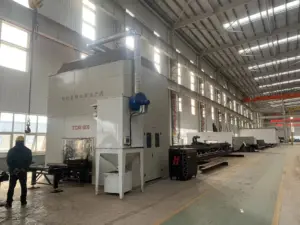
In many HCMC fabrication facilities, manual handling of large beams is a major safety risk and a bottleneck. An automated unloading system integrated with the 30kW laser utilizes a series of hydraulic lifters, motorized conveyor rollers, and lateral discharge arms. Once the laser completes the intricate bolt-hole patterns and end-profile cuts, the system detects the finished part and automatically transitions it to a storage rack or the next phase of the assembly line.
This automation ensures that the laser—a high-capital investment—never sits idle. While the unloading system clears a finished 12-meter beam, the loading system is already positioning the next raw member. This “continuous flow” architecture is essential for HCMC’s bridge contractors who are working against tight government deadlines and increasing labor costs.
Environmental and Local Considerations in HCMC
Operating a 30kW fiber laser in the tropical climate of Ho Chi Minh City presents unique engineering challenges. High humidity and ambient temperatures can wreak havoc on sensitive optical components and high-voltage power supplies.
To combat this, these heavy-duty profilers are equipped with industrial-grade, dual-circuit chilling systems. One circuit cools the laser source (the resonator), while the other cools the cutting head and the external optics. Additionally, the electronic cabinets are typically pressurized and air-conditioned to prevent condensation—the “silent killer” of fiber optics.
Furthermore, the 30kW laser is significantly more energy-efficient than the older CO2 lasers or high-definition plasma systems. In an era where “Green Construction” is becoming a requirement for international infrastructure tenders in Vietnam, the reduced carbon footprint and the elimination of chemical cleaning processes (since the laser leaves no dross) provide HCMC firms with a competitive edge in the global market.
Economic Impact on Bridge Engineering Projects
The ROI (Return on Investment) for a 30kW fiber laser in the bridge sector is driven by three factors: speed, precision, and material utilization.
1. **Speed:** A 30kW laser can cut 20mm carbon steel at speeds four to five times faster than a 6kW system. This allows a single machine to do the work of four older units.
2. **Precision:** By eliminating the need for secondary processing (grinding and drilling), the “time-to-site” for a bridge section is reduced by 30-40%.
3. **Nesting and Waste:** Sophisticated CAD/CAM software allows engineers to nest parts within an I-beam with minimal spacing. The narrow kerf (the width of the cut) of a fiber laser means more parts can be extracted from the same amount of raw steel—a critical advantage given the volatility of global steel prices.
For major projects like the expansion of the HCMC ring roads or the construction of new arterial bridges connecting the city to the Mekong Delta, these efficiencies translate into millions of dollars in saved taxpayer money and months of saved time.
The Expert’s Perspective: Why Ho Chi Minh City?
As an expert in the field, I am often asked why HCMC is becoming a hub for such high-end machinery. The answer lies in the synergy between Vietnam’s manufacturing policy and the specific geographical needs of the region. The soft soil of the Mekong Delta and the river-heavy geography of HCMC require innovative, lightweight yet strong steel bridge designs. These designs utilize “honeycomb” beams and perforated structural members that are nearly impossible to manufacture efficiently without a high-power laser.
Moreover, the local engineering talent in HCMC is rapidly upskilling. Vietnamese technicians are now among the most proficient in the world at operating 3D laser systems, integrating BIM (Building Information Modeling) data directly into the laser’s control software.
Conclusion: Bridging the Future
The 30kW Fiber Laser Heavy-Duty I-Beam Laser Profiler with Automatic Unloading is more than just a tool; it is a catalyst for industrial maturity. In the bustling industrial zones surrounding Ho Chi Minh City, the hum of the 30kW resonator is the sound of the future being built.
By marrying the raw power of 30,000 watts with the finesse of 5-axis robotic motion and the safety of automated handling, the bridge engineering sector in Vietnam is not just catching up to the rest of the world—it is leading. For the residents of HCMC, this means safer bridges, faster commutes, and a more robust infrastructure that can withstand the challenges of the 21st century. As we continue to push the boundaries of what fiber lasers can achieve, the skyline of Ho Chi Minh City will stand as a gleaming, steel-clad monument to the power of light.