The Dawn of Ultra-High Power: Why 30kW Matters for Dammam’s Industry
In the heart of the Eastern Province’s industrial zones, the 30kW fiber laser is not merely an upgrade; it is a paradigm shift. For decades, structural steel fabrication for power towers—the massive H-frames and lattices that carry high-voltage lines—relied on a combination of band saws, mechanical drills, and plasma cutters. While functional, these methods are labor-intensive and lack the surgical precision required for modern engineering.
The introduction of 30kW power levels changes the mathematics of production. At this wattage, the laser source generates a power density so high that it vaporizes heavy-gauge carbon steel almost instantaneously. In Dammam, where humidity and ambient heat can affect traditional mechanical processes, the fiber laser remains consistent. A 30kW source can effortlessly slice through 20mm to 50mm thick steel—common in the base plates and primary chords of power towers—at speeds that are 3 to 5 times faster than a 12kW alternative and significantly cleaner than oxygen-fuel or plasma cutting.
Advanced ±45° Bevel Cutting: Redefining Weld Preparation
The most critical feature for power tower fabrication is the ±45° 3D beveling head. Power towers are subject to immense structural loads, including high winds and the weight of heavy conductors. Consequently, the welding of these structures must be flawless. Traditional straight-cut beams require secondary processes—grinding or manual beveling—to create the V, Y, or K-shaped grooves necessary for full-penetration welding.
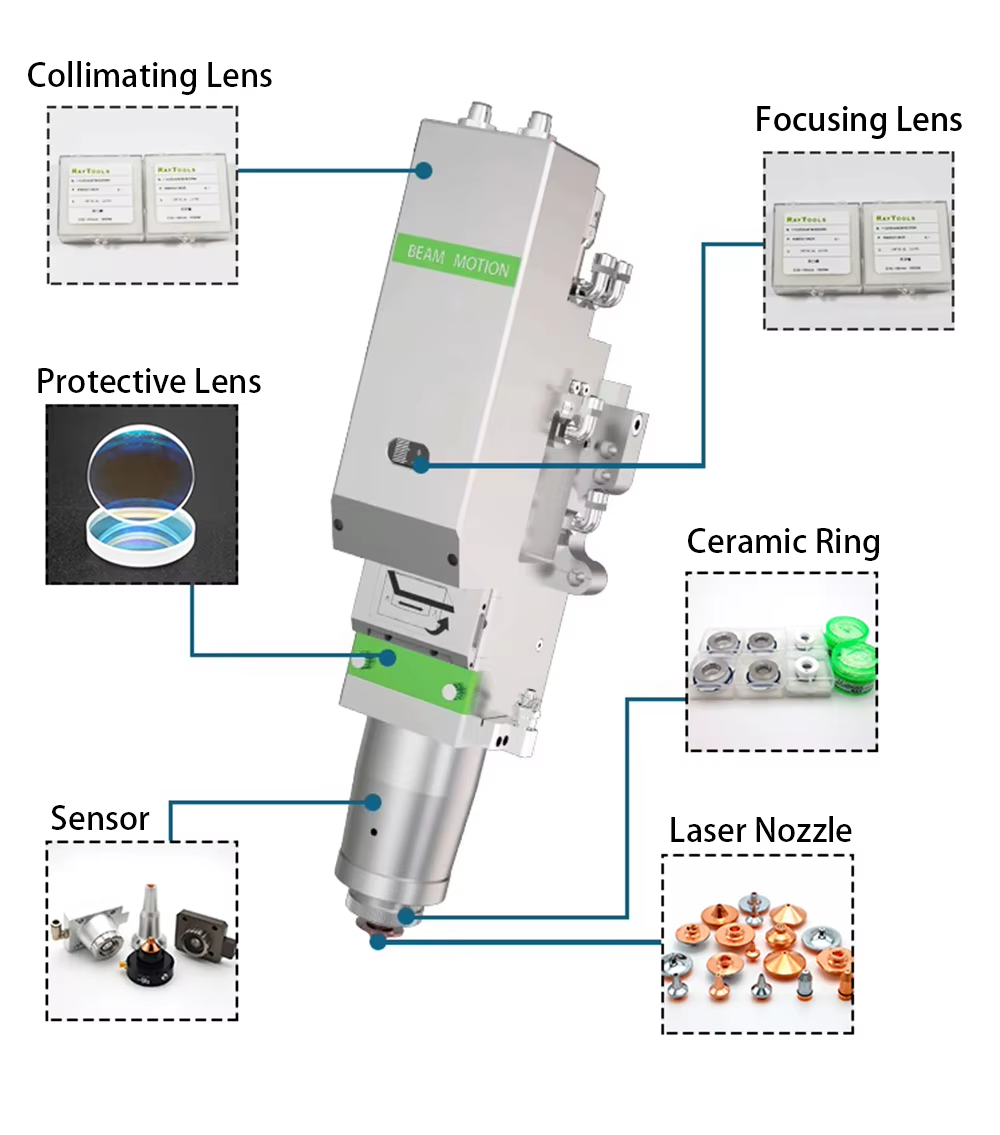
The 30kW I-beam profiler eliminates these secondary steps. Its 5-axis cutting head can tilt to ±45°, allowing the laser to create complex bevels directly on the edges of I-beams, H-beams, and channels during the initial cutting cycle. This ensures that every component arriving at the welding station is “weld-ready.” The precision of a fiber laser bevel is measured in microns, ensuring a tight fit-up that minimizes the amount of filler wire needed and reduces the risk of weld defects, which is paramount for the safety standards of the Saudi Electricity Company (SEC).
Structural Integrity and Precision in Power Tower Fabrication
Power towers are essentially giant, vertical jigsaw puzzles. Thousands of individual beams must be bolted together at extreme heights. If a bolt hole is off by even two millimeters, the entire assembly process grinds to a halt, costing thousands of Riyals in crane rentals and labor delays.
The 30kW I-beam profiler utilizes advanced CAD/CAM integration to translate engineering blueprints directly into cutting paths. The machine’s heavy-duty chucks and 3D sensing technology account for the “imperfections” inherent in raw structural steel, such as slight bows or twists in a 12-meter I-beam. By automatically compensating for these deviations, the laser ensures that every hole, notch, and miter cut is perfectly positioned relative to the beam’s actual geometry. This level of precision is virtually impossible to achieve with manual layout and mechanical drilling.
Heavy-Duty Engineering for Massive Profiles
The “Heavy-Duty” designation of this laser profiler is not marketing hyperbole; it refers to the machine’s ability to handle massive structural sections. Power towers utilize heavy I-beams (such as HEB or HEA series) that can weigh hundreds of kilograms per meter.
The system in Dammam features a reinforced bed and a sophisticated material handling system capable of supporting 12-meter to 15-meter lengths. The machine uses a three-chuck or four-chuck system to move the beam through the cutting zone. This allows for “zero-tailing” cutting, where the laser can process the very end of the beam, significantly reducing material waste—a critical factor given the fluctuating prices of global steel. In an industry where raw material costs can account for 60% of a project’s budget, the efficiency gains from the 30kW laser are substantial.
The Environmental and Economic Context of Dammam
Dammam serves as the gateway to the Kingdom’s energy sector. With the proximity to major steel producers like HADADEED (SABIC), local fabricators are perfectly positioned to supply the massive infrastructure projects in NEOM, the Red Sea Project, and the expanding national grid.
However, Dammam’s environment is harsh. High temperatures, saline air, and fine desert dust can wreak havoc on sensitive electronics. The 30kW fiber laser systems deployed here are equipped with specialized industrial chillers, dust-tight IP65-rated cabinets, and sophisticated filtration systems. The fiber optic delivery system itself is entirely enclosed, meaning there are no mirrors to align or contaminate, unlike older CO2 laser technology. This results in a machine that boasts an uptime of over 95%, even in the demanding climate of the Eastern Province.
Efficiency, Automation, and ROI
From an economic perspective, the return on investment (ROI) for a 30kW laser profiler in the power tower sector is driven by the “Cost Per Part” metric. While the initial capital expenditure is higher than plasma systems, the operational costs are remarkably low. Fiber lasers are highly energy-efficient, converting electricity into light with high yields.
Furthermore, the automation of the I-beam profiler reduces the reliance on a large, highly skilled manual workforce. In a single setup, the machine performs:
1. **Length Cutting:** Sizing the beam perfectly.
2. **Beveling:** Preparing edges for welding at ±45°.
3. **Feature Cutting:** Creating bolt holes, notches, and slots.
4. **Marking:** Laser-etching part numbers and assembly guides for the site crews.
This “all-in-one” processing means a single machine and one operator can replace a production line consisting of a saw, a drill line, and a manual grinding station. For a Dammam-based fabricator, this means a significantly smaller footprint and a much faster throughput.
Sustainability and the Future of Saudi Steel Fabrication
As Saudi Arabia moves toward more sustainable industrial practices, the fiber laser stands out as a “green” technology. Unlike plasma cutting, which generates significant volumes of hazardous fumes and metal dust, the 30kW laser profiler is typically paired with high-efficiency dust extraction and filtration units that capture 99.9% of particulates. Additionally, the extreme precision of the laser reduces the “kerf” (the width of the cut), which, combined with advanced nesting software, saves tons of steel annually.
Looking forward, the integration of AI and IoT (Internet of Things) into these 30kW systems in Dammam will allow for predictive maintenance and real-time monitoring. Fabricators will be able to track the progress of every power tower component through a digital twin, ensuring that the project stays on schedule and meets the rigorous quality control standards of the Kingdom’s energy infrastructure.
Conclusion
The 30kW Fiber Laser Heavy-Duty I-Beam Laser Profiler with ±45° bevel cutting is more than just a tool; it is a strategic asset for the Dammam industrial sector. By solving the most difficult challenges in power tower fabrication—precision, weld preparation, and heavy-material handling—this technology empowers Saudi fabricators to compete on a global scale. As the Kingdom continues to electrify its future, the 30kW laser will be the silent partner in every tower that rises across the desert, ensuring they are built stronger, faster, and more efficiently than ever before.