The Dawn of Ultra-High-Power Fabrication in Rayong
Rayong has long been the industrial heartbeat of Thailand, but the current expansion of the U-Tapao International Airport and surrounding aviation cities has demanded a leap in manufacturing capability. Traditional methods of processing structural steel—specifically heavy I-beams and H-beams—often relied on a combination of band saws, plasma cutters, and manual oxy-fuel torches. These methods, while functional, introduce significant margins for error and require extensive secondary processing.
The arrival of the 30kW Fiber Laser Heavy-Duty I-Beam Profiler changes the calculus entirely. At 30,000 watts, the laser source provides a power density capable of vaporizing thick-walled structural steel almost instantaneously. In the context of Rayong’s hot and humid coastal environment, the stability and efficiency of a fiber laser system are superior to CO2 or plasma alternatives, offering higher uptime and lower energy consumption per cut. For contractors working on the massive steel skeletons of airport terminals, this means the difference between months and weeks of fabrication time.
Unpacking the 30kW Advantage: Speed and Thickness
In the world of fiber lasers, power equals more than just thickness; it equals velocity. A 30kW source allows for the clean cutting of carbon steel beams with wall thicknesses that would stifle a 10kW or 12kW machine. In airport construction, where I-beams often feature webs and flanges exceeding 25mm to 40mm, the 30kW laser maintains a high feed rate while ensuring the Heat Affected Zone (HAZ) remains negligible.
Minimizing the HAZ is critical for structural integrity. Excessive heat from traditional plasma cutting can alter the metallurgical properties of the steel, potentially leading to brittleness near the joints. The 30kW fiber laser, through its concentrated beam and high-speed processing, ensures that the structural characteristics of the I-beam remain intact, meeting the stringent safety standards required for public aviation infrastructure.
The Geometric Precision of Heavy-Duty Profiling
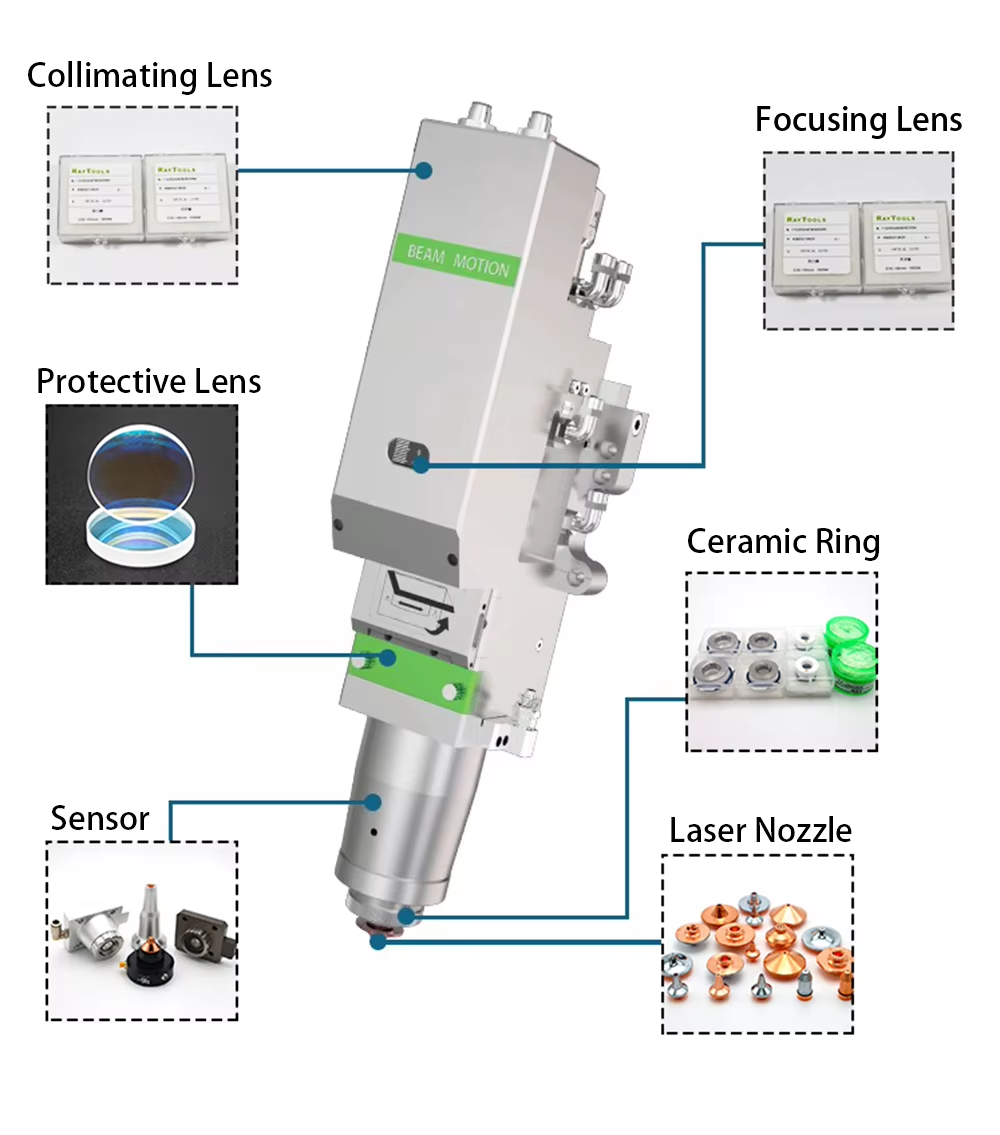
I-beams and H-beams are notoriously difficult to process due to their shape. Unlike flat sheets, a beam requires the laser head to navigate a complex three-dimensional space, maintaining a constant focal point while moving across flanges and webs. The heavy-duty profiler utilized in Rayong features advanced sensing technology and a multi-axis robotic or gantry-style head that “wraps” around the beam.
These machines are built to handle the physical scale of airport construction components. We are talking about beams that can be 12 to 18 meters in length and weigh several tons. The clamping and rotation systems must be synchronized with the CNC controller to ensure that a bolt hole drilled at the 12-meter mark is perfectly aligned with the corresponding bracket on the terminal’s main arch. The 30kW laser’s ability to integrate hole-cutting, slotting, and complex profiling into one continuous operation eliminates the cumulative error inherent in moving a beam from one station to another.
The Game Changer: ±45° Bevel Cutting for Weld Prep
Perhaps the most significant technological leap in this specific machine is the ±45° beveling head. In heavy structural engineering, beams are rarely joined with simple butt welds. To ensure full penetration and structural rigidity—essential for the wide-span roofs of airport lounges—the edges of the steel must be beveled (V-groove, Y-groove, or K-groove).
Traditionally, this beveling was done by hand-grinding or using a secondary beveling machine after the beam was cut to length. This process is labor-intensive, loud, dusty, and prone to inconsistency. The 30kW laser profiler handles this in-situ. As the laser cuts through the heavy flange of an I-beam, the 5-axis head tilts to the programmed angle (up to 45 degrees), creating a perfect weld-ready edge in the same motion as the primary cut.
This capability is transformative for Rayong-based fabricators. By delivering a “ready-to-weld” component directly from the laser bed to the construction site at U-Tapao, the need for on-site adjustments is virtually eliminated. The precision of a laser-cut bevel ensures that when two massive structural members meet, the fit-up is tight, reducing the volume of expensive weld filler metal required and shortening the time certified welders need to spend on each joint.
Supporting Airport Infrastructure: Scale and Safety
Airport construction is defined by large open spaces. To achieve those soaring, column-free terminal interiors, engineers utilize massive steel trusses and bespoke I-beam configurations. These structures are subject to immense dead loads and dynamic wind loads.
Using the 30kW profiler in Rayong allows for the creation of “tapered beams” or custom-profiled sections that optimize weight without sacrificing strength. The laser can easily cut complex patterns into the webs of I-beams (castellated beams), allowing for the passage of HVAC, electrical, and fire suppression systems through the structural members themselves. This integration of architecture and engineering is only commercially viable when the cutting process is automated and highly precise.
Furthermore, the traceability provided by modern CNC laser systems is a boon for airport project management. Every cut, hole, and bevel is logged, ensuring that the components used in the terminal’s skeleton meet the exact digital twin specifications designed by the architects.
Economic Impact on Rayong and the EEC
The deployment of such high-end machinery in Rayong reinforces the region’s status as a global hub for high-tech manufacturing. It attracts international investment by proving that the local supply chain can handle the world’s most demanding construction projects.
From a ROI (Return on Investment) perspective, while the initial capital expenditure for a 30kW system is significant, the operational savings are massive. The reduction in labor costs, the elimination of secondary finishing processes, and the drastic reduction in material waste through intelligent nesting software mean that the machine pays for itself within a few major projects. For the Rayong industrial sector, this represents a move away from “low-cost labor” toward “high-value expertise.”
Technical Challenges and Solutions in the Rayong Climate
Operating a 30kW fiber laser in a tropical environment like Rayong presents unique challenges, primarily regarding thermal management and power stability. The 30kW laser source generates significant internal heat, requiring a high-capacity, dual-circuit chilling system to keep the optics and the power source at a constant temperature.
Furthermore, the coastal air in Rayong can be corrosive. High-end profilers are therefore equipped with pressurized optical paths and robust filtration systems to prevent salt-laden air from contaminating the delicate protective windows and lenses. Advanced dust extraction systems are also integrated to handle the high volume of particulate matter generated when vaporizing heavy steel, ensuring a clean working environment and protecting the machine’s linear guides and electronics.
Future-Proofing Thailand’s Steel Industry
The 30kW Fiber Laser Heavy-Duty I-Beam Profiler with ±45° beveling is more than just a piece of equipment; it is a statement of intent for Thailand’s construction industry. As the U-Tapao Airport becomes a central node in Southeast Asian travel, the structures that support it must be built with the highest technology available.
By adopting this technology, Rayong’s fabricators are not just completing a project; they are developing a blueprint for the future of structural steel. The ability to move from a CAD drawing to a finished, beveled, and perfectly accurate 15-meter I-beam in a matter of minutes is a capability that will serve the region long after the airport is completed. Whether it is for high-rise buildings, bridges, or specialized industrial plants, the 30kW fiber laser has set a new gold standard for what is possible in heavy-duty metal fabrication.