The Dawn of High-Power Fiber Lasers in Thai Infrastructure
The industrial landscape of Rayong, Thailand, is currently undergoing a massive transformation. As the centerpiece of the Eastern Economic Corridor (EEC), the region is seeing a surge in sophisticated infrastructure projects, most notably the expansion of U-Tapao International Airport. In this high-stakes environment, the 30kW fiber laser H-beam cutting machine has emerged as a critical tool.
For decades, structural steel for airports—hangars, terminals, and maintenance buildings—relied on plasma cutting or mechanical sawing followed by manual grinding. However, as architectural designs become more complex and safety regulations more rigid, the margin for error has evaporated. A 30kW fiber laser offers a level of power density that was unimaginable a decade ago. It allows for the rapid processing of massive H-beams, I-beams, and channels with a level of thermal control that preserves the metallurgical integrity of the steel. In Rayong, where the tropical climate and proximity to the sea necessitate high-quality coatings and perfect welds to prevent corrosion, the clean, dross-free cut of a 30kW laser is not just a luxury; it is a structural necessity.
The Significance of 30kW Power for Heavy Structural Steel
Why 30kW? In the world of fiber lasers, power equates to more than just speed; it equates to the ability to handle extreme thicknesses with high-quality edge finishes. For airport construction, H-beams often feature web and flange thicknesses that challenge lower-wattage systems.
A 30kW source allows the machine to maintain a high feed rate even on 25mm to 50mm carbon steel. This high speed reduces the Heat Affected Zone (HAZ), a critical factor in structural engineering. When a laser cuts through an H-beam, excessive heat can alter the molecular structure of the steel, leading to brittleness or warping. The 30kW fiber laser’s ability to concentrate energy into a microscopic focal point ensures that the surrounding material remains cool and stable. For Rayong’s fabricators, this means the beams delivered to the U-Tapao site are dimensionally perfect, requiring no post-cut straightening or heat treatment, which significantly lowers the total cost of ownership.
Mastering Complexity: The ±45° Bevel Cutting Advantage
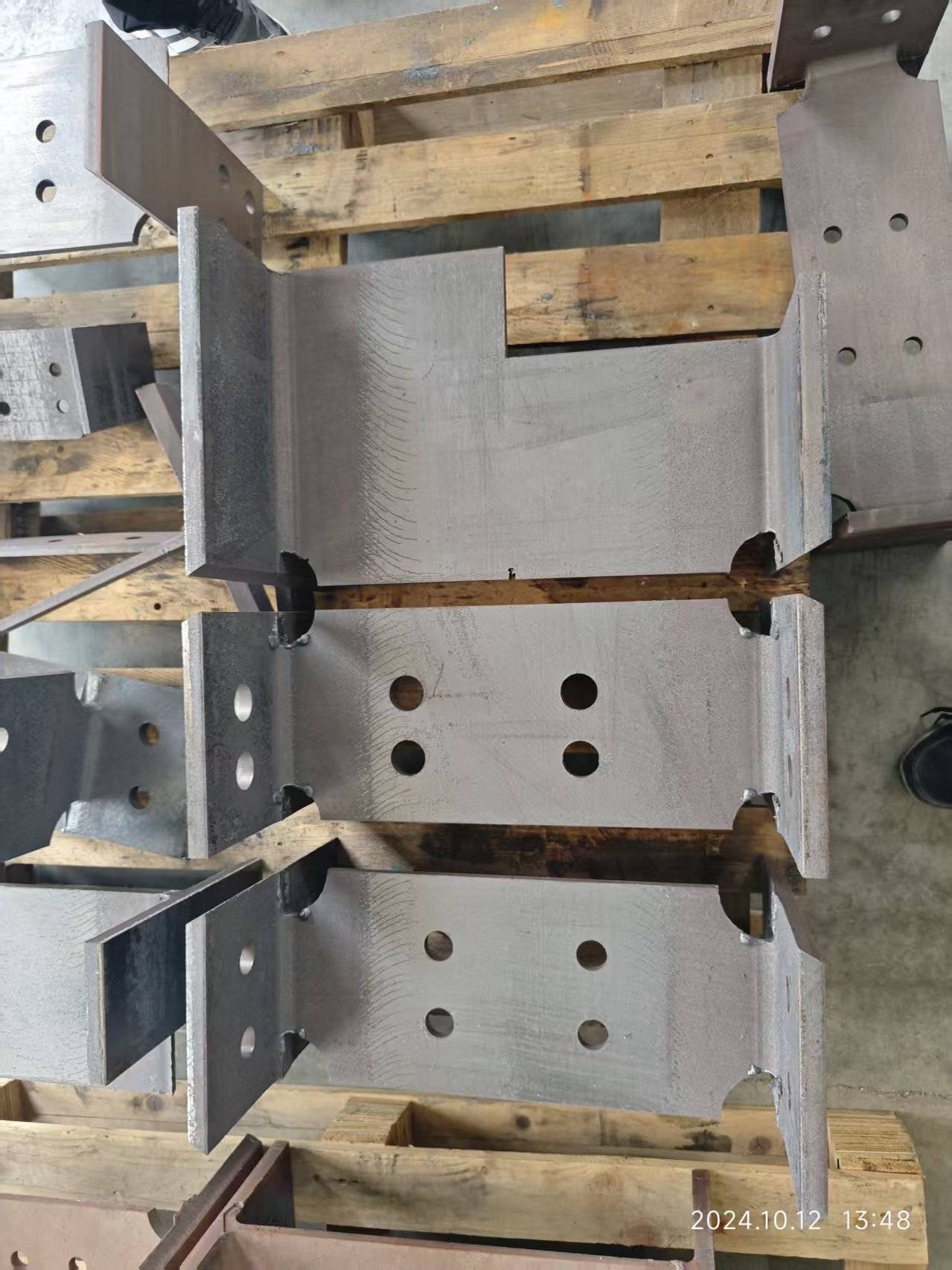
Perhaps the most revolutionary feature of this machine is the ±45° bevel cutting head. In traditional structural steel fabrication, cutting the beam to length is only half the battle. To prepare a beam for welding—especially in high-load airport structures—the edges must be beveled to create V, X, Y, or K-shaped joints.
The integrated 5-axis robotic head on the 30kW laser allows for these bevels to be cut simultaneously with the main profile. This eliminates the need for a secondary workstation where workers would typically use hand-held torches or grinders to create the bevel. By automating this, the machine ensures that every bevel is consistent to within a fraction of a degree. This precision is vital for the automated welding robots often used in modern workshops; if the bevel is inconsistent, the weld penetration will be uneven, potentially compromising the structural safety of an airport terminal. The ±45° range allows for complex intersections where beams meet at odd angles, a common feature in the “bird-wing” roof designs favored in contemporary aviation architecture.
Precision Engineering for Airport Hangars and Terminals
Airport construction is unique in its requirement for massive, clear-span spaces. Hangars must house wide-body aircraft without the interference of support columns, requiring enormous trusses and H-beams. These components are under immense tension and compression.
The 30kW H-beam laser ensures that the bolt holes, slots, and notches required for these trusses are positioned with a tolerance of ±0.05mm. When dealing with a 12-meter H-beam, traditional methods often see a “creep” in measurements due to manual marking. The laser machine’s CNC system, integrated with BIM (Building Information Modeling) software, translates architectural drawings directly into the steel. In the Rayong context, this means that when the steel arrives at the U-Tapao construction site, it fits together like a giant Lego set. This “first-time-right” philosophy is essential for keeping multi-billion baht projects on schedule.
Local Impact: Rayong as a Hub for High-Tech Fabrication
Installing such advanced machinery in Rayong places Thai fabricators at the forefront of the ASEAN construction market. The EEC has attracted significant investment, and the ability to produce world-class structural steel locally reduces the reliance on imported pre-fabricated components from China or Europe.
Localizing 30kW laser technology means that engineering changes can be made on the fly. If an architect adjusts the design of a terminal’s support structure, the Rayong-based facility can update the CAD files and begin cutting the new H-beams within the hour. Furthermore, the logistical advantage of having this capacity in Rayong—just kilometers away from the major construction sites—cannot be overstated. It minimizes transportation costs and reduces the carbon footprint of the project, aligning with Thailand’s “Green Industry” initiatives.
Efficiency, ROI, and Environmental Sustainability
From an expert’s perspective, the ROI (Return on Investment) of a 30kW fiber laser is driven by its efficiency. While the initial capital expenditure is significant, the reduction in labor costs and the increase in throughput are staggering. One 30kW laser can replace three to four plasma cutting lines while producing a higher quality product.
Moreover, fiber lasers are significantly more energy-efficient than older CO2 lasers or plasma systems. They convert a higher percentage of electrical energy into light, and because they cut so much faster, the energy consumed per meter of cut is much lower. In an era where “Green Airport” certifications are becoming standard, using environmentally friendly manufacturing processes helps contractors meet sustainability targets. The lack of chemical waste and the reduction in noise pollution compared to mechanical sawing also make for a safer, cleaner working environment for the local Thai workforce.
The Future of Structural Steel in Thailand
The 30kW Fiber Laser H-Beam Cutting Machine is more than just a tool; it is a catalyst for industrial evolution. As Rayong continues to grow as a technological powerhouse, the adoption of such high-end laser systems will set a new benchmark for all infrastructure projects in Southeast Asia.
For the U-Tapao airport expansion, this technology ensures that the structural “bones” of the project are of the highest possible quality. The ±45° beveling allows for the sophisticated, organic shapes seen in modern architecture, while the 30kW power ensures that even the heaviest structural elements are handled with ease. As a fiber laser expert, I see this as a pivotal moment where the precision of the laboratory meets the ruggedness of the construction site. The result is a safer, faster, and more aesthetically flexible approach to building the gateways of the future. The sky is no longer the limit for Thai structural engineering; it is the starting point.