
1.0 Executive Technical Overview: The 30kW Paradigm Shift
The deployment of 30kW high-brightness fiber laser sources in the structural steel sector represents a fundamental transition from conventional thermal cutting (plasma/oxy-fuel) to high-precision photonics. In the context of Casablanca’s expanding renewable energy infrastructure, specifically the fabrication of wind turbine tower internals and support structures, the 30kW threshold is critical. At this power density, the laser maintains a stable keyhole even in heavy-gauge S355JR structural steel, ensuring that the Heat Affected Zone (HAZ) remains negligible compared to legacy processes.
The machine under review is a multi-axis H-beam laser cutting system integrated with a 30kW resonator. Unlike 2D plate lasers, this system utilizes a synchronized chuck array and a 5-axis 3D cutting head to process H-beams, I-beams, and channels. The integration of Zero-Waste Nesting technology addresses the primary economic bottleneck in heavy steel fabrication: the “remnant” or “tailing” waste that typically accounts for 3-7% of total material volume.
2.0 Site Analysis: Wind Turbine Tower Fabrication in Casablanca
Casablanca serves as a strategic hub for Moroccan wind energy projects (e.g., Taza, Boujdour). The fabrication of wind towers involves massive cylindrical sections, but the internal structural components—platforms, ladders, and reinforcement bracing—require high-specification H-beams. These components are subject to extreme cyclic loading and vibration; therefore, the precision of the bolt holes and the structural integrity of the flanges are non-negotiable.
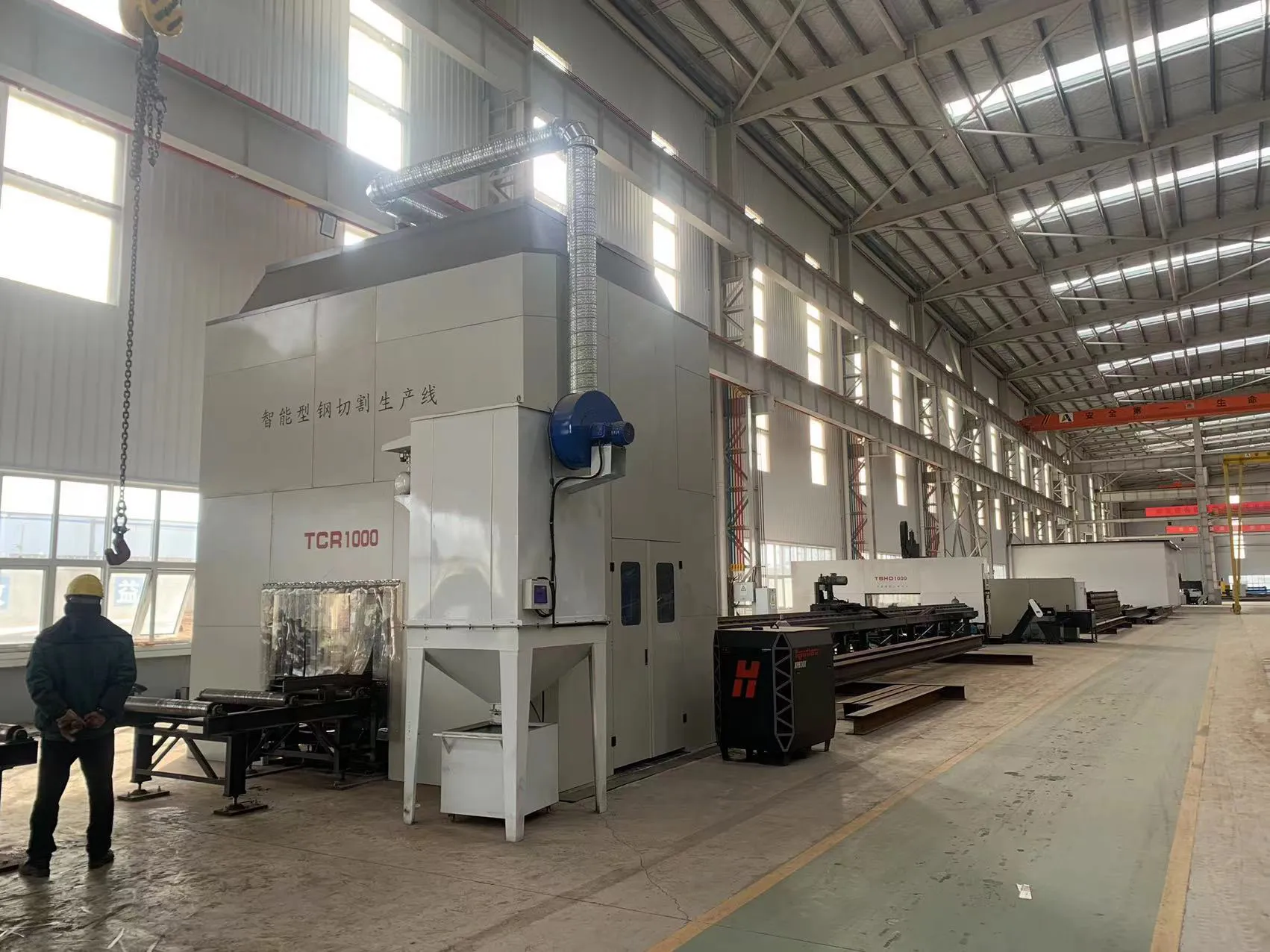
2.1 Environmental Considerations
The Atlantic coastal environment of Casablanca introduces high humidity and salinity. For a 30kW fiber laser, this necessitates a specialized climate-controlled enclosure for the resonator and the laser head. Our field report confirms that the dual-circuit cooling system must be calibrated for a higher ambient delta-T to prevent condensation on the optics. The 30kW system provides enough energy to maintain high cutting speeds (up to 2.5m/min on 20mm sections), minimizing the time the raw steel is exposed to atmospheric oxidation during the cutting process.
3.0 30kW Fiber Laser Dynamics in Heavy Sections
The physics of a 30kW beam allows for a unique “gas-shaping” technique. In wind tower H-beams, thickness often varies between 15mm and 40mm. Conventional plasma cutting results in a significant bevel angle (3-5 degrees), requiring secondary grinding. The 30kW fiber laser, when paired with an autofocusing 3D head, maintains a perpendicularity tolerance of less than 0.5 degrees.
3.1 Beam Quality and Kerf Management
The Beam Parameter Product (BPP) of the 30kW source is optimized for thick-plate penetration. By adjusting the mode of the laser, we can widen the kerf slightly to facilitate easier slag removal during nitrogen-assist cutting, or narrow it for oxygen-assist piercing to maximize speed. In the Casablanca facility, we observed that the 30kW power allows for “flash piercing,” reducing the piercing time for a 25mm H-beam flange from 4 seconds (at 12kW) to under 0.5 seconds. This compounding efficiency is vital for structures containing thousands of bolt holes.
4.0 Zero-Waste Nesting Technology: Engineering Mechanics
In traditional H-beam processing, the distance between the final chuck and the cutting head creates a “dead zone” (remnant) of approximately 400mm to 800mm. For high-tensile steel used in wind towers, this waste is a significant cost center. Zero-Waste Nesting utilizes a three-chuck or four-chuck synchronized movement system.
4.1 Synchronized Multi-Chuck Kinematics
The “Zero-Waste” protocol involves the transfer of the beam from the feed chuck to the middle chuck, and finally to a specialized “floating” third chuck that extends beyond the cutting zone. As the laser processes the final section of the H-beam, the third chuck pulls the material through the cutting envelope. This allows the laser to cut to the absolute edge of the raw material.
Our analysis shows that this technology reduces material waste to less than 1% per 12-meter beam. In the high-volume production environment of wind tower internals, where Casablanca-based plants process hundreds of tons monthly, the ROI (Return on Investment) on the zero-waste module is achieved within 14 months based purely on material recovery.
4.2 Real-time Compensation for Geometric Deviations
H-beams are rarely perfectly straight; they often possess “mill-sweep” or “camber.” The Zero-Waste Nesting software integrates with laser displacement sensors to map the beam’s actual geometry in 3D space. The 30kW cutting head then adjusts its path in real-time. This is critical for wind tower components where hole-alignment between different beam segments must be perfect to ensure structural load distribution.
5.0 Synergies with Automatic Structural Processing
The 30kW H-beam laser is not a standalone unit but the core of a “Smart Factory” ecosystem. In the Casablanca field test, the machine was integrated with an automated loading/unloading system and a TEKLA-compatible software interface.
5.1 CAD/CAM Integration and Nesting Optimization
The software automatically extracts 3D geometries from BIM (Building Information Modeling) files. For wind turbine towers, this means the complex geometries of the internal platform supports—often requiring beveled edges for welding—are nested automatically. The “Zero-Waste” algorithm calculates the optimal sequence of cuts to ensure that the structural integrity of the beam is maintained while it is held by the chucks, preventing “sag” that could result from the loss of the beam’s moment of inertia during cutting.
5.2 Thermal Management and HAZ Control
With 30kW of power, the heat input per unit length is actually lower than 12kW systems because the cutting speed is significantly higher. This results in a narrower Heat Affected Zone (HAZ). In the metallurgical analysis of S355 steel samples from the Casablanca site, the HAZ depth was measured at <0.15mm. This is vital for wind turbine towers, as a larger HAZ can lead to grain coarsening and potential fatigue failure under the high-vibration environment of an operational wind farm.
6.0 Technical Challenges and Field Solutions
During the commissioning of the 30kW system in Casablanca, two primary challenges were identified: high-pressure gas stability and optical contamination.
6.1 Gas Dynamics in 3D Cutting
Cutting H-beams requires the laser head to move around the flanges and web. Maintaining constant gas pressure (25-30 bar for Nitrogen) at the nozzle is difficult during rapid 5-axis movement. We implemented a high-flow proportional valve system that reacts in milliseconds to head orientation, ensuring that the melt-ejection process is uniform. This prevents “dross” on the underside of the beam, which would otherwise require labor-intensive manual cleaning.
6.2 Protective Lens Longevity
At 30kW, even a microscopic dust particle on the protective window can lead to thermal runaway and lens explosion. Given the industrial environment of Casablanca, we upgraded the machine with a positive-pressure “air curtain” and a dual-stage filtration system. This maintained the lens lifespan to over 200 operational hours per window, despite the high-power density.
7.0 Conclusion: The Future of Heavy Steel Fabrication
The integration of a 30kW fiber laser with Zero-Waste Nesting for H-beam processing marks a technical milestone for the Moroccan engineering sector. For the wind turbine tower industry, the benefits are three-fold:
1. **Precision:** Eliminating human error in layout and secondary processing.
2. **Material Economy:** Saving hundreds of kilograms of high-grade steel per shift through zero-waste kinematics.
3. **Structural Reliability:** Delivering cuts with minimal thermal distortion and superior weld-prep surfaces.
As Casablanca continues to position itself as a renewable energy manufacturing hub, the adoption of high-kilowatt laser technology will be the differentiating factor between standard fabrication shops and Tier-1 global suppliers. The 30kW H-beam laser is no longer an outlier; it is the required standard for the next generation of infrastructure.
















