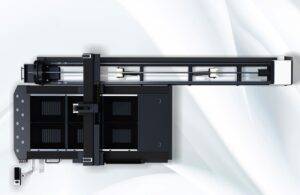
The Dawn of 30kW Fiber Laser Technology in Queretaro
Queretaro has long been the heartbeat of Mexico’s aerospace and automotive sectors, but a new era of heavy structural engineering is emerging. As the demand for sophisticated architectural marvels—specifically modern sports stadiums—increases, the limitations of traditional plasma cutting and mechanical sawing have become evident. Enter the 30kW fiber laser.
A 30kW fiber laser represents the “ultra-high power” tier of industrial photonics. In the context of H-beam fabrication, this power level is not merely about speed; it is about the ability to penetrate thick-walled structural steel with a narrow heat-affected zone (HAZ). For the massive H-beams required in stadium trusses and cantilevered roofs, the 30kW source allows for high-speed vapor cutting through thicknesses that were previously the exclusive domain of oxy-fuel or high-definition plasma. This technological leap provides Queretaro-based fabricators with a competitive edge, allowing them to deliver projects faster and with a level of edge quality that requires zero post-processing.
Revolutionizing H-Beam Processing for Large-Scale Structures
Structural H-beams (also known as I-beams or universal beams) are the backbone of stadium construction. They must support immense loads, often spanning hundreds of meters to create open-air seating and weather-resistant canopies. Traditionally, processing these beams involved a multi-step workflow: sawing to length, drilling holes for bolts, and manual torch-cutting for copes and notches.
The 30kW H-beam fiber laser machine consolidates these processes into a single automated cell. Utilizing a 3D cutting head—often mounted on a robotic arm or a high-precision gantry—the machine can execute complex bevels, miter cuts, and bolt holes in a single pass. For stadium structures, where geometry is rarely simple and often involves complex intersecting angles for tension rings and support columns, the laser’s ability to maintain +/- 0.05mm accuracy over a 12-meter beam is a game-changer. This precision ensures that when the steel arrives at the construction site in Queretaro or beyond, the fit-up is perfect, significantly reducing on-site welding time and structural errors.
The Science of Zero-Waste Nesting in Structural Steel
In the world of structural steel, material costs account for a massive percentage of the total project budget. Historically, H-beam processing resulted in significant “drop” or scrap—short sections of beams that were unusable and sold for pennies as remelt. “Zero-Waste Nesting” is the software-driven solution to this economic and environmental challenge.
Advanced nesting software designed for 30kW lasers uses AI algorithms to analyze the entire project’s Bill of Materials (BOM). In Queretaro’s cutting-edge facilities, the software doesn’t just look at one beam at a time; it looks at the entire inventory of raw H-beams and the hundreds of required components for a stadium’s frame.
The “Zero-Waste” approach utilizes several key techniques:
1. **Common Line Cutting:** Sharing a single cut line between two different parts, eliminating the “kerf” waste and reducing the number of pierces.
2. **Fragment Stitching:** Utilizing what would traditionally be scrap sections to create smaller gussets or connection plates.
3. **Remnant Management:** Precisely tracking the dimensions of every off-cut and automatically suggesting it for the next project’s smaller components.
By implementing these strategies, fabricators can increase material utilization from a standard 80% to as high as 96-98%. In a project as massive as a football stadium, saving 15% of the total steel weight through smarter nesting translates to millions of dollars in cost savings and a significantly lower carbon footprint.
Engineering Stadium Structures: Precision Meets Power
Stadiums are among the most demanding structures in civil engineering. They must withstand dynamic loads from thousands of moving fans, wind uplift on massive roofs, and, in many parts of Mexico, seismic activity. This requires the use of high-strength structural steel grades that can be difficult to process with traditional tools.
The 30kW fiber laser excels here because its high power density allows it to cut through high-tensile steel without altering the metallurgical properties of the material. The “cool” nature of fiber laser cutting (relative to plasma) means the edges remain ductile and free from micro-cracking. This is vital for the fatigue life of stadium components.
Furthermore, the complexity of modern stadium aesthetics—often featuring organic, flowing lines—demands “non-standard” beam geometries. The 30kW H-beam laser can perform “3D profiling,” carving out curved webs and tapered flanges that allow architects to push the boundaries of design without traditional manufacturing constraints. Queretaro’s proximity to world-class engineering firms makes it the ideal hub for this high-spec fabrication.
Queretaro: The Strategic Hub for Infrastructure Fabrication
The choice of Queretaro as a center for 30kW fiber laser adoption is no accident. The region’s logistical advantages—situated on the NAFTA corridor with direct rail and highway links to both Mexico City and the US border—make it a prime location for heavy steel fabrication.
Moreover, the local workforce in Queretaro has evolved. The transition from manual labor to “technician-based” fabrication is well underway. Operating a 30kW laser with zero-waste nesting software requires a blend of traditional structural knowledge and high-level digital literacy. Local technical universities are now tailoring programs to support this high-tech manufacturing shift, ensuring that the operators managing these multi-million dollar machines are as precise as the lasers themselves.
Environmental Impact and the Green Construction Shift
Sustainability is no longer an option in modern construction; it is a mandate. The 30kW fiber laser contributes to “Green Building” certifications (such as LEED) in several ways. First, the energy efficiency of a fiber laser is roughly 3-4 times higher than that of a CO2 laser, and significantly cleaner than plasma cutting which generates massive amounts of dust and fumes.
Second, the Zero-Waste Nesting capability directly aligns with circular economy principles. By minimizing the raw material required to build a stadium, we reduce the energy-intensive process of steel production and transportation. For a project in Queretaro, sourcing steel and processing it locally with zero-waste technology minimizes the “embedded carbon” of the stadium even before the first bolt is tightened.
The Future: Integration with BIM and Digital Twins
As we look toward the future of stadium construction in Mexico, the integration of 30kW lasers with Building Information Modeling (BIM) is the final piece of the puzzle. The nesting software now talks directly to the BIM model. When an architect changes a beam’s thickness in a digital model, the information flows directly to the 30kW laser in Queretaro.
This digital thread ensures that the “As-Built” structure matches the “As-Designed” model with terrifying accuracy. The 30kW Fiber Laser H-Beam Cutting Machine is no longer just a tool; it is a physical extension of the digital design process.
Conclusion
The deployment of 30kW Fiber Laser H-Beam machines in Queretaro represents the pinnacle of structural steel fabrication. By marrying the sheer force of 30,000 watts of light with the surgical precision of Zero-Waste Nesting, the industry is now capable of producing stadium structures that are lighter, stronger, and more sustainable. As Queretaro continues to cement its reputation as a technological powerhouse, the steel skeletons of the world’s next great stadiums will increasingly bear the mark of this laser-cut revolution—perfectly executed, zero-waste, and built for the future.