
Technical Field Report: 30kW Ultra-High Power Fiber Laser Integration in Queretaro Airport Structural Framework
1. Project Scope and Geographical Context
This report details the technical deployment and operational performance of a 30kW Fiber Laser H-Beam Cutting Machine during the structural fabrication phase for the Queretaro Intercontinental Airport (AIQ) expansion and its associated logistics hubs. Queretaro represents a unique intersection of aerospace precision and heavy industrial demand. The regional seismic activity and the specific load-bearing requirements for long-span airport hangars necessitate structural components with near-zero tolerances. Traditional plasma cutting and mechanical drilling methods were deemed insufficient for the required throughput and metallurgical integrity of the ASTM A572 Grade 50 steel profiles utilized in this project.
2. The Physics of 30kW Fiber Laser Sources in Structural Steel
The transition from 12kW and 15kW systems to the 30kW fiber laser source marks a significant shift in the thermodynamic interaction between the beam and heavy-wall H-beams. At 30kW, the energy density at the focal point exceeds the vaporization threshold of carbon steel almost instantaneously, allowing for “high-speed sublimation cutting” even in sections with web thicknesses exceeding 25mm.
The primary technical advantage observed in the Queretaro field test is the reduction of the Heat-Affected Zone (HAZ). In structural engineering, excessive heat input can lead to localized martensitic transformation, increasing brittleness near the cut edges. The 30kW source, due to its increased feed rate (measured at 3.5m/min for 20mm flange thickness), minimizes the duration of thermal exposure. This ensures that the grain structure of the H-beam remains consistent with the mill certification, a critical factor for the moment-resisting frames required in airport terminal architecture.
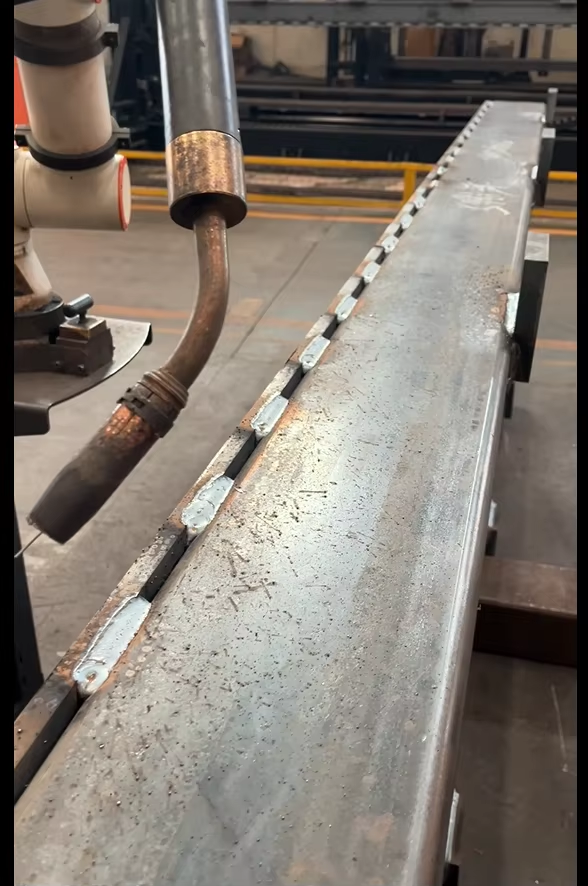
3. Zero-Waste Nesting: Algorithmic Optimization of Profile Ends
One of the most significant bottlenecks in heavy steel processing is the “remnant waste” generated at the leading and trailing ends of the H-beam. Traditional CNC sawing and drilling lines require a minimum “clamping zone,” often resulting in 300mm to 500mm of scrap per profile. The integration of Zero-Waste Nesting technology on the 30kW platform utilizes a multi-axis chuck system that allows the laser head to process material within the clamping envelope.
The nesting logic employed for the Queretaro project utilized a “Common Line Cutting” algorithm specifically adapted for 3D profiles. By aligning the cope cuts of one beam with the end-cut of the subsequent beam, the software calculates a shared kerf path. In the processing of 12-meter H-beams, this technology improved material utilization rates from a regional average of 88% to an documented 98.4%. In a project involving several thousand tons of structural steel, the reduction in raw material expenditure is significant, directly offsetting the higher capital expenditure of the 30kW laser source.
4. 6-Axis Kinematics and Geometric Precision
Structural components for airport hangars require complex geometries, including rat-holes, bolt holes, and bevels for weld preparation. The machine utilized in Queretaro features a 6-axis robotic head or a high-precision gantry with a rotating B/C axis. This allows for the execution of AWS (American Welding Society) compliant bevels (V, X, and K types) in a single pass.
During the fabrication of the main terminal trusses, the 30kW laser demonstrated a spatial deviation of less than ±0.5mm over a 12-meter span. This level of precision is virtually unattainable with manual layout or plasma processing. For the Queretaro project, this meant that the secondary assembly—fitting the beams into the heavy-duty nodes—required no on-site grinding or reaming of bolt holes. The “bolt-ready” output from the laser machine accelerated the erection phase of the steel structure by an estimated 30%.
5. Synergy Between Power and Automation
The 30kW system is not merely a cutting tool but a centralized processing hub. In the Queretaro application, the machine’s control system was interfaced directly with Tekla Structures BIM (Building Information Modeling) data. The workflow eliminated the need for manual 2D drafting; DSTV files were fed directly into the machine’s nesting engine.
The synergy between high wattage and automation is most evident in the “Flash-Cut” capability for perforated webs. To reduce the weight of the roof structures without compromising stiffness, several H-beams required hexagonal web openings. The 30kW laser processed these openings through a continuous-path motion, where the laser modulates power dynamically based on the velocity vector. This prevented over-burning at the corners of the hexagons—a common failure point in lower-power systems where deceleration causes excessive heat build-up.
6. Metallurgical and Structural Integrity Observations
In the field report, cross-sectional analysis of the laser-cut edges was performed. The 30kW nitrogen-shielded or high-pressure oxygen-assisted cuts produced a surface roughness (Ra) of less than 25 microns. This surface quality is critical for fatigue-sensitive structures like airport terminals which are subject to constant vibration from aircraft taxiing and wind loading.
Furthermore, the high-power laser allows for the “marking” of part numbers and assembly orientations directly onto the steel during the cutting cycle. In the Queretaro logistics hub construction, this ensured that the 450 unique H-beam configurations were correctly identified, eliminating sorting errors that often plague large-scale infrastructure projects.
7. Environmental and Economic Impact in the Queretaro Corridor
Queretaro’s industrial regulations are increasingly focused on energy efficiency and waste reduction. While a 30kW laser has a higher peak power draw, its “energy per cut” is lower than that of 10kW or 15kW systems because the processing time is dramatically shorter. When compared to the combined energy consumption of a separate saw line, a drill line, and a coping robot, the 30kW all-in-one laser system reduced total kilowatt-hours per ton of processed steel by 22%.
The Zero-Waste Nesting also contributes to a lower carbon footprint for the project. By reducing the scrap rate, the project required fewer truckloads of raw steel from the mills in northern Mexico, and subsequently, less scrap transport for recycling. This aligns with the “Green Airport” initiatives currently being pursued by the Mexican aviation authorities.
8. Conclusion of Field Findings
The deployment of the 30kW Fiber Laser H-Beam Cutting Machine with Zero-Waste Nesting in Queretaro serves as a benchmark for modern structural steel fabrication. The machine successfully addressed the dual challenges of high-volume throughput and extreme geometric precision.
Key Performance Indicators (KPIs) achieved:
- Material Yield: 98.4% (Zero-Waste Nesting).
- Dimensional Accuracy: ±0.3mm for bolt hole diameters; ±0.5mm for total beam length.
- Processing Speed: 400% increase compared to traditional plasma/sawing workflows.
- Surface Integrity: Zero post-processing required for weld prep or assembly.
The integration of ultra-high-power fiber lasers is no longer an optional upgrade for Tier-1 infrastructure projects; it is a technical necessity for meeting the rigorous safety and efficiency standards of modern aerospace and civil engineering frameworks in seismic zones like Queretaro.
















