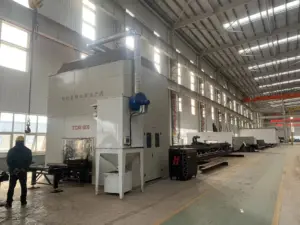
The Dawn of Ultra-High Power in Rayong’s Industrial Hub
Rayong has long been the heartbeat of Thailand’s heavy industry, serving as a critical node for the Eastern Economic Corridor (EEC). As the global demand for energy infrastructure surges, the fabrication of power towers—structures that must withstand immense environmental stress and mechanical load—requires a shift from “good enough” to “absolute precision.” The arrival of 30kW fiber laser technology marks the end of the era where thick-section H-beams were relegated to slow, high-heat plasma cutting or labor-intensive mechanical processing.
A 30kW fiber laser is not merely a faster version of its 12kW or 20kW predecessors; it is a transformative tool that changes the physics of the cut. At 30,000 watts, the energy density allows for “high-speed vaporization cutting” even in thick carbon steels used for structural H-beams. In Rayong’s humid coastal environment, where oxidation and material integrity are constant concerns, the speed of the 30kW laser minimizes the Heat Affected Zone (HAZ), ensuring that the metallurgical properties of the H-beam remain uncompromised during the fabrication of critical power infrastructure.
The Engineering Marvel: Infinite Rotation 3D Cutting Head
The most significant hurdle in H-beam processing has traditionally been the geometry of the workpiece itself. An H-beam consists of a central web and two parallel flanges, creating internal corners and deep channels that are difficult for standard laser heads to reach. The Infinite Rotation 3D Head solves this spatial puzzle through advanced 5-axis kinematics.
Unlike traditional 3D heads that are limited by internal cabling—requiring the head to “unwind” after a certain degree of rotation—the Infinite Rotation head utilizes a specialized slip-ring and optical path design. This allows the cutting torch to rotate endlessly around its C-axis. For power tower fabrication, where beams often require complex bevels, countersinks, and notched joints for interlocking assemblies, the infinite rotation capability allows for continuous, fluid motion. This results in a seamless cut surface and eliminates the “start-stop” marks that can become points of fatigue failure in a transmission tower.
The 3D head also provides the ability to perform +/- 45-degree beveling. This is crucial for weld preparation (K, Y, and X-type joints). In the past, these bevels had to be ground manually after the initial cut. Now, the 30kW laser cuts the beam to length and adds the welding bevel in a single, high-speed pass.
Optimizing H-Beam Processing for Power Tower Integrity
Power towers are essentially giant, vertical puzzles made of H-beams, I-beams, and angles. Their structural integrity relies on the precision of their connection points. A typical high-voltage tower requires thousands of bolt holes and interlocking notches. If a bolt hole is off by even two millimeters, the cumulative error over a 50-meter tower can be catastrophic.
The 30kW H-beam laser machine utilizes integrated sensing technology to compensate for the natural deviations in structural steel. Large H-beams are rarely perfectly straight; they often possess slight bows or twists from the rolling mill. The 3D laser head uses “touch-and-sense” or laser-scanning mapping to identify the actual position of the beam in 3D space, adjusting the cutting path in real-time to ensure every hole and notch is perfectly placed relative to the beam’s actual geometry.
Furthermore, the 30kW power allows for “flying cuts” on bolt holes. Where a mechanical drill might take 30 seconds to penetrate a 20mm flange, the 30kW laser pierces and circles the hole in under two seconds. This exponential increase in throughput is what allows Rayong-based fabricators to bid on massive international infrastructure projects with aggressive deadlines.
Revolutionizing Weld Preparation and Assembly
In power tower fabrication, welding is often the most time-consuming phase. The quality of the weld is directly dictated by the fit-up of the parts. Using traditional methods, gaps between beams are common, requiring “gap-filling” welding techniques that weaken the overall structure.
The precision of the 3D Infinite Rotation head ensures a “zero-gap” fit. When two beams are cut to interlock, they snap together with machined precision. This not only reduces the amount of welding wire required but also speeds up the welding process by allowing for automated robotic welding systems to take over. Because the laser-cut edge is clean—free of the dross and slag associated with plasma—the need for secondary grinding is eliminated. In the Rayong factories, this translates to a cleaner workspace, lower noise pollution, and a significantly reduced labor cost per ton of steel.
Economic Impact: Why 30kW is the “Sweet Spot” for the EEC
Investors and factory owners in Rayong look closely at the Total Cost of Ownership (TCO). While a 30kW laser represents a significant capital investment, the ROI (Return on Investment) is driven by three factors: gas consumption, electricity efficiency, and secondary processing elimination.
1. **Gas Efficiency:** At 30kW, the laser can use compressed air or high-pressure nitrogen to cut through thicknesses that previously required expensive oxygen. This significantly lowers the cost per meter of the cut.
2. **Wall-Plug Efficiency:** Modern fiber lasers have a wall-plug efficiency of about 40-45%, far higher than CO2 lasers or older plasma systems.
3. **Throughput:** One 30kW H-beam laser machine can typically replace three to four mechanical processing lines (sawing, drilling, and milling). This frees up floor space in Rayong’s premium industrial zones, allowing for more streamlined factory layouts.
Addressing the Challenges of Power Grid Expansion
As Thailand and the wider ASEAN region move toward renewable energy, the power grid must be expanded to connect remote solar and wind farms to urban centers. This requires a new generation of “Smart Towers” that are lighter yet stronger.
High-strength low-alloy (HSLA) steels are increasingly used to reduce the weight of these towers. However, HSLA steel is harder to machine and more sensitive to heat. The 30kW fiber laser is the ideal tool for HSLA, as its concentrated beam delivers the necessary energy to cut the material so quickly that the surrounding crystal structure of the steel is not altered. This ensures that the tower remains flexible enough to sway in high winds without cracking, a vital requirement for the tropical storm conditions often faced in Southeast Asia.
The Role of Software and Digital Twins
The 30kW H-beam machine in Rayong is not just a piece of hardware; it is an integrated software platform. Modern systems use TEKLA or AutoCAD structural files directly. The software “nests” the parts onto the H-beams to minimize scrap, and then simulates the 3D head’s movement to prevent collisions with the beam’s flanges.
This digital integration allows Rayong fabricators to participate in the “Digital Twin” workflow. Every cut, hole, and bevel is logged, providing a “birth certificate” for every component of the power tower. For infrastructure projects, this level of traceability is becoming a standard requirement for quality assurance and long-term maintenance.
Conclusion: The Future of Rayong’s Fabrication Sector
The integration of 30kW Fiber Laser H-Beam machines with Infinite Rotation 3D Heads is more than an upgrade; it is a total reimagining of what is possible in heavy structural engineering. For the power tower fabrication industry in Rayong, this technology provides a dual advantage: the power to conquer the thickest, toughest materials and the finesse to execute complex 3D geometries.
As the Eastern Economic Corridor continues to evolve into a global manufacturing powerhouse, the adoption of such ultra-high-power laser systems ensures that Thailand remains at the forefront of the global supply chain. By reducing waste, increasing speed, and guaranteeing structural perfection, the 30kW fiber laser is literally building the backbone of the future energy grid, one H-beam at a time. For the fiber laser expert, the verdict is clear: the future of heavy fabrication is light—delivered at 30,000 watts of surgical precision.