
1.0 Executive Summary: Technical Deployment in Queretaro’s Railway Sector
This technical report evaluates the field performance and integration of a 30kW Fiber Laser H-Beam Cutting System, specifically optimized for heavy-duty structural steel applications within the Queretaro railway infrastructure corridor. The primary objective of this deployment was to address the manufacturing bottlenecks associated with high-tensile H-beams (HEA/HEB profiles) used in bridge supports, overhead gantries, and terminal frameworks. By utilizing a high-brightness 30kW fiber source coupled with a 5-axis ±45° beveling head, the facility achieved a significant reduction in post-processing requirements while maintaining the stringent tolerances required by Mexican railway engineering standards (NOM and international AWS D1.1/D1.5).
2.0 Power Dynamics: The 30kW Fiber Source Advantage
2.1 Power Density and Kerf Management
The transition to a 30kW fiber laser source represents a paradigm shift in structural steel processing. In the context of Queretaro’s industrial demand, where thick-walled H-beams (often exceeding 25mm in web and flange thickness) are standard, the 30kW source provides a power density that ensures rapid transition from solid to plasma states. This high energy input allows for significantly higher feed rates compared to 12kW or 20kW alternatives.
From a metallurgical perspective, the increased speed reduces the Heat Affected Zone (HAZ). In railway infrastructure, minimizing the HAZ is critical for maintaining the fatigue resistance of the steel. The 30kW source ensures that the structural integrity of ASTM A572 Grade 50 steel—commonly used in these rail projects—remains uncompromised by excessive thermal cycling during the cutting process.
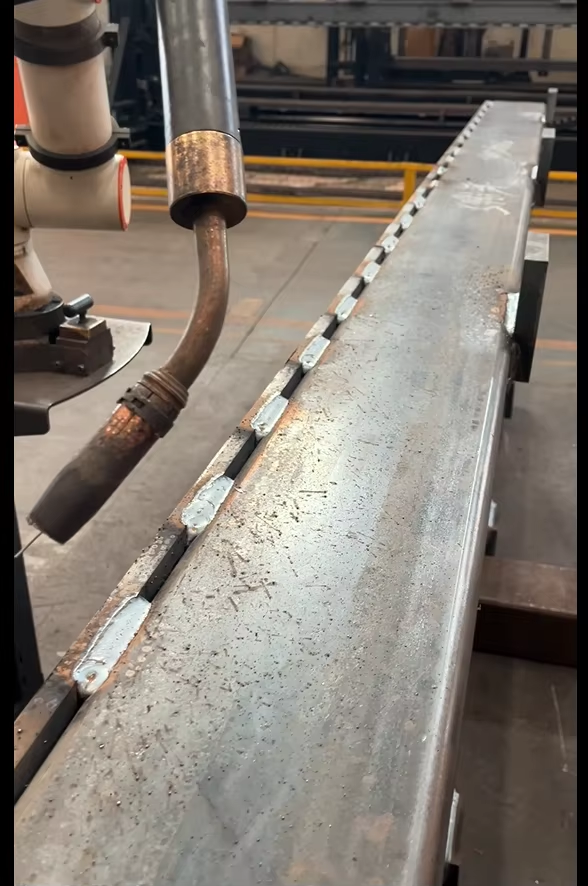
2.2 Gas Consumption and Piercing Efficiency
The 30kW system utilizes ultra-high-pressure nitrogen or oxygen-assisted cutting depending on the finish requirement. In our field observations, the “Flash Piercing” technology enabled by the 30kW source reduced piercing time on 30mm flange sections by 70% compared to traditional plasma or lower-wattage laser systems. This efficiency is vital when processing complex H-beam profiles that require dozens of bolt-hole piercings and structural cut-outs per linear meter.
3.0 Precision Engineering: ±45° Bevel Cutting Technology
3.1 The Mechanics of 5-Axis Interpolation
The core innovation in this H-beam system is the ±45° 3D beveling head. Traditional H-beam processing requires three distinct stages: sawing to length, drilling for fasteners, and manual grinding for weld preparation. The 30kW laser system integrates these into a single thermal process. The head utilizes high-torque servo motors to achieve rapid angular adjustments, allowing for complex geometries such as “K,” “V,” “X,” and “Y” type bevels.
In Queretaro’s rail bridge fabrication, weld strength is non-negotiable. The ±45° beveling capability allows for precise edge preparation that facilitates full-penetration welds. Our field measurements indicated an angular deviation of less than ±0.5°, which significantly exceeds the accuracy of manual plasma beveling or mechanical milling.
3.2 Solving the “Flange-to-Web” Intersection Challenge
One of the most difficult aspects of H-beam processing is maintaining bevel consistency at the radius where the flange meets the web. The 5-axis software algorithms in the 30kW system dynamically compensate for the beam’s focal length as the head rotates. This ensures that even at a 45° tilt, the laser maintains a constant standoff distance and focus position, preventing kerf widening or dross accumulation at the beam’s internal fillets.
4.0 Application in Queretaro’s Railway Infrastructure
4.1 Demand for High-Volume Structural Components
Queretaro serves as a logistical hub connecting central Mexico to the northern borders. The expansion of rail freight and passenger lines necessitates the rapid production of heavy-duty structural frames. The 30kW H-beam laser addresses this by providing a “Ready-to-Weld” component directly from the machine bed. For instance, in the fabrication of support pillars for elevated rail sections, the machine processed H-beams with pre-beveled ends and bolt patterns in a single pass, reducing the production cycle from 4 hours (manual) to 18 minutes (automated laser).
4.2 Precision for Seismic and Dynamic Loads
Railway structures are subject to intense dynamic loads and seismic activity common in certain Mexican regions. The precision of laser-cut bolt holes (with tolerances within ±0.1mm) ensures a “friction-grip” fit that is superior to punched or plasma-cut holes. The smooth surface finish (Ra < 12.5 μm) of the laser-cut edge eliminates the micro-fissures often associated with mechanical shearing, thereby reducing the risk of stress corrosion cracking in the harsh outdoor environments of Queretaro.
5.0 Automation Synergy and Workflow Integration
5.1 Intelligent Material Handling
The 30kW system is paired with an automated logistical chain. For H-beams spanning up to 12 meters, the machine utilizes a series of hydraulic chucks and support rollers that automatically detect the beam’s profile and any inherent deviations (such as slight bowing or twisting common in hot-rolled steel). The control system performs a “Workpiece Recognition” scan, adjusting the cutting path in real-time to match the actual geometry of the beam rather than the theoretical CAD model.
5.2 Nesting Software for Structural Profiles
The integration of specialized 3D nesting software allows engineers in the Queretaro facility to maximize material utilization. By nesting multiple small structural plates or brackets within the “web” area of a larger H-beam, material waste is reduced by an estimated 15%. Furthermore, the software automatically generates the 5-axis toolpaths for the ±45° bevels, eliminating the need for manual G-code programming for complex weld preps.
6.0 Technical Analysis of Edge Quality and Metallurgy
6.1 Surface Roughness and Slag Adhesion
Field tests at the 30kW level demonstrate that the high kinetic energy of the auxiliary gas jet, combined with the extreme temperature of the laser, produces a “dross-free” finish on both the upper and lower edges of the H-beam flanges. This is particularly important for railway infrastructure where components are often galvanized. A clean, dross-free edge ensures uniform zinc coating thickness, preventing premature oxidation of the structural steel.
6.2 Hardening Effects on High-Carbon Steels
A common concern with thermal cutting is the localized hardening of the cut edge, which can complicate subsequent drilling or tapping. However, the high feed rates of the 30kW fiber laser minimize the residence time of the heat source. Our micro-hardness testing across the cut cross-section showed a negligible increase in Vickers hardness (HV), ensuring that the material remains ductile enough to withstand the vibrations inherent in railway operations.
7.0 Conclusion: The Future of Heavy Structural Processing
The deployment of the 30kW Fiber Laser H-Beam Cutting Machine with ±45° beveling in Queretaro establishes a new benchmark for structural steel fabrication. The synergy between extreme power (30kW) and geometric flexibility (5-axis beveling) solves the industry’s most persistent issues: low throughput, high labor costs for weld prep, and inconsistent tolerances.
For the railway sector, this technology provides a critical path toward faster project completion and higher structural reliability. As Queretaro continues to modernize its infrastructure, the transition from conventional mechanical processing to high-wattage automated laser systems is no longer an option but a technical necessity for maintaining global engineering standards.
End of Report
Lead Field Engineer, Structural Steel Division




























