
Technical Field Report: Implementation of 30kW Fiber Laser H-Beam Processing in Ho Chi Minh City Railway Infrastructure
1. Project Overview and Strategic Context
The expansion of railway infrastructure in Ho Chi Minh City (HCMC), specifically regarding the development of Metro Line 2 and the structural reinforcement of elevated transit corridors, has necessitated a paradigm shift in structural steel fabrication. Traditional methods—comprising band sawing, radial drilling, and manual oxy-fuel or plasma beveling—have proven insufficient to meet the stringent tolerances and accelerated timelines required for these urban transit projects. This report evaluates the deployment of the 30kW Fiber Laser H-Beam Cutting Machine, equipped with a ±45° 3D 5-axis cutting head, as the primary fabrication driver for heavy structural sections.
In the context of HCMC’s tropical climate and the specific seismic requirements of elevated rail, the structural integrity of H-beams (Universal Beams) is paramount. The 30kW system represents the current zenith of high-power density applications, allowing for the processing of heavy-gauge carbon steel with a Heat-Affected Zone (HAZ) significantly smaller than that produced by thermal plasma processes.
2. 30kW Fiber Laser Power Density and Kerf Dynamics
The integration of a 30kW fiber laser source is not merely a quantitative upgrade in speed but a qualitative shift in material interaction. At 30kW, the energy density at the focal point allows for the instantaneous sublimation of carbon steel even in sections exceeding 25mm in flange thickness.
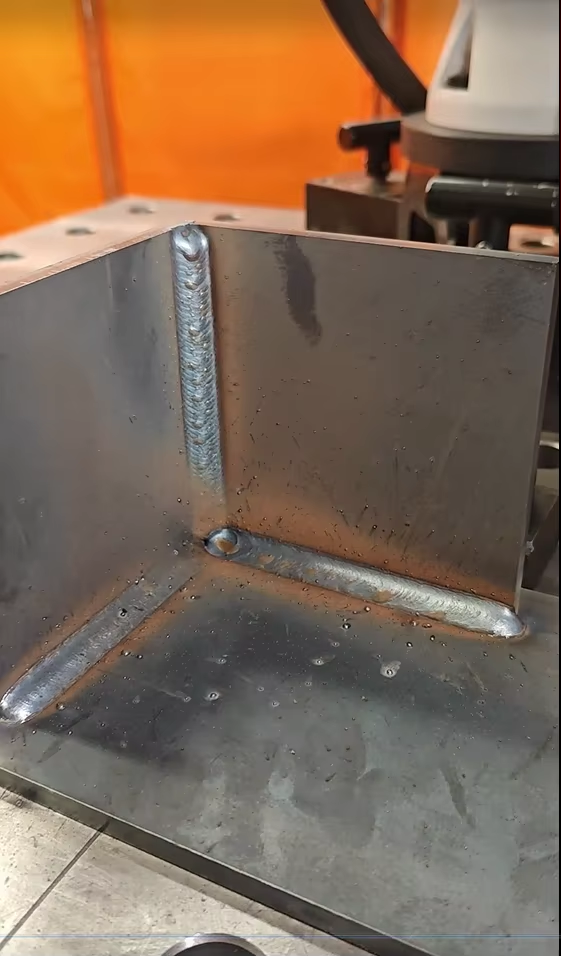
During field testing on Q355B structural steel (a standard in Vietnamese rail construction), the 30kW source demonstrated a consistent ability to maintain a narrow kerf width (0.5mm to 0.8mm), which is critical for the precision fit-up required in railway bridging components. The high-power density facilitates “high-speed melt-ejection,” reducing the dross accumulation on the lower surface of the flange—a common failure point in lower-wattage systems. This eliminates secondary grinding processes, directly reducing the labor-hour per ton of processed steel.
3. Kinematics of ±45° Bevel Cutting in Structural Sections
The core technical challenge in H-beam processing is the transition between the web and the flange, particularly the “R-zone” (the inner radius). Conventional 2D laser systems are incapable of navigating these geometries for complex joinery. The ±45° 5-axis head utilizes a sophisticated kinematic transform to maintain the TCP (Tool Center Point) while adjusting the angle of incidence.
3.1 Weld Preparation and Joint Efficiency
In railway infrastructure, full-penetration welds are often mandatory for vibration-heavy environments. The ±45° beveling capability allows for the automated creation of V, Y, and K-type grooves. In our observations in HCMC, the machine successfully executed compound bevels on 400mm x 400mm H-beams, maintaining an angular accuracy of ±0.5°. This precision ensures that when beams are mated for field welding, the root gap is uniform, significantly reducing the risk of hydrogen-induced cracking and improving the fatigue life of the railway support structures.
3.2 Bolt-Hole Integrity
A critical failure mode in rail infrastructure is the deformation of bolt holes under cyclic loading. Plasma-cut holes often exhibit a “taper” effect and a hardened edge layer that can lead to stress risers. The 30kW laser, through high-frequency pulsing and precision beam oscillation, produces holes with a cylindricity tolerance of <0.1mm. This allows for interference-fit bolting, essential for the structural rigidity of HCMC’s elevated stations.
4. Synergy Between Power and Automation
The technical efficacy of the 30kW source is maximized through its integration with automated structural processing software. The workflow observed involves the direct ingestion of TEKLA or STRUMIS IFC files, which are سپس (then) converted into 5-axis toolpaths.
4.1 Material Sensing and Compensation
Structural H-beams are rarely perfectly straight; they exhibit “sweep” and “camber” inherent to the hot-rolling process. The machine utilizes a laser-based touch-sensing or vision-sensing system to map the actual geometry of the beam before the first cut. The CNC control system then realigns the 5-axis cutting path in real-time to match the physical workpiece. This “active compensation” is vital for the HCMC projects, where material batches may vary in dimensional consistency.
4.2 Throughput Analysis
In a comparative analysis conducted on-site, a standard fabrication sequence (cutting to length, drilling 12 holes, and beveling two edges) took approximately 45 minutes using traditional mechanical and manual methods. The 30kW H-Beam Laser completed the same sequence in 4 minutes and 12 seconds. This 10x increase in throughput is the primary driver for meeting the aggressive 2025-2030 HCMC infrastructure milestones.
5. Addressing Environmental and Operational Variables in HCMC
Operating high-power fiber lasers in Ho Chi Minh City presents specific challenges related to ambient humidity and power grid stability.
5.1 Humidity and Optical Protection
High humidity can lead to condensation on the protective windows of the cutting head, leading to catastrophic failure of the 30kW optics. The system deployed utilizes a pressurized, desiccated air-curtain and a double-sealed optical chamber. Furthermore, the chiller units are oversized to maintain a stable ΔT (temperature differential) for the laser source, preventing thermal lensing that would otherwise degrade the bevel accuracy during long production runs.
5.2 Power Quality
The 30kW source requires a stable 380-480V supply with significant current draw. The field installation included a dedicated voltage stabilizer and active power filter to mitigate the harmonics common in industrial zones in the periphery of HCMC. This ensures that the beam quality (M²) remains constant, which is essential for maintaining the integrity of the ±45° cuts at the extreme ends of the focal range.
6. Structural Performance and Metallurgical Observations
From a senior engineering perspective, the most significant advantage of the 30kW laser over plasma cutting is the reduction in the Heat-Affected Zone (HAZ). Metallurgical cross-sections of the H-beam flanges cut for the HCMC project show a HAZ depth of less than 0.2mm.
In railway engineering, a large HAZ can lead to local embrittlement, making the structure susceptible to stress corrosion cracking, especially in the high-salinity/high-humidity air of Southern Vietnam. The 30kW laser’s speed ensures that the heat input per unit length is kept to a minimum, preserving the grain structure of the parent metal and ensuring that the yield strength of the H-beam remains within design specifications after the cutting process.
7. Conclusion
The deployment of the 30kW Fiber Laser H-Beam Cutting Machine with ±45° beveling technology represents a critical advancement for the Ho Chi Minh City railway sector. By consolidating cutting, drilling, and weld preparation into a single automated process, the technology solves the dual challenges of precision and throughput. The ability to produce high-fidelity bevels on heavy sections with minimal heat input ensures that the resulting infrastructure meets the 100-year service life requirements of modern transit systems. Future implementations should focus on further integrating BIM (Building Information Modeling) data with the machine’s real-time sensing capabilities to achieve a fully autonomous “Steel-to-Site” fabrication pipeline.





























