
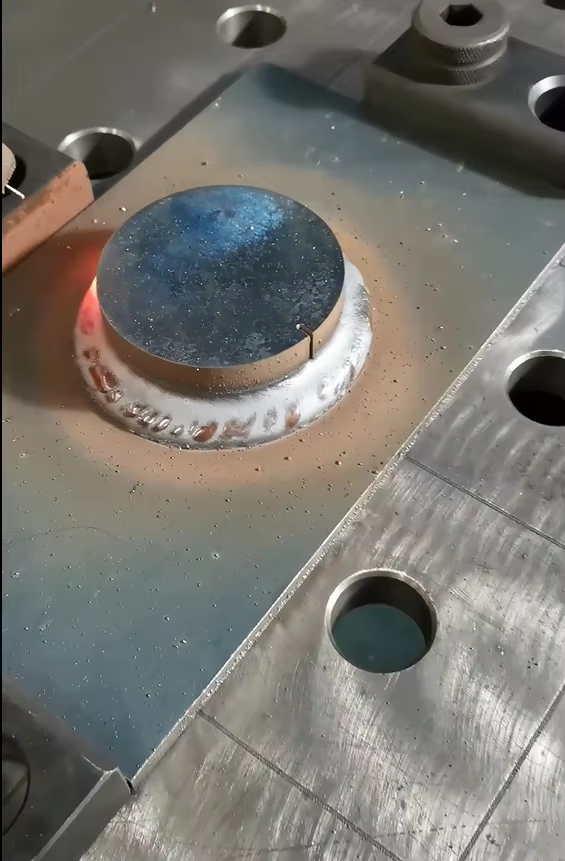
Technical Field Report: 30kW Fiber Laser H-Beam Processing in Houston’s Wind Energy Sector
1. Introduction and Operational Context
The industrial landscape of Houston, Texas, has undergone a significant transition as legacy oil and gas fabrication facilities pivot toward the renewable energy sector, specifically the manufacturing of onshore and offshore wind turbine tower components. This report analyzes the field performance of the 30kW Fiber Laser H-Beam Cutting Machine, integrated with ±45° beveling kinematics. The deployment of ultra-high-power fiber lasers in structural steel fabrication represents a paradigm shift from traditional plasma-arc or mechanical sawing and drilling lines. In the context of wind tower internals—such as platforms, secondary bracing, and flange reinforcement—the requirement for high-precision geometries in thick-section H-beams (HEA/HEB profiles) is absolute.
2. The Physics of 30kW High-Power Density in Structural Steel
The core of this system is the 30kW ytterbium fiber laser source. At this power level, the energy density at the focal point exceeds 10^7 W/cm². In Houston’s high-volume fabrication environments, the 30kW threshold is critical for maintaining “High-Speed Melt Extraction.”
Unlike 10kW or 12kW systems that rely heavily on exothermic reactions (oxygen cutting) which can lead to larger Heat Affected Zones (HAZ), the 30kW system allows for high-pressure nitrogen or dry air cutting on structural steel up to 20mm-25mm for H-beam webs and flanges. This results in a purely kinetic removal of molten material, ensuring that the metallurgical properties of the ASTM A572 or A992 Grade 50 steel—standard in Houston’s structural shops—remain uncompromised by excessive thermal cycling.
3. Kinematics of ±45° Bevel Cutting for Weld Preparation
The most significant bottleneck in wind turbine tower construction is the preparation of weld joints. Traditionally, H-beams required secondary processing—manual grinding or specialized milling—to achieve the V, X, or K-profile bevels necessary for Full Penetration (CJP) welds.
The integrated 5-axis/6-axis laser head on this 30kW system facilitates ±45° beveling directly on the H-beam flanges and webs in a single pass.
- Precision Articulation: The B and C axes of the cutting head utilize high-torque AC servo motors with absolute encoders, allowing for real-time compensation of the Beam’s “Center of Gravity” shift during the tilt.
- Kerf Compensation: As the bevel angle increases toward 45°, the effective thickness of the material (the path length of the laser) increases by a factor of 1.414. The 30kW power reserve is essential here; it maintains the cutting speed at 45° that a 15kW machine could only achieve on a 0° vertical cut.
- AWS D1.1 Compliance: The resulting bevels meet the stringent requirements of the American Welding Society (AWS) D1.1 structural welding code, providing a surface finish (Ra) often below 12.5 μm, eliminating the need for post-cut grinding.
4. Application Specifics: Houston Wind Turbine Tower Fabrication
In the Houston sector, wind tower internals (the structural “skeletons” inside the steel cylinders) demand complex intersections where H-beams must contour perfectly to the inner diameter of the tower.
Complex Geometry Processing:
The 30kW H-Beam machine utilizes specialized “pipe-nesting” logic applied to structural shapes. It can cut “saddle” shapes into the ends of H-beams so they can be welded flush against the curved interior of a 5-meter diameter tower section. The ±45° beveling allows these saddle cuts to be pre-beveled for high-strength fillet or groove welds, which are vital for resisting the harmonic vibrations and structural loads inherent in wind energy production.
5. Synergy Between Laser Power and Automatic Structural Processing
The integration of the 30kW source with an automated material handling system creates a “closed-loop” production environment. In Houston’s heavy-industry corridors, labor costs and safety risks associated with moving 40-foot H-beams are significant.
5.1. Automated Profiling and Detection
Structural steel is rarely perfectly straight. The machine employs laser-based “Touch-and-Sense” or “Optical Scanning” to map the actual deformation (bow, twist, and camber) of the H-beam before cutting. The 30kW cutting head’s Z-axis response time (typically <10ms) works in tandem with this data to maintain a constant standoff distance, even while executing a complex 45° bevel on a twisted flange.
5.2. Throughput vs. Traditional Methods
Field data indicates that a 30kW laser system completes a standard H-beam “bolt hole and cope” sequence—including beveling for weld prep—in approximately 18% of the time required by a CNC drill and saw line followed by manual oxy-fuel beveling.
- Laser Speed: 3.5 – 5.0 m/min on 16mm flange thickness.
- Bevel Consistency: Variance of <0.5mm over a 12-meter beam length.
6. Heat Affected Zone (HAZ) and Metallurgical Integrity
A primary concern for senior engineers in the Houston wind sector is the HAZ, which can embrittle the steel and lead to fatigue failure. The 30kW fiber laser’s high feed rate significantly narrows the HAZ compared to plasma cutting. Microstructural analysis of the cut edge shows a martensitic transformation zone of less than 0.1mm. This is negligible for the structural integrity of wind tower internals, where fatigue resistance is a primary design criterion.
7. Software Integration: From TEKLA to the Shop Floor
The efficiency of the 30kW H-Beam machine is maximized through the direct ingestion of NC1 (DSTV) files from BIM software like Tekla Structures. In the Houston engineering offices, designers can specify the bevel requirements in the 3D model. The machine’s CAM post-processor automatically calculates the 5-axis toolpath, power modulation, and gas pressure adjustments required for the ±45° transitions. This eliminates manual layout errors, which are the leading cause of rework in large-scale steel construction.
8. Environmental and Operational Considerations in the Gulf Coast Climate
Operating high-power lasers in Houston requires specific attention to ambient conditions. The 30kW system utilizes a dual-circuit high-capacity chiller to manage the thermal load of the laser source and the cutting optics. Given the high humidity in the region, the beam delivery path is pressurized with dry, filtered air to prevent “thermal lensing” or contamination of the protective windows.
9. Conclusion
The deployment of the 30kW Fiber Laser H-Beam Cutting Machine with ±45° beveling technology represents the current zenith of structural steel processing. For Houston’s wind turbine tower manufacturers, the technology addresses the dual challenges of precision and throughput. By consolidating sawing, drilling, coping, and beveling into a single automated laser process, fabricators achieve a level of geometric accuracy that was previously unattainable. The power density of the 30kW source ensures that these gains do not come at the expense of metallurgical quality, positioning it as the standard-bearer for the next generation of heavy structural fabrication.
















