
1.0 Executive Summary: The Industrial Transition in the GCC Heavy Lifting Sector
In the context of Dubai’s expanding industrial infrastructure, particularly within the specialized crane manufacturing sector (EOT, Gantry, and Jib cranes), the transition from legacy plasma and mechanical sawing to high-power fiber laser technology has reached a critical inflection point. This report analyzes the technical deployment of a 30kW Fiber Laser H-Beam Cutting Machine equipped with a ±45° beveling head. The integration of 30,000 watts of coherent light with multi-axis kinematic systems addresses the fundamental bottlenecks of heavy-duty structural steel processing: weld preparation efficiency, dimensional accuracy, and thermal-mechanical stability.
2.0 Technical Specifications of the 30kW Fiber Laser Source
2.1 Power Density and Material Penetration
The 30kW fiber laser source represents the upper echelon of industrial photonics. At this power level, the energy density at the focal point is sufficient to achieve instantaneous sublimation of high-tensile carbon steels (such as S355JR or S355J2+N) commonly used in crane girders. Unlike lower-wattage systems, the 30kW source maintains a high cutting speed even on the thick flanges of H-beams (up to 25mm-40mm), minimizing the Heat Affected Zone (HAZ).
2.2 Beam Quality and Kerf Management
Maintaining a low M² factor is essential for deep-section H-beam processing. The 30kW source utilized in this field application provides a stabilized beam profile that ensures uniform kerf width from the entry point to the exit point of the flange. This is critical for crane manufacturing, where structural joints must bear significant dynamic loads and any irregularity in the cut edge could serve as a stress concentrator.
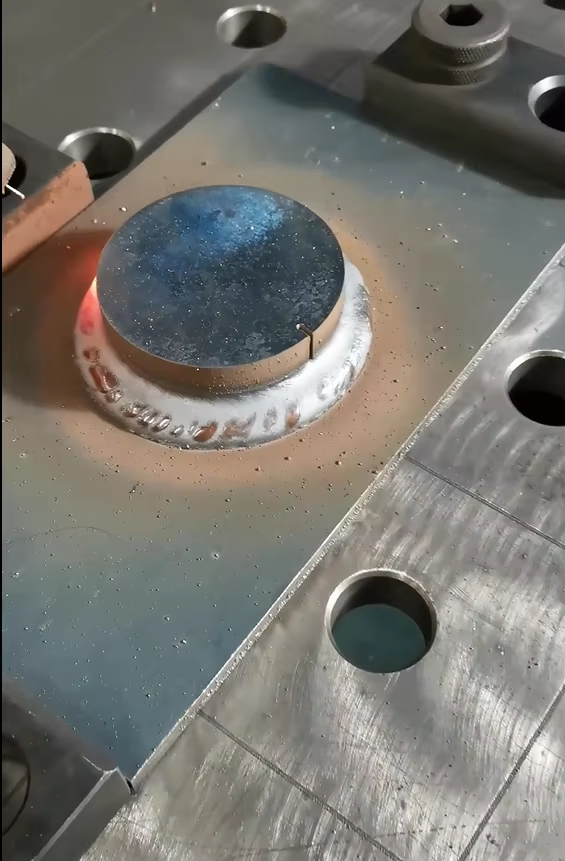
3.0 The ±45° Bevel Cutting Kinematics
3.1 Solving the Weld Preparation Bottleneck
Traditionally, H-beams required secondary processing—grinding or oxy-fuel beveling—to create the V, X, or K-shaped grooves necessary for full-penetration welding. The ±45° beveling head integrates this process into a single workstation. By utilizing a 5-axis linkage system, the laser head can tilt dynamically relative to the beam’s web and flanges. This allows for the simultaneous cutting of the structural shape and the weld prep angle.
3.2 Geometric Accuracy and Positional Compensation
H-beams are rarely perfectly straight; they often exhibit “camber” or “sweep” from the rolling mill. The 30kW system incorporates high-precision touch probes or laser sensors to map the beam’s actual geometry in real-time. The control software then applies a kinematic compensation algorithm to the ±45° head, ensuring that the bevel angle remains constant relative to the beam’s surface, regardless of any inherent structural deformation. This level of precision is unattainable with manual or semi-automated plasma systems.
4.0 Application in Dubai’s Crane Manufacturing Sector
4.1 Structural Demands of Heavy Lifting Equipment
Cranes manufactured in Dubai are often destined for port facilities (DP World) or heavy industrial zones (JAFZA), where they operate under extreme ambient temperatures and high humidity. These environmental factors necessitate superior weld integrity to prevent stress corrosion cracking and fatigue failure. The 30kW laser’s ability to produce clean, oxide-free (when using Nitrogen/Oxygen mixes) beveled edges directly facilitates high-quality robotic welding.
4.2 Processing Heavy Girders and End Carriages
Crane girders are typically comprised of large H-beams or box sections. The 30kW H-beam laser machine processes these components by cutting complex apertures for motor mounts, cable routing, and end-carriage bolt patterns with a tolerance of ±0.1mm. For end carriages, where alignment is critical for wheel longevity, the laser’s ability to maintain perpendicularity on thick-walled sections is a significant technical advantage.
5.0 Synergy Between High Power and Automation
5.1 Through-feed Efficiency
The 30kW machine is not a standalone tool but a node in an automated structural processing line. In the Dubai facility, the system is integrated with heavy-duty infeed and outfeed conveyors capable of handling beams up to 12 meters. The synergy lies in the “one-touch” workflow: a Raw H-beam enters the enclosure, and a fully beveled, drilled, and notched component exits. This eliminates the need for intermediate crane lifts within the factory, reducing the risk of material damage and increasing throughput by approximately 300% compared to traditional methods.
5.2 CAD/CAM Integration with Tekla and SolidWorks
For crane engineering, software compatibility is paramount. The 30kW system utilizes specialized nesting software that directly imports DSTV or STEP files from structural detailing software like Tekla Structures. The software automatically calculates the complex 5-axis toolpaths required for intersection cuts—where the web meets the flange—ensuring that the ±45° bevel is maintained even through variable thickness transitions.
6.0 Thermal Management and Assist Gas Dynamics
6.1 High-Pressure Gas Delivery
At 30kW, the management of the molten pool is critical. The system utilizes a high-pressure gas delivery manifold. For thick H-beam flanges, Oxygen (O2) is often used for exothermic cutting to maximize speed, while Nitrogen (N2) is reserved for thinner sections or where an oxide-free surface is mandated for specific paint specifications. The nozzle design must withstand the intense back-reflection and heat generated during the piercing of 30mm+ steel.
6.2 Cooling and Environmental Stability
Operating a 30kW laser in the Dubai climate requires a robust industrial chilling system. The field report indicates the use of a dual-circuit chiller with a cooling capacity of at least 60kW to manage the heat load from the laser source and the cutting head optics. Furthermore, the machine enclosure is pressurized to prevent the ingress of fine desert dust, which can compromise the sensitive optical path of the fiber laser.
7.0 Comparative Analysis: Laser vs. Plasma and Sawing
7.1 Operational Cost and Consumables
While the initial capital expenditure (CAPEX) of a 30kW laser is higher than a plasma system, the operational expenditure (OPEX) in a high-volume crane factory is lower. The laser eliminates the need for drill bits, saw blades, and frequent plasma electrode changes. The primary costs are electricity and assist gases. In the Dubai context, where labor costs for secondary grinding are rising, the “finished-cut” quality of the laser provides a rapid Return on Investment (ROI).
7.2 Edge Quality and HAZ
Plasma cutting typically results in a significant HAZ, which can harden the edges of S355 steel, making them brittle and prone to cracking under the dynamic loads of a crane. The 30kW laser, due to its extreme cutting speed, minimizes the time-at-temperature for the steel. Metallurgical analysis of the beveled edges shows a minimal martensitic layer, preserving the base metal’s ductility and ensuring better weld fusion.
8.0 Conclusion: The Future of steel structure Fabrication
The deployment of the 30kW Fiber Laser H-Beam Machine in Dubai’s crane sector marks a departure from “rough” fabrication toward “precision” structural engineering. The ability to execute ±45° bevel cuts on massive structural members with sub-millimeter accuracy allows engineers to design lighter, stronger crane components. As the GCC continues to invest in high-capacity infrastructure, the adoption of ultra-high-power laser technology with multi-axis beveling capabilities will become the standard for any facility aiming for international quality certifications and optimized production cycles.
The field data confirms that the 30kW source, when paired with intelligent 5-axis kinematics, successfully mitigates the inherent challenges of H-beam processing, delivering a superior structural product ready for immediate assembly and high-integrity welding.
















