The Dawn of Ultra-High Power: Why 30kW Matters for Shipbuilding
In the realm of fiber lasers, the leap from 12kW or 20kW to 30kW is not merely a linear upgrade in speed; it is a qualitative transformation in material capability. For a shipbuilding yard, where structural integrity is non-negotiable, the 30kW source provides the “overpower” necessary to maintain a stable keyhole in thick-walled structural members.
When cutting heavy-duty H-beams or thick-walled channels used in ship hulls and internal frames, the laser must maintain a consistent beam quality across varying thicknesses. A 30kW fiber laser offers a power density that allows for high-speed fusion cutting with nitrogen or high-quality oxidation cutting with oxygen on sections exceeding 30mm to 50mm in thickness. This power level ensures that the Heat Affected Zone (HAZ) remains incredibly narrow, preserving the metallurgical properties of the marine-grade steel—a critical factor in preventing stress corrosion cracking in maritime environments.
The Mechanics of ±45° Bevel Cutting in 3D Space
Traditional laser cutters are restricted to 2D planes, but shipbuilding relies on complex structural geometries. A 30kW CNC Beam and Channel Laser Cutter utilizes a sophisticated 5-axis robotic head or a bridge-style gantry with rotational axes to achieve ±45° beveling.
In shipbuilding, parts are rarely joined at simple 90-degree angles. To ensure full penetration welds (FPW) that can withstand the rigors of the open sea, edges must be prepared with V, Y, K, or X-shaped bevels. Historically, this was done via manual grinding or secondary plasma operations, both of which introduce human error and significant labor costs. The 30kW laser integrates this process into a single pass. The CNC controller calculates the beam’s focal position in real-time as the head tilts, compensating for the increased “apparent thickness” the laser must penetrate when cutting at an angle. For instance, a 20mm plate cut at 45 degrees effectively becomes a 28.2mm path for the laser. The 30kW reserve ensures this transition is seamless and burr-free.
Optimizing Structural Profiles: Beams, Channels, and Angles
Processing structural profiles like H-beams and U-channels presents unique challenges compared to flat sheets. The laser must navigate the transitions between the web and the flanges, where material thickness can vary and internal radii can trap heat.
The 30kW CNC system specialized for Riyadh’s industrial requirements utilizes advanced 3D nesting software. This software allows the shipyard’s engineers to import complex CAD models of the vessel’s skeleton. The machine’s sensing technology—often involving high-speed capacitive sensors or blue-light 3D scanners—detects any structural deformations in the raw beams (common in long-run structural steel) and adjusts the cutting path in milliseconds. This ensures that every bolt hole, coping cut, and bevel is perfectly aligned with the ship’s master design, drastically reducing the “fit-up” time during assembly in the dry dock.
Strategic Implementation in Riyadh: Vision 2030 and Maritime Growth
Riyadh has emerged as a central hub for industrial innovation in the Middle East, serving as the logistical heart for projects like the King Salman International Complex for Maritime Industries and Services. Deploying a 30kW laser cutter in this region offers specific strategic advantages.
The Saudi climate, characterized by high ambient temperatures and dust, requires specific engineering considerations for high-power lasers. A 30kW system in Riyadh is typically outfitted with high-capacity, dual-circuit industrial chillers and pressurized, dust-proof enclosures for the optical path. Furthermore, the push for “Made in Saudi” components means that local yards are moving away from importing pre-cut steel and toward in-house fabrication. By owning 30kW capability, a Riyadh-based yard becomes a Tier-1 supplier for the Red Sea projects and the expanding naval fleet, offering a level of precision that smaller 2D shops cannot match.
Comparing Fiber Laser vs. Plasma in Heavy Shipbuilding
For decades, plasma cutting was the king of the shipyard due to its ability to cut thick steel cheaply. However, the 30kW fiber laser is rapidly displacing plasma for several technical reasons:
1. **Precision and Tolerance:** Plasma typically has a tolerance of ±1.0mm to ±2.0mm. A 30kW laser maintains tolerances within ±0.1mm. In modular shipbuilding, where sections are built separately and welded together, this precision eliminates the need for expensive on-site “re-work.”
2. **Verticality of Cut:** Plasma cuts often exhibit a slight taper. The 30kW fiber laser, with its superior beam divergence control, produces perfectly vertical edges or precisely controlled bevel angles.
3. **Secondary Operations:** Laser-cut edges are weld-ready. Plasma-cut edges often have a nitride layer (if cut with air) or dross that must be ground off. Eliminating this step saves thousands of man-hours per vessel.
4. **Energy Efficiency:** While 30kW sounds high, the wall-plug efficiency of fiber lasers is roughly 35-40%, significantly higher than older CO2 lasers or high-def plasma systems when considering the speed of the cut.
The Role of CNC Automation and 4.0 Integration
The 30kW laser is not just a cutting tool; it is a data-driven node in a Smart Shipyard. Modern systems in Riyadh are integrated into the yard’s ERP (Enterprise Resource Planning) systems.
The CNC controller manages the complex kinematics of the ±45° head, but it also tracks gas consumption, nozzle wear, and power usage. For beam and channel cutting, the “Four-Chuck” system is often employed. This mechanical arrangement supports the long profiles, allowing for “zero-tailing” (cutting right to the end of the beam), which minimizes material waste—a critical factor when dealing with expensive marine-grade alloys or high-strength structural steel. This level of automation allows a single operator to oversee the processing of several tons of steel per shift, significantly increasing the “throughput per square meter” of the shipyard facility.
Maintenance and Longevity in the Riyadh Industrial Sector
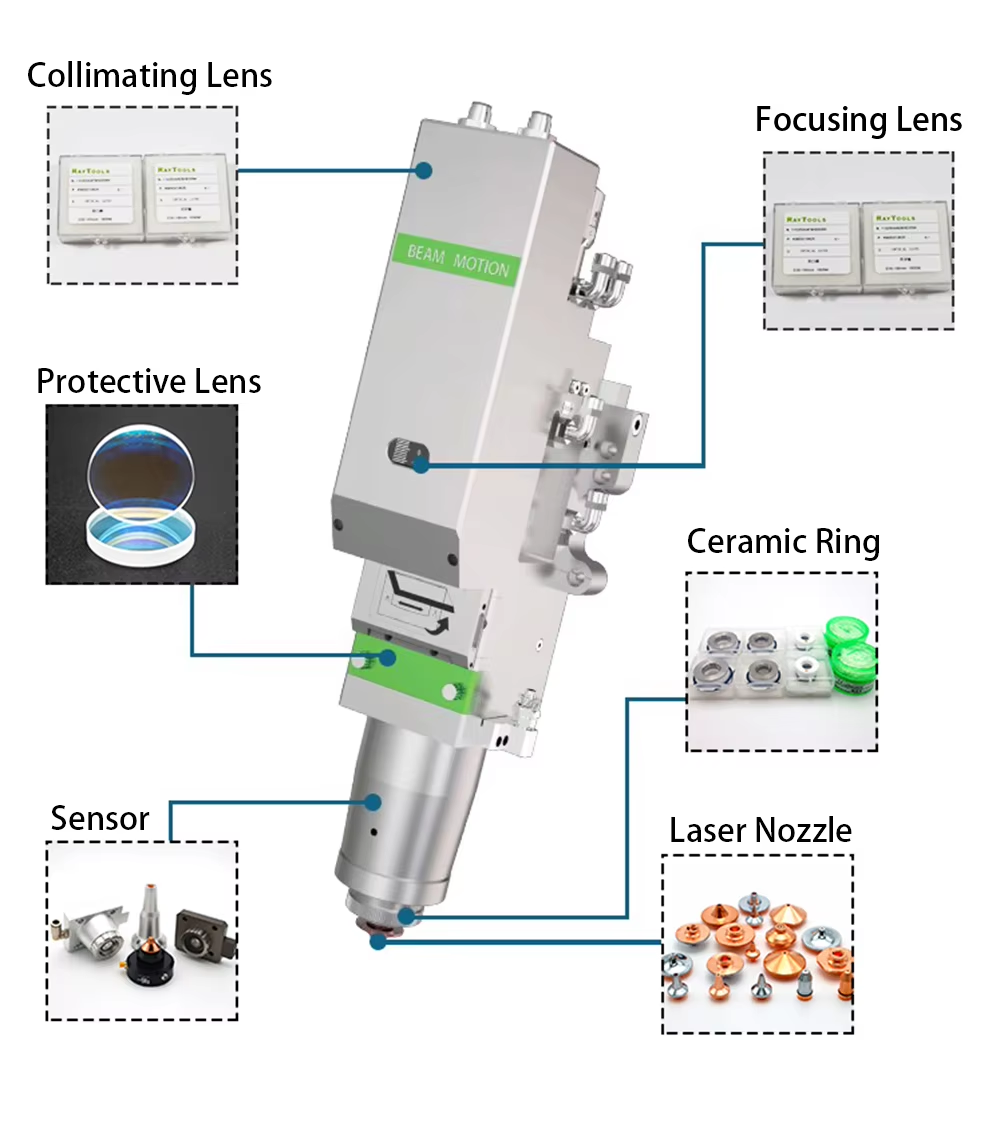
As an expert, I must emphasize that a 30kW laser is a high-precision instrument that demands a rigorous maintenance protocol, especially in a desert environment. The optical transition components (collimator and focusing lenses) are under immense thermal stress at 30kW.
Shipyards in Riyadh must invest in “Clean Room” environments for lens replacement and utilize high-purity cutting gases (Nitrogen at 99.999% purity) to prevent contamination of the cutting head. The stability of the power grid in Riyadh is generally excellent, but for a 30kW machine, voltage stabilizers and surge protection are mandatory to protect the sensitive laser diodes. When properly maintained, these machines offer a service life exceeding 100,000 hours, providing a massive return on investment over the lifecycle of multiple shipbuilding contracts.
Conclusion: The Future of Maritime Fabrication
The 30kW Fiber Laser CNC Beam and Channel Cutter with ±45° beveling is more than a purchase; it is a statement of industrial intent. For a shipbuilding yard in Riyadh, it represents the bridge between traditional heavy industry and the high-tech future of “Industry 4.0.”
By combining the raw power of 30,000 watts with the delicate finesse of a 5-axis CNC head, shipbuilders can achieve levels of structural complexity and production speed that were previously impossible. As Saudi Arabia continues to expand its maritime footprint, this technology will be the cornerstone of a faster, leaner, and more precise manufacturing ecosystem, ensuring that the vessels of tomorrow are built on a foundation of laser-perfect precision.