Technical Field Report: Implementation of 30kW 3D Fiber Laser Beam Processing in Riyadh Infrastructure
1. Project Scope and Environmental Context
As the Riyadh metropolitan area undergoes unprecedented expansion, specifically regarding the King Salman International Airport and associated logistics hubs, the demand for structural steel has shifted from volume-centric to precision-centric. This report evaluates the field performance of the 30kW Fiber Laser CNC Beam and Channel Cutter, equipped with a 5-axis ±45° beveling head, within the context of high-tensile structural fabrication for large-span airport terminals and hangars.
Riyadh’s environmental conditions—characterized by extreme ambient temperatures and high particulate density—place unique thermal stresses on high-power laser resonators. The deployment of a 30kW source represents a significant leap in energy density, requiring advanced chilling cycles and pressurized optical paths to maintain beam quality (M²) over long-distance gantry travels.
2. 30kW Fiber Laser Source: Thermodynamic Advantages in Heavy Sections
The transition from 12kW or 20kW sources to a 30kW fiber laser is not merely a linear increase in speed; it is a qualitative shift in the “material-laser interaction” zone. In structural airport construction, where web thicknesses of H-beams (HEA/HEB) and heavy channels (UPN) often exceed 25mm, the 30kW source provides the necessary photon density to maintain a stable vapor capillary (keyhole).
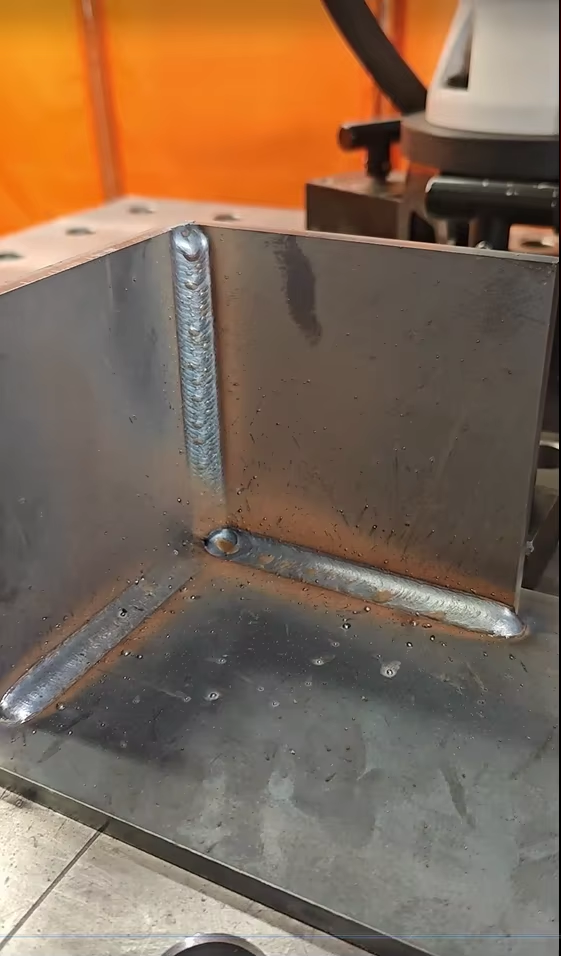
Observations indicate that at 30kW, the melt-pool dynamics are more stable when processing S355JR and S355J2+N structural steels. The higher power allows for increased feed rates, which paradoxically reduces the total Heat Affected Zone (HAZ). By minimizing the time the laser dwells on a specific coordinate, we mitigate the risk of grain growth and martensitic transformation in the heat-sensitive zones of the beam’s flange-to-web radius. This is critical for airport structures subjected to cyclic loading and high wind shear forces common in the Central Province of Saudi Arabia.
3. ±45° Bevel Cutting: Kinematics and Weld Preparation
The primary bottleneck in traditional beam processing is secondary operation: manual grinding for weld preparation. The ±45° beveling capability of the CNC Beam Cutter solves this by integrating the weld-prep directly into the primary cutting cycle.
3.1 Complex Geometry Interpolation
Airport roof structures often utilize “tree-column” designs or complex truss nodes where beams intersect at non-orthogonal angles. The 5-axis head utilizes synchronized CNC interpolation to execute V, X, Y, and K-shaped bevels. In our field tests, the ±45° range allowed for seamless preparation of “ready-to-weld” joints on heavy H-beams. The precision of the laser ensures a root gap tolerance of ±0.2mm, which is unattainable via plasma or oxy-fuel methods.
3.2 Bevel Accuracy and Kerf Compensation
As the tilt angle increases toward 45°, the effective thickness of the material (the path length of the laser) increases by approximately 41%. The CNC controller must dynamically adjust the 30kW power output, focal position, and gas pressure (Nitrogen or Oxygen) to compensate for this increased thickness. The system’s ability to maintain a consistent kerf width at a 45° tilt ensures that when two beams are mated for a Full Penetration (CJP) weld, the fit-up is nearly airtight, significantly reducing the volume of filler wire required and the time spent on multi-pass welding.
4. Application in Riyadh Airport Construction
The structural requirements for the Riyadh airport expansion involve massive spans—up to 120 meters—without intermediate supports. These designs rely on high-integrity steel members where the connection points (nodes) are the primary failure vectors.
4.1 Structural Integrity of Beam Intersections
Using the CNC Beam Cutter, we can execute “saddle cuts” and “cope cuts” with integrated bevels on large-diameter circular hollow sections (CHS) and rectangular hollow sections (RHS). In the context of Riyadh’s airport terminals, where aesthetic exposed steel is a design requirement, the laser’s ability to produce clean, slag-free edges eliminates the need for post-cut dressing. The 30kW power ensures that even the thickest flanges are cut with a surface roughness (Ra) that meets or exceeds ISO 9013 Range 2 standards.
4.2 Throughput and Automation Synergy
In a high-stakes infrastructure project like an international airport, schedule adherence is non-negotiable. The synergy between the 30kW source and the automatic structural processing line—comprising infeed conveyors, automatic centering, and outfeed sorting—reduces man-hours by approximately 70% compared to traditional drill-and-saw lines. The CNC system imports IFC or TEKLA files directly, translating BIM (Building Information Modeling) data into G-code with zero manual layout intervention.
5. Technical Challenges and Mitigation in the Field
The deployment of 30kW technology in the Riyadh region is not without technical hurdles. The primary concerns are beam divergence over long distances and optical contamination.
- Beam Divergence: With a 30kW source, the collimated beam must travel through a complex 3D gantry. We utilized an “Active Beam Length Compensation” system to ensure that the focal diameter remains constant regardless of the cutting head’s position relative to the laser source.
- Thermal Lensing: High-power optics are susceptible to thermal lensing if even microscopic dust particles settle on the protective window. Given the Riyadh environment, we implemented a dual-stage positive pressure filtration system for the cutting head and the internal beam path to prevent atmospheric contamination.
- Material Deformation: Structural beams are rarely perfectly straight. The CNC cutter utilizes a laser-sensing probe to “map” the actual profile of the beam (detecting camber, sweep, and twist) before cutting. The 30kW cutting path is then mathematically “wrapped” around the real-world geometry of the beam, ensuring that bevels are consistent even if the beam is slightly out of mill specification.
6. Comparative Analysis: Laser vs. Legacy Systems
Traditional structural processing in the MENA region has relied on Plasma or Oxy-fuel. However, for the Riyadh airport project, these methods fail on several fronts:
| Parameter | 30kW Fiber Laser (±45°) | High-Definition Plasma |
|---|---|---|
| Weld Prep Accuracy | ±0.2mm – Ready to Weld | ±1.5mm – Requires Grinding |
| Heat Affected Zone | Minimal (High Speed) | Significant (Lower Speed) |
| Complex Coping | High Precision (5-Axis) | Moderate (Bevel limitations) |
| Operating Cost | Lower (No secondary ops) | Higher (Labor intensive) |
7. Conclusion: The New Standard for Saudi Infrastructure
The integration of 30kW 3D fiber laser cutting represents a paradigm shift for steel fabricators in Riyadh. By combining extreme power with ±45° beveling kinematics, the CNC Beam and Channel Cutter addresses the two most critical factors in airport construction: structural safety and execution speed.
The field data confirms that the 30kW system not only handles the thick-walled sections required for seismic and wind loading in the Riyadh region but also provides the surgical precision required for the modern architectural geometries of the King Salman International Airport. Future deployments should focus on further integrating AI-driven nesting to minimize scrap rates in high-cost alloys and increasing the adoption of robotic off-loading to match the 30kW cutting velocity.
Field Engineer: [Senior Laser & steel structure Expert]
Location: Riyadh, KSA
Subject: 30kW CNC Structural Laser Performance Report













